
[論文レビュー] Full Event Particle-Level Unfolding with Variable-Length Latent Variational Diffusion
変長潜在拡散モデル(Particle VLD)を導入し、検出器レベルのデータを条件として全イベント・粒子レベルの展開を実行する。LHCでの半レプトン性tt̄生成でデモンストレーション。
The measurements performed by particle physics experiments must account for the imperfect response of the detectors used to observe the interactions. One approach, unfolding, statistically adjusts the experimental data for detector effects. Recently, generative machine learning models have shown promise for performing unbinned unfolding in a high number of dimensions. However, all current generative approaches are limited to unfolding a fixed set of observables, making them unable to perform full-event unfolding in the variable dimensional environment of collider data. A novel modification to the variational latent diffusion model (VLD) approach to generative unfolding is presented, which allows for unfolding of high- and variable-dimensional feature spaces. The performance of this method is evaluated in the context of semi-leptonic top quark pair production at the Large Hadron Collider.
研究の動機と目的
- 高価なシミュレーションに頼らず、検出器効果の展開を動機付ける。
- 可変次元のコライダー因子データ(物体数が異なる)での全イベント展開を可能にする。
- 可変観測量と多重性を扱うように、Variational Latent Diffusion(VLD)を拡張する。
- SMおよびBSM注入を含む現実的なLHC様式の半レプトンtt̄イベントで性能を評価する。
提案手法
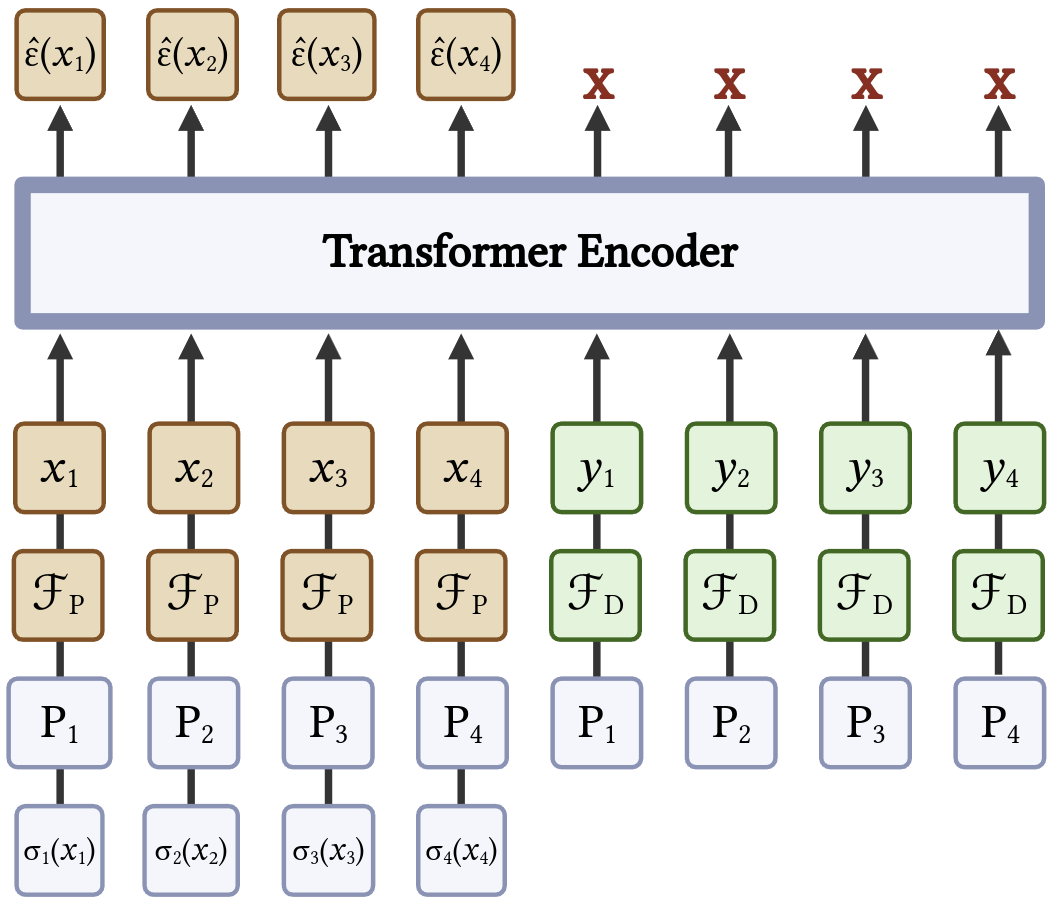
- 粒子レベルオブジェクトの数を予測する多重度予測器を導入することで、可変長出力へVariational Latent Diffusion (VLD)を適応させる。
- 可変長の粒子オブジェクトを潜在空間へ写像するため、Transformerベースのエンコーダ/デコーダを備えたParticle VAEを用いる。
- X|Y生成の条件付き潜在空間へ検出器レベルの観測値を写像する検出器エンコーダを採用する。
- 要素ごと・オブジェクトごとの拡散過程を、オブジェクトごとのノイズスケジュールとセット条件付きのノイズ除去ネットワークで実装する。
- 展開時の可変イベントサイズに対応するため、ガンマ分布に従う多重度サンプルを組み込む。
![Figure 1 : A Flow diagram of the components of Particle VLD. Pairs of particle level ( ${\mathcal{O}_{P}}$ ) and detector level ( ${\mathcal{O}_{D}}$ ) events are used to train the model using the loss functions introduced in Ref. [ 18 ] . At inference time, a detector level event is used to produce](https://ar5iv.labs.arxiv.org/html/2404.14332/assets/x1.png)
実験結果
リサーチクエスチョン
- RQ1最終状態の对象数が可変の場合に、全イベント粒子レベルの展開を達成できるか?
- RQ2検出器レベルの観測を条件付けることで、可変次元性にわたる粒子レベルの運動学を正確に再構成できるか?
- RQ3SMデータセットに対する方法の性能と、真の分布が撹乱された場合(BSM注入)での性能はどうなるか?
- RQ4事前分布の選択が展開分布へ与える影響はどの程度か、反復的な事前重み付け法でそれを緩和できるか?
主な発見
- 本手法は可変多重性を持つ粒子レベルの観測量への展開を可能にし、半レプトン性tt̄イベントで実証された。
- 展開したレプトンおよびジェットの運動量分布は、真の粒子レベル分布と優れた一致を示すが、エッジ領域にいくつかの不一致がある。
- 表ベースの指標(Wasserstein、Energy、KL)は、ほとんどの観測量について、展開分布が検出器分布よりも真実に近いことを示す。
- 本手法は物理注入(BSM)をサポートし、事前分布のシフトに対する頑健性を検証できる。
- 拡散モデルはオブジェクトごとのノイズスケジュールと、粒子レベルのXと検出器レベルのYの情報を活用する文脈対応のノイズ除去ネットワークを用いる。
より良い研究を、今すぐ始めましょう
論文設計から論文執筆まで、研究時間を劇的に削減しましょう。
クレジットカード登録不要
このレビューはAIが作成し、人間の編集者が確認しました。