
[論文レビュー] Fundamental charges for dual-unitary circuits
本稿は、1+1次元の双対ユニタリ量子回路における幅$w$の保存電荷と幅$w$のソリトンの間の一対一対応を確立し、このような電荷が有効光速で右または左に移動するソリトンとして伝播することを示している。主な結果は、これらの回路におけるすべての保存密度が根本的にソリトン励起状態に結びついており、特にキュービット系(d=2)において、積状態およびフェルミオン的ジョルダン=ヴァイアーガー変換を用いて明示的な構成が与えられていることである。
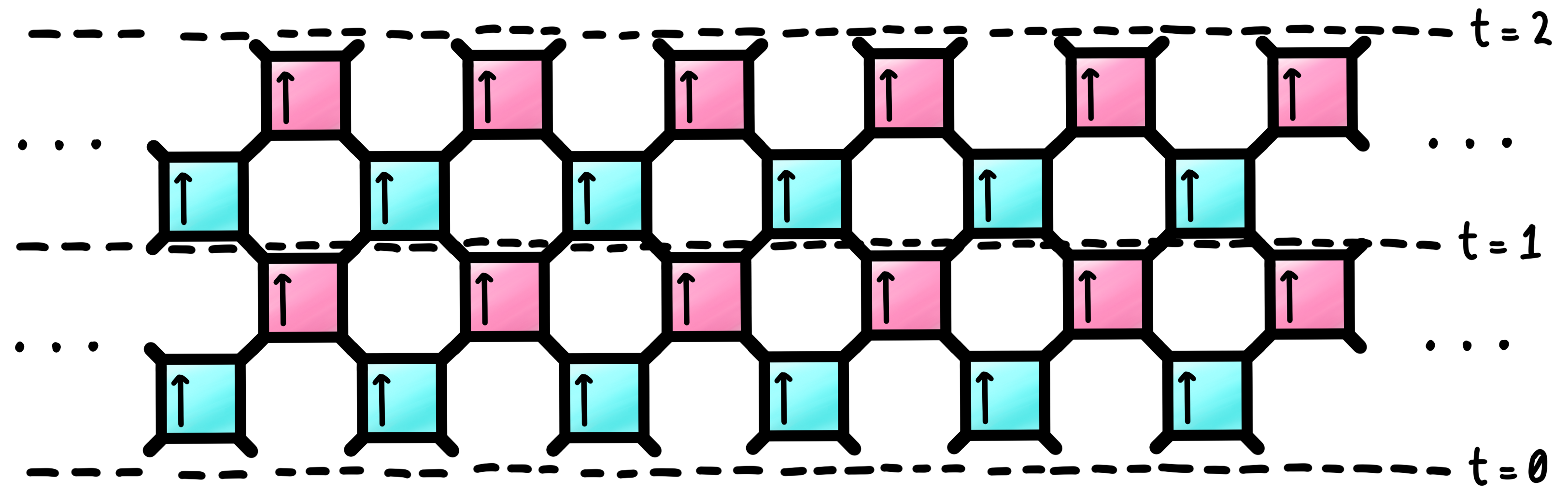
Dual-unitary quantum circuits have recently attracted attention as an analytically tractable model of many-body quantum dynamics. Consisting of a 1+1D lattice of 2-qudit gates arranged in a 'brickwork' pattern, these models are defined by the constraint that each gate must remain unitary under swapping the roles of space and time. This dual-unitarity restricts the dynamics of local operators in these circuits: the support of any such operator must grow at the effective speed of light of the system, along one or both of the edges of a causal light cone set by the geometry of the circuit. Using this property, it is shown here that for 1+1D dual-unitary circuits the set of width-$w$ conserved densities (constructed from operators supported over $w$ consecutive sites) is in one-to-one correspondence with the set of width-$w$ solitons - operators which, up to a multiplicative phase, are simply spatially translated at the effective speed of light by the dual-unitary dynamics. A number of ways to construct these many-body solitons (explicitly in the case where the local Hilbert space dimension $d=2$) are then demonstrated: firstly, via a simple construction involving products of smaller, constituent solitons; and secondly, via a construction which cannot be understood as simply in terms of products of smaller solitons, but which does have a neat interpretation in terms of products of fermions under a Jordan-Wigner transformation. This provides partial progress towards a characterisation of the microscopic structure of complex many-body solitons (in dual-unitary circuits on qubits), whilst also establishing a link between fermionic models and dual-unitary circuits, advancing our understanding of what kinds of physics can be explored in this framework.
研究の動機と目的
- 双対ユニタリ回路における多体保存電荷の微視的構造を特定すること。
- 双対ユニタリ回路における保存電荷が単純なソリトン励起状態を超えて存在可能かどうかを特定すること。
- ジョルダン=ヴァイアーガー変換を介してフェルミオン的モデルと双対ユニタリ回路との関係を調査すること。
- キュービット系(d=2)における双対ユニタリ回路のソリトンが、特定の積状態またはフェルミオン的構成によって完全に分類可能かどうかを調査すること。
- この電荷-ソリトン対応が非エルゴディックなダイナミクスに与える影響、およびCFTやトポロジカル相への応用可能性を理解すること。
提案手法
- ゲートが空間的および時間的両方向でユニタリであることを保証する双対ユニタリティ制約を活用し、光円錐的ダイナミクスとバッテリー的演算子成長を強制する。
- レンガ積み回路の因果的構造を用いて、幅$w$の保存電荷が有効光速で空間的に移動する演算子に対応しなければならないことを示す。
- キュービット系(d=2)に対して、より小さなソリトンの積を用いてソリトンを明示的に構成し、それらが保存密度として果たす役割を示す。
- ジョルダン=ヴァイアーガー変換に基づく第二の構成法を導入し、非積状態のソリトンのフェルミオン的解釈を明らかにする。
- 演算子ダイナミクスおよび光円錐伝播の定理を適用して、双対ユニタリ回路におけるすべての保存電荷が必然的にソリトン的であることを証明する。
- これらの構成が、非エルゴディックなダイナミクスの存在および有限系における保存量の構造に与える影響を分析する。
実験結果
リサーチクエスチョン
- RQ11+1次元の双対ユニタリ回路におけるすべての保存電荷は、有効光速で伝播するソリトン励起状態に必然的に関連しているか?
- RQ2キュービット系(d=2)における双対ユニタリ回路の幅$w$のすべてのソリトンは、より小さなソリトンの積またはフェルミオン的ジョルダン=ヴァイアーガー写像によって構成可能か?
- RQ3非積状態のソリトンが保存電荷を生成する役割は何か?また、積状態に基づく構成とはどのように異なるか?
- RQ4これらのソリトンに基づく保存電荷は、恒久的相関やポアソン型レベル統計といった非エルゴディックなダイナミクスをどの程度引き起こすか?
- RQ5ソリトン-電荷対応は、高次元量子回路に一般化可能か?また、 conformal field theories におけるキラル輸送をモデル化するために利用可能か?
主な発見
- 1+1次元の双対ユニタリ回路において、幅$w$の保存密度と幅$w$のソリトンの間に一対一対応が存在し、ソリトンは有効光速で空間的に移動する演算子である。
- 双対ユニタリ回路におけるすべての保存電荷は、根本的に右または左に移動するソリトンに制限されており、局所的電荷密度のダイナミクスは自明であることを示唆している。
- キュービット系(d=2)では、より小さなソリトンの積としてソリトンを明示的に構成でき、保存量を体系的に生成する方法が得られる。
- より小さなソリトンの積に分解できない第二のソリトンのクラスが存在し、それらはジョルダン=ヴァイアーガー変換の下でフェルミオン的演算子の積として自然に記述される。
- d=2の双対ユニタリ回路では、これらの二つの構成法によってすべてのソリトン、したがってすべての保存電荷が完全に分類可能である可能性が示唆される。
- ソリトンと保存電荷の対応は、特にキラル輸送と端モードを介して、双対ユニタリ回路と conformal field theories の間の新たなつながりを提供する。

より良い研究を、今すぐ始めましょう
論文の読解から最終レビューまで、研究時間を劇的に削減しましょう。
クレジットカード登録不要
このレビューはAIが作成し、人間の編集者が確認しました。