
[論文レビュー] Fusion-DHL: WiFi, IMU, and Floorplan Fusion for Dense History of Locations in Indoor Environments
本論文では、WiFi、IMU、フロアプランデータを統合して、高精度で高密度な屋内位置履歴を生成するマルチモーダル統合システムFusion-DHLを提案する。インertialナビゲーションとWiFiベースの地理的局所化を統合し、フロアプラン整合性をCNNで最適化することで、約5mのRMSEを達成。これは現在の最先端技術(例:Google Fused Location Provider)の2倍の精度で、10倍以上も高密度である。
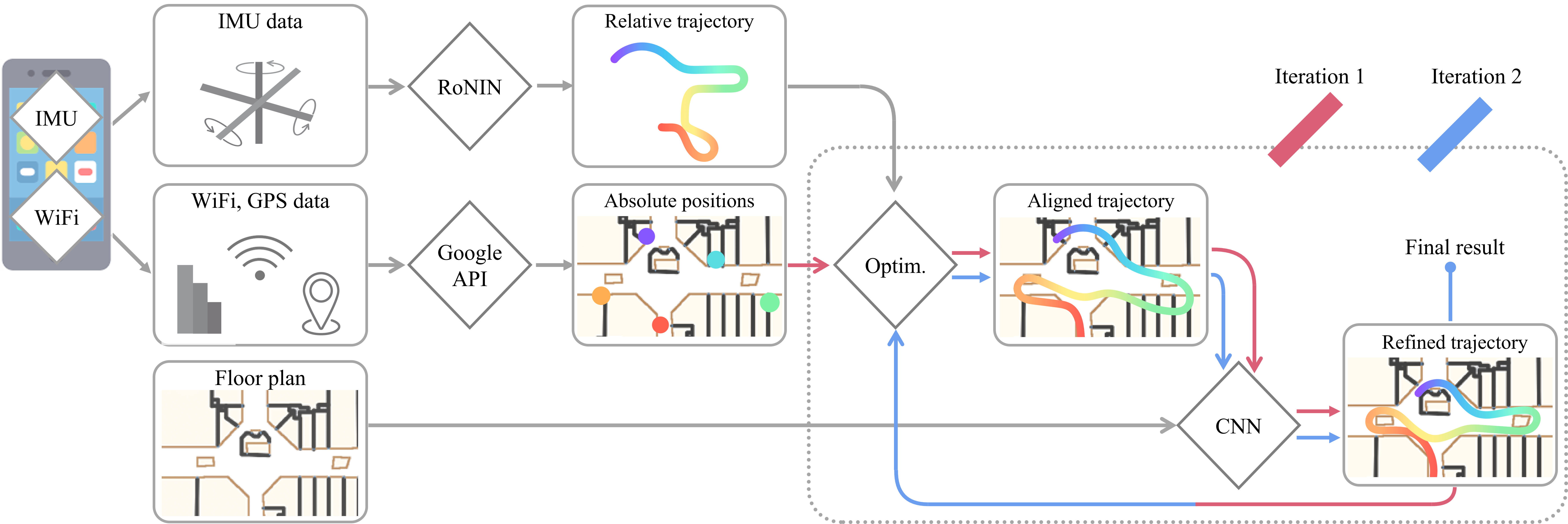
The paper proposes a multi-modal sensor fusion algorithm that fuses WiFi, IMU, and floorplan information to infer an accurate and dense location history in indoor environments. The algorithm uses 1) an inertial navigation algorithm to estimate a relative motion trajectory from IMU sensor data; 2) a WiFi-based localization API in industry to obtain positional constraints and geo-localize the trajectory; and 3) a convolutional neural network to refine the location history to be consistent with the floorplan. We have developed a data acquisition app to build a new dataset with WiFi, IMU, and floorplan data with ground-truth positions at 4 university buildings and 3 shopping malls. Our qualitative and quantitative evaluations demonstrate that the proposed system is able to produce twice as accurate and a few orders of magnitude denser location history than the current standard, while requiring minimal additional energy consumption. We will publicly share our code, data and models.
研究の動機と目的
- 接触追跡や空間利用状況の分析などの応用分野における、高密度かつ高精度な屋内位置履歴システムの不足を解消すること。
- 現在のシステムが抱える低更新頻度や高消費電力の問題を克服し、高密度でオフラインでの位置履歴推定を可能にすること。
- インertial、無線、空間的文脈的情報を統合することで、既存のソリューションを凌駕する精度を実現すること。
- 特別なハードウェアを必要とせず、標準スマートフォンでも動作するスケーラブルでエネルギー効率の良いシステムを構築すること。
- 今後の研究のための新しいベンチマークデータセットを提供すること。このデータセットには、多様な屋内環境における真値位置データが含まれる。
提案手法
- 生のIMUセンサデータから相対的な運動軌跡を推定するために、最先端のデータドリブンなインertialナビゲーションアルゴリズム「RoNIN」を用いる。
- Google Fused Location Provider (FLP) APIを活用し、スパarsなWiFiベースのグローバル位置固定を取得し、インertial軌跡を地図に一致させる。
- 2段階の最適化プロセスを適用し、FLPの位置からのずれを最小化すると同時に、フロアプランの幾何構造を尊重するように軌跡を精緻化する。
- 畳み込みニューラルネットワーク(CNN)を用いてさらに軌跡を補正し、壁の貫通や歩行不能領域への侵入をペナルティ化することで、フロアプランとの整合性を強制する。
- 未確認の建物やフロアプランに対しても一般化を高めるために、合成データの拡張を活用する。
- FLP位置のクラスタに基づいてフロアプラン画像をクロップすることで、メモリ使用量を削減し、推論効率を向上させる。
実験結果
リサーチクエスチョン
- RQ1WiFi、IMU、フロアプランデータの統合により、既存のシステムと比較して屋内位置履歴の精度と密度を顕著に向上させられるか?
- RQ2CNNベースの補正ステップは、フロアプラン整合性を強制し、軌跡のずれを是正するのにどの程度効果的か?
- RQ3トレーニング時に見なかった異なる建物タイプやフロアプランに対しても、このシステムはどの程度一般化できるか?
- RQ4標準スマートフォン上で、低消費電力で高精度かつ高密度な位置履歴を達成できるか?
- RQ5Google Fused Location Providerのような産業界基準と比較して、本手法の性能は、更新頻度と位置誤差の観点でどの程度優れているか?
主な発見
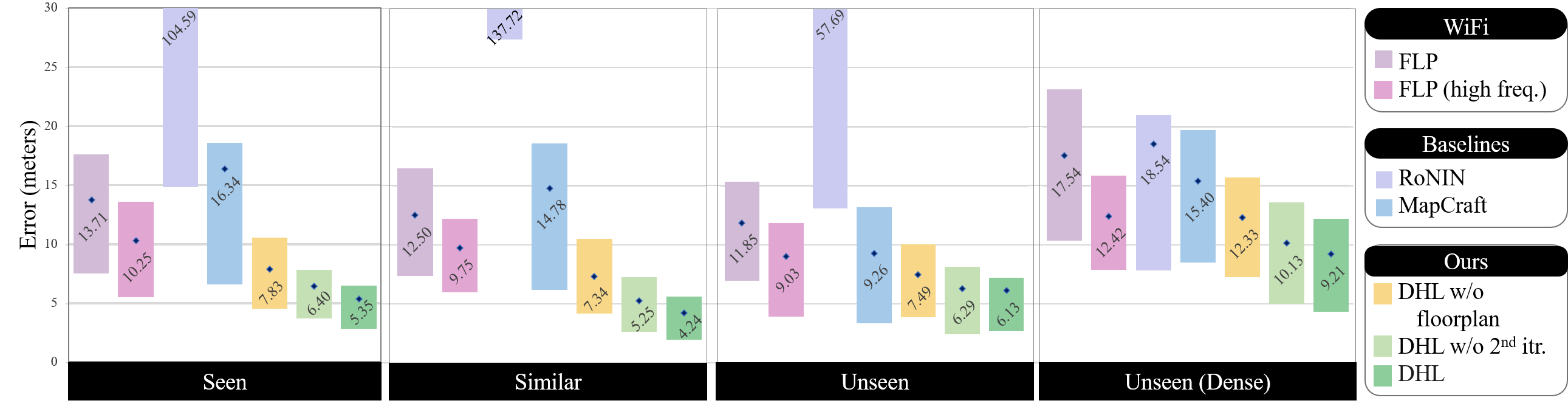
- 提案されたFusion-DHLシステムは、平均RMSEが約5メートルを達成し、現在の最先端技術(Google Fused Location Provider)の約12メートルの誤差の半分にまで低減している。
- システムは50Hzの更新レートで位置履歴を生成しており、FLPシステムの1/60Hzに比べて数個のオーダーも高密度である。
- 1回のパスではなく、2段階の最適化とCNNの反復処理を追加することで、局所化誤差が約1メートル低減しており、反復的精緻化の有効性が示された。
- 未確認の建物(例:新しいショッピングモール)においても、誤差が常に10メートル未満を維持し、FLPやMapCraftを上回る精度を発揮した。
- 合成学習データの使用により、全テスト環境で平均局所化誤差が6.85mから5.57mに低減し、一般化への貢献が確認された。
- 定性的な結果から、CNNが軌跡が壁やエスカレーターを貫通するのを効果的に防ぎ、FLP や MapCraftには欠落していた高周波の運動詳細を保持していることが明らかになった。
より良い研究を、今すぐ始めましょう
論文の読解から最終レビューまで、研究時間を劇的に削減しましょう。
クレジットカード登録不要
このレビューはAIが作成し、人間の編集者が確認しました。