
[論文レビュー] Future changes in the vertical structure of severe convective storm environments over the U.S. central Great Plains
本研究は、気候変動が米国中央グラートプレインズ地域における極端な積乱雲激震環境の全高さにわたる構造にどのように影響するかを調査している。特に、固定された高いCAPEと高いせん断条件における熱力学的および運動学的プロファイルに注目している。境界層の湿度や対流圏上層のラッピングレートにやや小さい変化がある一方で、低層風せん断とストーム相対ヘルミシティの増加は、竜巻の発生可能性が高まる可能性を示唆している。一方で、混合効果とLCLの上昇による相反する要因が、これらの傾向を相殺する可能性がある。
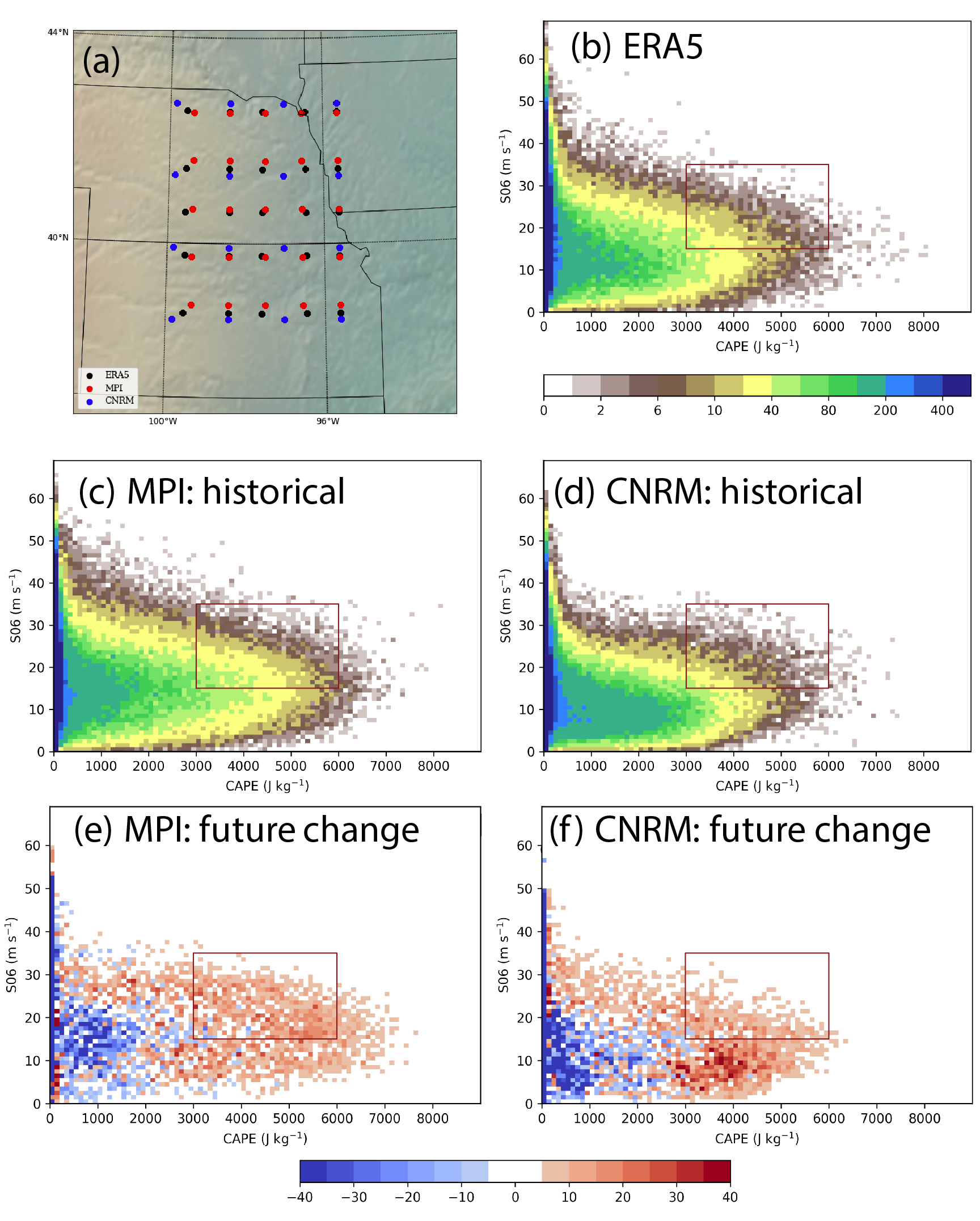
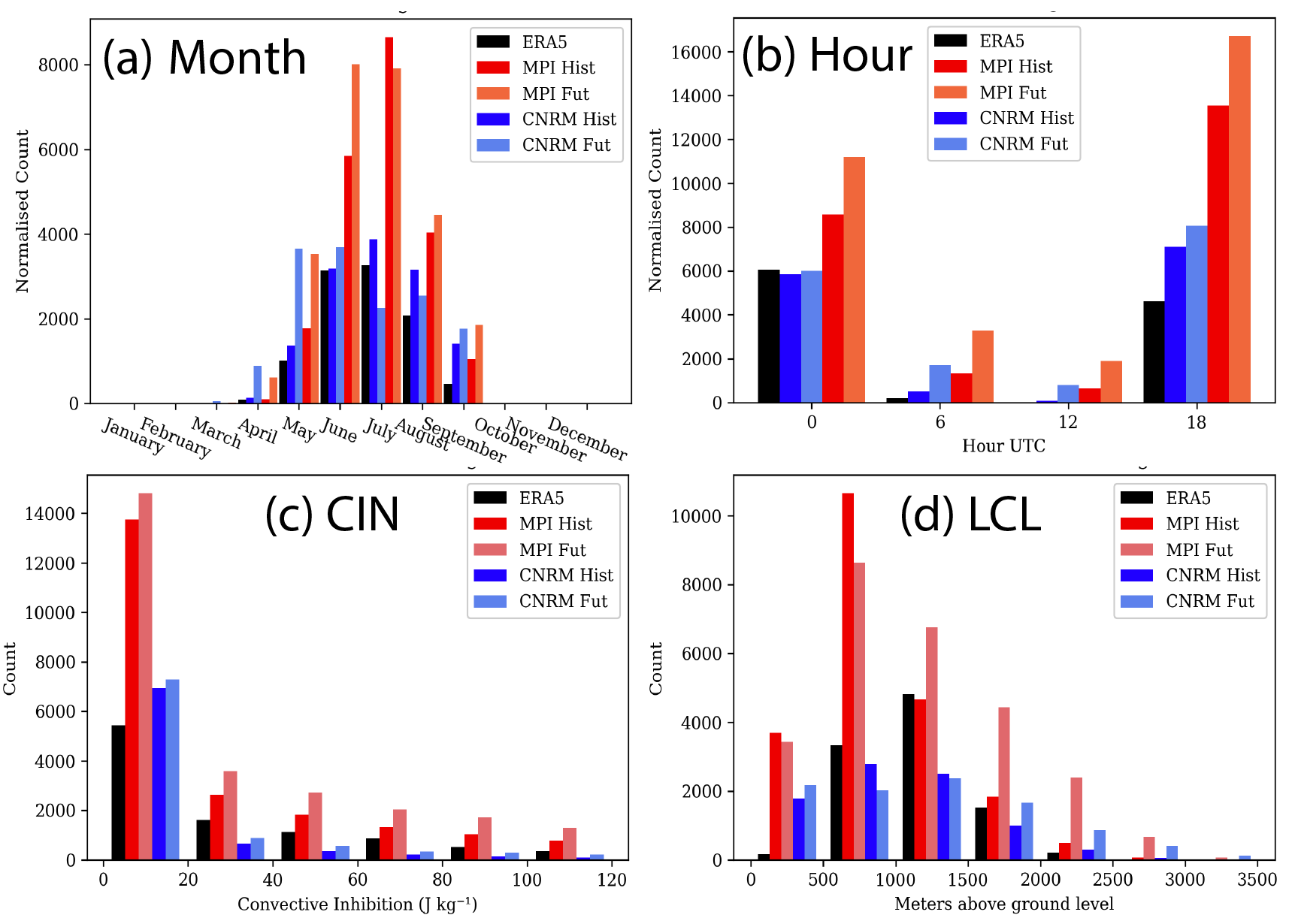
The effect of warming on severe convective storm potential is commonly explained in terms of changes in vertically-integrated ("bulk") environmental parameters, such as CAPE and 0--6 km shear. However, such events are known to depend on details of the vertical structure of the thermodynamic and kinematic environment that can change independently of these bulk parameters. This work examines how warming may affect the complete vertical structure of these environments for fixed ranges of values of high CAPE and bulk shear, using data over the central Great Plains from two high-performing climate models. Temperature profiles warm relatively uniformly with height, with a slight decrease in free tropospheric lapse rate, and the tropopause shifts upwards at constant temperature. The boundary layer becomes slightly drier (-2--4\% relative humidity) while the free troposphere becomes slightly moister (+2--3\%). Moist static energy (MSE) increases relatively uniformly with height with slightly larger increase within the boundary layer. Moist static energy deficit increases slightly above 4 km altitude. Wind shear and storm-relative helicity increase within the lowest 1.5 km associated with stronger hodograph curvature. Changes are broadly consistent between the two models despite differing biases relative to ERA5. The increased low-level shear and SRH suggests an increased potential for severe thunderstorms and tornadoes, while the slight increase in free tropospheric MSE deficit (enhanced entrainment) and decrease in boundary layer relative humidity (higher LCL) may oppose these effects. Evaluation of the net response of severe convective storm outcomes cannot be ascertained here but could be explored in simulation experiments.
研究の動機と目的
- 気候温暖化下での極端な積乱雲激震環境の完全な高さ方向の熱力学的および運動学的構造が、CAPE やせん断といった全体パラメータとは独立してどのように変化するかを評価すること。
- ラッピングレート、湿度、ホドグラフの湾曲度といった垂直プロファイルの詳細な変化が、全体パラメータのみから予測されるものとは異なる、極端な雷雨および竜巻のリスクにどのように影響するかを評価すること。
- 異なるバイアスを示す2つの高精度な気候モデルを用いて、これらの変化の妥当性がどの程度保たれるかを検証すること。
- CAPE や全体的せん断が一定である場合に、竜巻生成や対流強度に影響を与える環境要因の主な変化を特定すること。
提案手法
- 中央グラートプレインズ地域の6時間ごとのERA5再解析データとCMIP6モデル出力(歴史的およびSSP585シナリオ)を用いた。
- 全体パラメータ(CAPE やS06)を固定した環境を選別し、垂直構造の変化を全体パラメータとは独立して分離した。
- 大気全体にわたる温度、湿度、風、および派生変数(例:湿球静的エネルギー、ストーム相対ヘルミシティ)を分析した。
- ラッピングレート、相対湿度、湿球静的エネルギー(MSE)、ホドグラフ湾曲度といった主要変数の垂直プロファイルを計算し、混合および低層渦度の変化を評価した。
- 異なるバイアスを示す2つのCMIP6モデル間での結果を比較し、発見の妥当性を検証した。
- 統計的および視覚的分析(例:プロファイル図、異常マップ)を用いて、環境構造の変化を解釈した。
実験結果
リサーチクエスチョン
- RQ1気候温暖化が、CAPE と 0–6 km せん断が一定である場合に、極端な積乱雲激震環境の高さ方向熱力学的構造にどのように影響するか。
- RQ2低層風せん断とストーム相対ヘルミシティにどのような変化が生じ、それらが竜巻生成の可能性にどのように影響するか。
- RQ3境界層の相対湿度と対流圏上層のラッピングレートの変化が、対流発生および混合効果にどのように影響するか。
- RQ4異なるバイアスを示す複数の気候モデル間で予測される構造的変化がどの程度一貫性を示すか。
- RQ5湿球静的エネルギーおよびMSE欠損の変化が、深層対流および極端な嵐の強度にどのように影響するか。
主な発見
- 温度プロファイルは高さにわたって一様に暖かくなり、一定温度での圏圏上層が上昇した。これは熱的に拡張した対流圏を示している。
- 境界層の相対湿度はわずかに2–4%減少し、対流圏自由対流高度(LCL)が上昇し、対流発生効率が低下する可能性がある。
- 対流圏上層はわずかに湿潤化(相対湿度+2–3%)し、対流圏上層のラッピングレートはわずかに低下し、高高度での不安定性が減少した。
- 湿球静的エネルギー(MSE)は高さにわたって一様に増加し、境界層での増加がわずかに大きかった。これは対流に利用可能なエネルギーが増加していることを示唆している。
- 低層風せん断とストーム相対ヘルミシティは、ホドグラフ湾曲度の強化により、1.5 km以下の層で増加し、竜巻生成の可能性が高まっていることを示している。
- 4 km以上の高度で、対流圏上層のMSE欠損がわずかに増加した。これは混合および希釈効果が強化され、上昇気流が抑制され、極端な嵐の強度が低下する可能性があることを示唆している。
より良い研究を、今すぐ始めましょう
論文の読解から最終レビューまで、研究時間を劇的に削減しましょう。
クレジットカード登録不要
このレビューはAIが作成し、人間の編集者が確認しました。