
[論文レビュー] Gaussian Boson Sampling with Pseudo-Photon-Number Resolving Detectors and Quantum Computational Advantage
この論文は、Jiǔzhāng 3.0量子コンピュータで擬似光子数分解検出器(PPNRD)を用いたガウス型ボソンサンプリングを実証し、古典的スーパーコンピュータが生成するのに600年以上を要するサンプルを生成することで、量子計算的優位性(QCA)を達成した。実験サンプルは、ベイズ検定と相関関数解析を用いて、現在知られているすべての古典的すり替えモデルに対して検証され、Frontierスーパーコンピュータに対して1.5×10¹⁶倍の高速化が確認された。
We report new Gaussian boson sampling experiments with pseudo-photon-number-resolving detection, which register up to 255 photon-click events. We consider partial photon distinguishability and develop a more complete model for the characterization of the noisy Gaussian boson sampling. In the quantum computational advantage regime, we use Bayesian tests and correlation function analysis to validate the samples against all current classical mockups. Estimating with the best classical algorithms to date, generating a single ideal sample from the same distribution on the supercomputer Frontier would take ~ 600 years using exact methods, whereas our quantum computer, Jiuzhang 3.0, takes only 1.27 us to produce a sample. Generating the hardest sample from the experiment using an exact algorithm would take Frontier ~ 3.1*10^10 years.
研究の動機と目的
- 擬似光子数分解検出(PPNRD)を用いたガウス型ボソンサンプリングにおける量子計算的優位性(QCA)の実証。
- 部分的光子区別可能性を考慮した、より包括的なノイズありガウス型ボソンサンプリングのモデル構築。
- 実験サンプルを、すべての既知の古典的すり替えモデル(treewidthサンプラーおよびIPSモックアップを含む)に対して検証。
- Exactアルゴリズムを用いたFrontierスーパーコンピュータ上で、実験の古典的シミュレーションコストをベンチマーク化。
- ベイズ検定と2次相関関数分析を用いた、古典的シミュレーションを除外する強固な検証フレームワークの確立。
提案手法
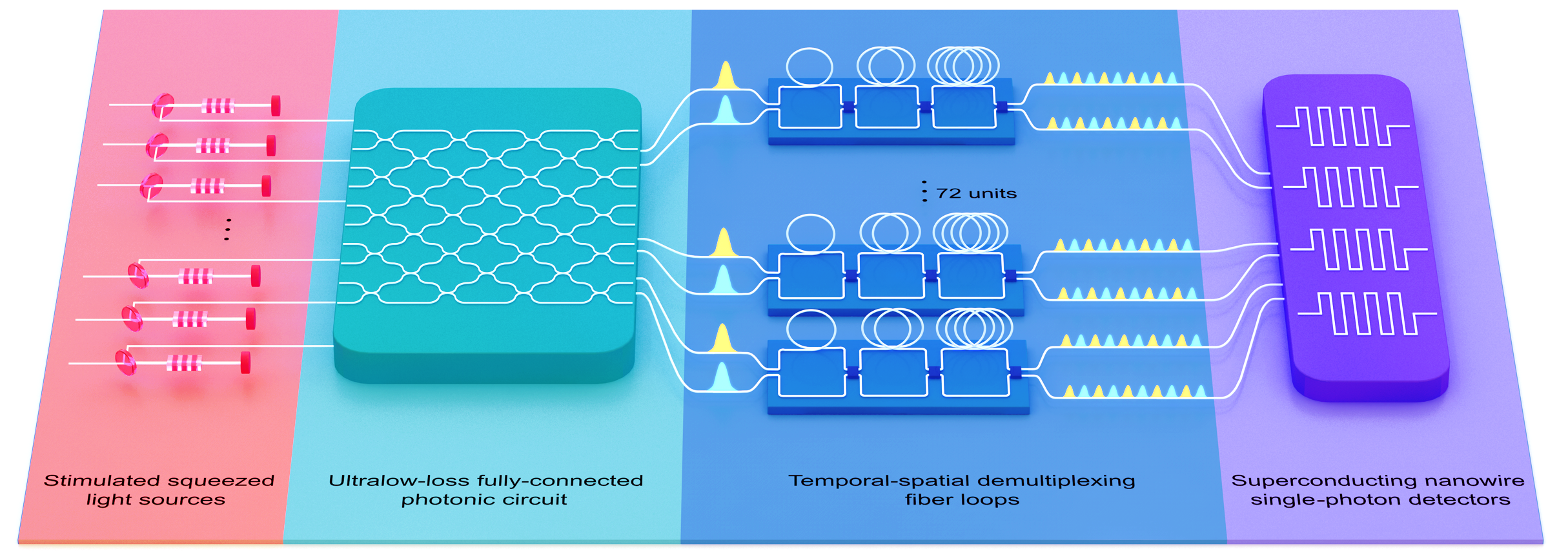
- 実験は、1152のフォールアウト・ビン(出力モード)を有するJiǔzhāng 3.0を用い、各ビンにしきい値検出器を装備することで、擬似光子数分解検出(PPNRD)を模擬。
- PPNRDモデルは、1152の出力ビンを個別モードとして扱うことで形式化され、検出イベントの有効数と計算複雑度が増加する。
- 計算コストは $ T(\vec{N}) = \frac{1}{2} C_{\text{Frontier}} M N^3 G^{N/2} $ でモデル化され、ここで $ G = \left( \prod_{i=1}^{M} (n_i + 1) \right)^{1/N} $ であり、光子クリック多重性の効果を捉える。
- ベイズ仮説検定を用いて、実験サンプルと古典的すり替え分布との比較を行い、統計的妥当性を評価。
- 実験、真値、およびモックアップとの間で2次相関関数を計算・比較し、乖離を検出し、古典的シミュレーションを除外。
- シミュレーションコストは、事前ベンチマークから得られる $ C_{\text{Frontier}} $ を用いてFrontierスーパーコンピュータ上で推定され、量子スピードアップを定量化。
実験結果
リサーチクエスチョン
- RQ1擬似光子数分解検出を用いたガウス型ボソンサンプリングは、古典的スーパーコンピュータに対して検証可能な量子計算的優位性を達成できるか?
- RQ2部分的光子区別可能性と実験的ノイズは、GBS実験の妥当性とシミュレーションコストにどのように影響するか?
- RQ3treewidthサンプラーおよびIPSモックアップを含む、すべての既知の古典的すり替えモデルは、相関ベースおよびベイズ検証手法によって除外可能か?
- RQ4Exactアルゴリズムを用いたFrontierスーパーコンピュータ上で、この実験の1サンプルを生成するための古典的シミュレーションコストはどの程度か?
- RQ5PPNRD検出は、標準的しきい値検出と比較して、GBSの計算複雑度を顕著に増加させるか?
主な発見
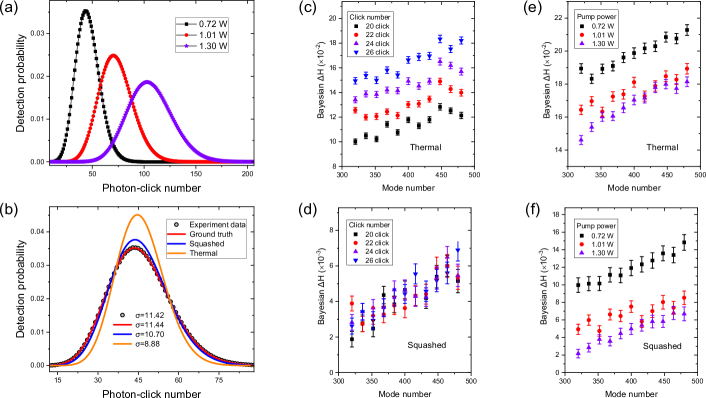
- Jiǔzhāng 3.0量子コンピュータは1サンプルを1.27 μsで生成するが、同様のタスクをExact古典的シミュレーション法で実行するには、Frontierスーパーコンピュータで約600年を要する。
- 実験で得られた最も困難なサンプルは、Frontier上でExact古典的アルゴリズムを用いて生成するのに3.1×10¹⁰年以上を要し、量子スピードアップが1.5×10¹⁶倍に達することを示した。
- 従来、強力な古典的すり替えモデルと見なされていたtreewidthサンプラーは、2次相関関数解析により明確に除外され、実験的および理論的真値から顕著な乖離を示した。
- 実験の2次相関関数は、真値との2ノルム距離D=0.040、勾配K=1.006であり、熱的状態モックアップ(D=0.275、K=2.108)およびスクァッシュド状態モックアップ(D=0.052、K=1.110)を上回る性能を示した。
- ベイズ検定により、実験サンプルが理想のGBS分布と統計的に区別不能であり、現在のすべての古典的すり替えモデルによって生成された可能性が除外された。
- PPNRD検出方式は、有効出力モード数とシミュレーションコスト式におけるGの値を増加させることで、シミュレーション複雑度を高め、中程度の光子クリック数に対してもExact古典的シミュレーションが不可能になる。
より良い研究を、今すぐ始めましょう
論文の読解から最終レビューまで、研究時間を劇的に削減しましょう。
クレジットカード登録不要
このレビューはAIが作成し、人間の編集者が確認しました。