
[論文レビュー] Generative agent-based modeling with actions grounded in physical, social, or digital space using Concordia
論文は Concordia を紹介する。Generative Agent-Based Models (GABMs) を構築するためのライブラリで、エージェントは自然言語で行動し、ゲームマスターが環境をシミュレートする。物理的、社会的、デジタル空間への grounding と外部APIとの統合を可能にする。
Agent-based modeling has been around for decades, and applied widely across the social and natural sciences. The scope of this research method is now poised to grow dramatically as it absorbs the new affordances provided by Large Language Models (LLM)s. Generative Agent-Based Models (GABM) are not just classic Agent-Based Models (ABM)s where the agents talk to one another. Rather, GABMs are constructed using an LLM to apply common sense to situations, act "reasonably", recall common semantic knowledge, produce API calls to control digital technologies like apps, and communicate both within the simulation and to researchers viewing it from the outside. Here we present Concordia, a library to facilitate constructing and working with GABMs. Concordia makes it easy to construct language-mediated simulations of physically- or digitally-grounded environments. Concordia agents produce their behavior using a flexible component system which mediates between two fundamental operations: LLM calls and associative memory retrieval. A special agent called the Game Master (GM), which was inspired by tabletop role-playing games, is responsible for simulating the environment where the agents interact. Agents take actions by describing what they want to do in natural language. The GM then translates their actions into appropriate implementations. In a simulated physical world, the GM checks the physical plausibility of agent actions and describes their effects. In digital environments simulating technologies such as apps and services, the GM may handle API calls to integrate with external tools such as general AI assistants (e.g., Bard, ChatGPT), and digital apps (e.g., Calendar, Email, Search, etc.). Concordia was designed to support a wide array of applications both in scientific research and for evaluating performance of real digital services by simulating users and/or generating synthetic data.
研究の動機と目的
- Concordia を柔軟なライブラリとして紹介する。generative agent-based models (GABMs) を構築する。
- LLM ベースの行動生成と環境 grounding の間を仲介するモジュラーアーキテクチャを説明する。
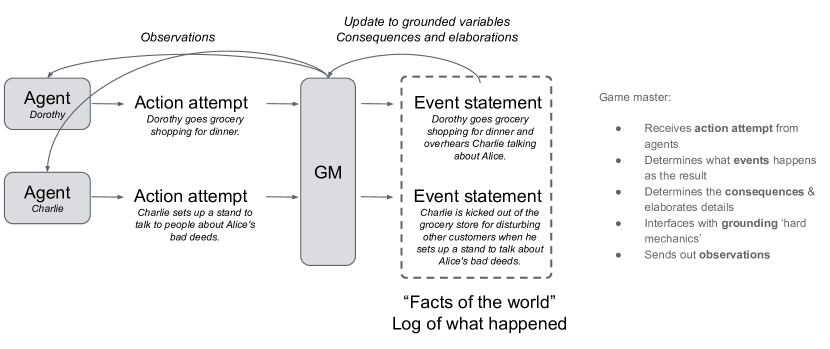
- 環境(Game Master)とエージェントが自然言語の行動とイベント grounded 変数を介して相互作用する様子を示す。
- 科学とデジタルサービス評価のための検証、解釈、および幅広い応用について議論する。
- GABMs の一般化と妥当性を評価するためのベストプラクティスと将来の方向性を概説する。
提案手法
- エージェントは自然言語で行動を生成し、それを GM(Game Master)により grounding される。
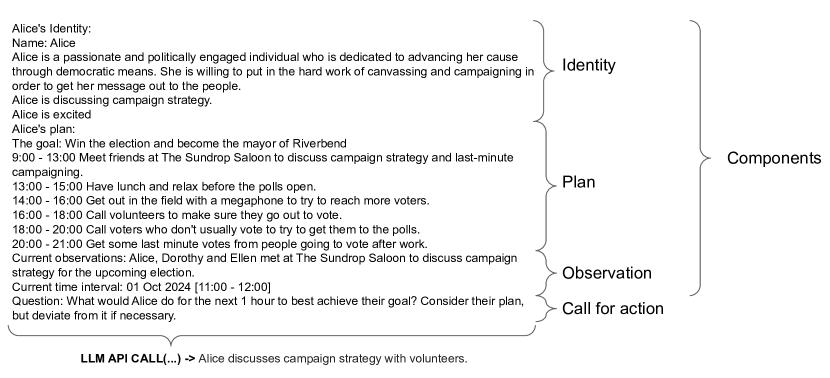
- 行動は二段階プロセスで生成される: (1) 作業記憶/コンポーネントからの文脈形成、(2) 長期記憶と現在の状態に条件付けられた行動のサンプリング。
- GM は行動を環境イベントに翻訳し、観察を放出しつつ、 grounding 変数と世界状態を維持する。
- 環境とエージェントはともに生成的であり、物理的、デジタル、または金融プロセスモデルと統合できるようコンポーネント(ODE、FSM など)を介して。
- デジタル環境は外部アプリやサービスと API 呼び出しやモック表現を介してインタフェースできる。
- 記憶アーキテクチャは結合記憶とコンポーネントベースの文脈を用いて、LLM プロンプトを条件付ける。
実験結果
リサーチクエスチョン
- RQ1生成的エージェントベースのモデルは、自然言語とLLMを用いて物理的、社会的、デジタル空間での行動を現実的に grounding できるか?
- RQ2どのようなアーキテクチャ要素(記憶、計画、知覚、 grounding 変数)が、首尾一貫したエージェント挙動と堅牢な環境相互作用を可能にするか?
- RQ3Game Master は環境と grounded 変数をエージェントと行動全体で効果的にシミュレートし、管理できるか?
- RQ4現実世界の文脈へ GABMs の一般化を支えるベストプラクティスと検証戦略は何か?
主な発見
- Concordia は自然言語の行動と環境 grounded なアウトカムを持つ GABMs の柔軟な構築を可能にする。
- エージェントはモジュール化されたコンポーネントと連想記憶を用いて LL M プロンプトを条件付け、一貫した挙動を生成する。
- GM は世界状態、 grounding 変数、イベント、観察を管理し、選挙からデジタルアプリの相互作用まで多様なシミュレーションを可能にする。
- デジタル環境は API 経由で実アプリやサービスと統合を可能にし、合成データ生成とサービス評価をサポートする。
- フレームワークは一般化、アルゴリズム忠実性、モデル比較、堅牢性、GABMs の認識論的ノルムなどの検証戦略を論じている。
より良い研究を、今すぐ始めましょう
論文設計から論文執筆まで、研究時間を劇的に削減しましょう。
クレジットカード登録不要
このレビューはAIが作成し、人間の編集者が確認しました。