
[論文レビュー] Generative AI is already widespread in the public sector
本研究は英国の公共部門専門職938名を調査し、生成系AIの利用がすでに広く行われており、生産性向上への顕著な楽観性がある一方、ガイダンスと説明責任の明確さには限界があることを示している。
Generative AI has the potential to transform how public services are delivered by enhancing productivity and reducing time spent on bureaucracy. Furthermore, unlike other types of artificial intelligence, it is a technology that has quickly become widely available for bottom-up adoption: essentially anyone can decide to make use of it in their day to day work. But to what extent is generative AI already in use in the public sector? Our survey of 938 public service professionals within the UK (covering education, health, social work and emergency services) seeks to answer this question. We find that use of generative AI systems is already widespread: 45% of respondents were aware of generative AI usage within their area of work, while 22% actively use a generative AI system. Public sector professionals were positive about both current use of the technology and its potential to enhance their efficiency and reduce bureaucratic workload in the future. For example, those working in the NHS thought that time spent on bureaucracy could drop from 50% to 30% if generative AI was properly exploited, an equivalent of one day per week (an enormous potential impact). Our survey also found a high amount of trust (61%) around generative AI outputs, and a low fear of replacement (16%). While respondents were optimistic overall, areas of concern included feeling like the UK is missing out on opportunities to use AI to improve public services (76%), and only a minority of respondents (32%) felt like there was clear guidance on generative AI usage in their workplaces. In other words, it is clear that generative AI is already transforming the public sector, but uptake is happening in a disorganised fashion without clear guidelines. The UK's public sector urgently needs to develop more systematic methods for taking advantage of the technology.
研究の動機と目的
- 英国の公共サービスにおける生成系AIの現状認識と使用状況を評価する。
- 生成系AIを採用している公共部門の職種とその普及率を定量化する。
- 生成系AI導入に関連する生産性向上の認識と懸念を評価する。
- GenAI出力に関するガイダンスの入手可能性と説明責任の明確さを特定する。
提案手法
- Qualtricsを用いた2023年11月実施の英国公務部門専門職938名を対象としたオンライン調査。
- NHS、救急サービス、社会福祉、学校、大学の参加者を対象にProlificを通じて募集。
- AIタイプを生成系(Generative)、意思決定支援(Decision-Support)、知覚系(Perceptive)に分類;GenAIの使用と認識に焦点を当てる。
- 記述統計、カイ二乗検定、単因子ANOVAをRで用いた統計分析。
実験結果
リサーチクエスチョン
- RQ1公的部門の労働者の間で生成系AIの認識の程度と実際の使用はどの程度か。
- RQ2どの部門や職種でGenAIの普及が高いか、利用は人口統計とどのように関連しているか。
- RQ3労働者がGenAIと関連付ける生産性への影響、特に官僚的な時間の削減について。
- RQ4職場でのGenAI使用に関する認識されたリスク、ガイダンス、説明責任の懸念は何か。
主な発見
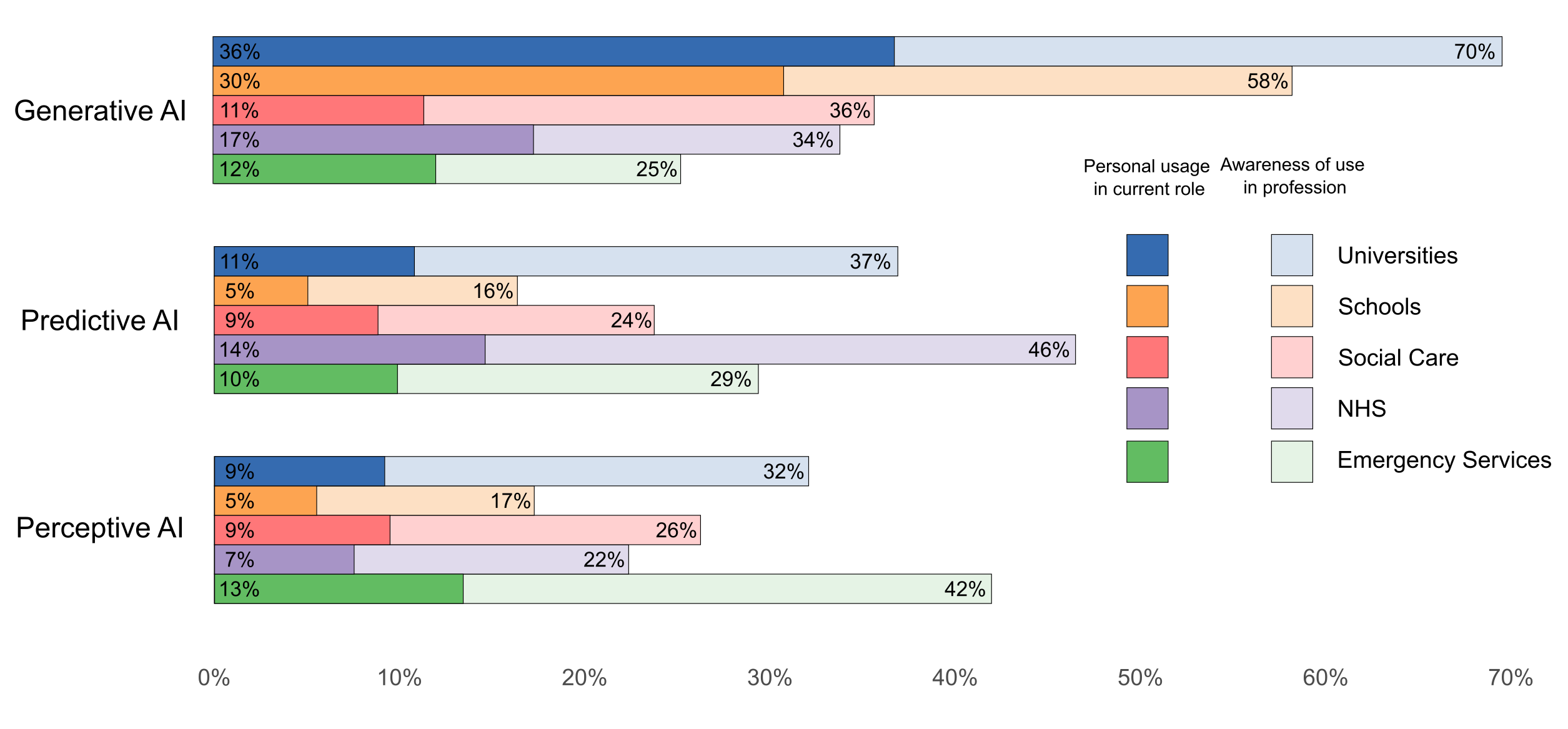
- GenAIの認識: 回答者の45%が自分の業務領域でGenAIの使用を認識しており、22%がGenAIシステムを積極的に使用している。
- 部門ごとに普及は異なり、大学36.4%、学校30.5%がGenAIの使用が高いと報告する一方、NHS 17%、救急サービス12%、社会福祉11%が低い普及を報告している。
- GenAI利用者( n=209) のうち132名(63%)がChatGPTを使用; 大学(26.7%)と学校(19.6%)はChatGPTの使用を報告する割合が高い。
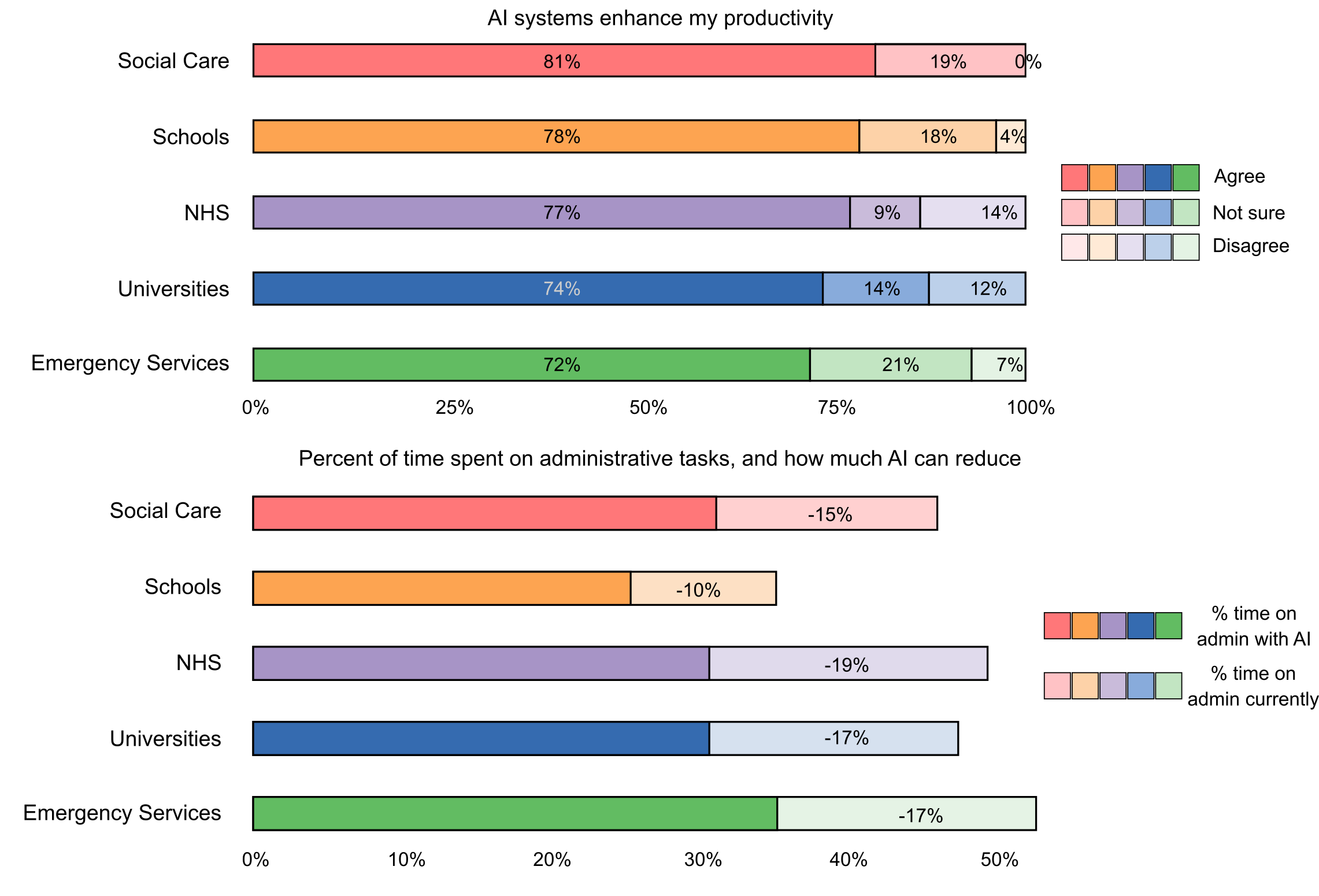
- GenAIを使用する回答者は生産性の向上と官僚化の削減を認識し、NHSの利用者は官僚的な時間が50%から30%に低下すると見積もっている。
- GenAI出力に対する総合的な信頼は高く(利用者の61%)、16%は自分の仕事が奪われることを恐れている。
- 多くの回答者(76%)は英国が公共サービスにAIを活用する機会を逃していると感じ、32% は職場でGenAIの使用に関する明確なガイダンスがあると感じている。
より良い研究を、今すぐ始めましょう
論文設計から論文執筆まで、研究時間を劇的に削減しましょう。
クレジットカード登録不要
このレビューはAIが作成し、人間の編集者が確認しました。