
[論文レビュー] Generative AI Meets Semantic Communication: Evolution and Revolution of Communication Tasks
本論文は、semantic communicationにおける深層生成モデルの統一的な視点を提示し、diffusion、VAEs、GANs、flowモデルが従来のビット回復を超える新たなタスク、アプリケーション、アーキテクチャパラダイムをどのように可能にするかを示す。効率的で信頼性が高く、説明可能な生成的意味通信に向けた課題と今後の指針について議論する。
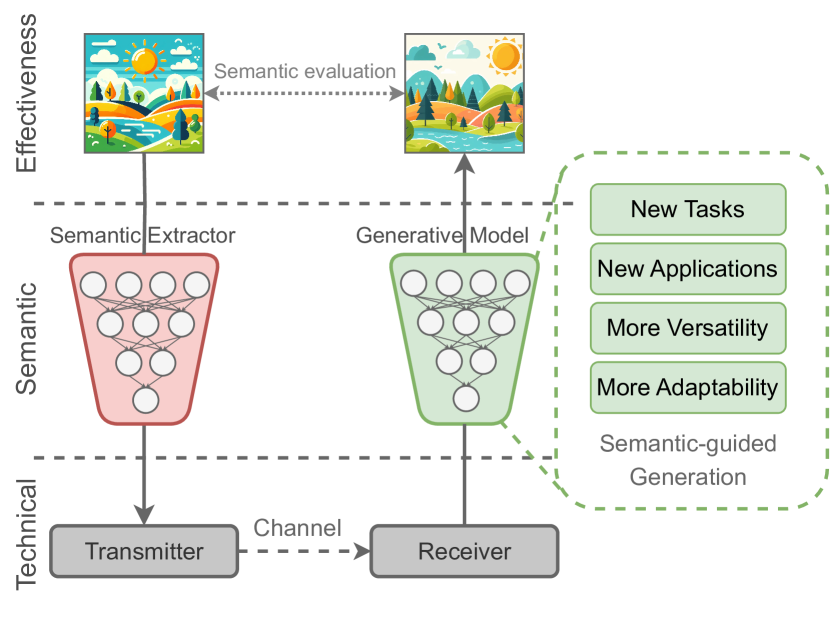
While deep generative models are showing exciting abilities in computer vision and natural language processing, their adoption in communication frameworks is still far underestimated. These methods are demonstrated to evolve solutions to classic communication problems such as denoising, restoration, or compression. Nevertheless, generative models can unveil their real potential in semantic communication frameworks, in which the receiver is not asked to recover the sequence of bits used to encode the transmitted (semantic) message, but only to regenerate content that is semantically consistent with the transmitted message. Disclosing generative models capabilities in semantic communication paves the way for a paradigm shift with respect to conventional communication systems, which has great potential to reduce the amount of data traffic and offers a revolutionary versatility to novel tasks and applications that were not even conceivable a few years ago. In this paper, we present a unified perspective of deep generative models in semantic communication and we unveil their revolutionary role in future communication frameworks, enabling emerging applications and tasks. Finally, we analyze the challenges and opportunities to face to develop generative models specifically tailored for communication systems.
研究の動機と目的
- 意味通信における深層生成モデルと、それらが将来の6Gで果たす役割に関する統一的な視点を提供する。
- 生成モデルが従来の通信問題を超えて意味タスクとアプリケーションを根本的に変革する方法を示す。
- 効率的で特化した生成的意味通信フレームワークへの道筋と課題を議論する。
提案手法
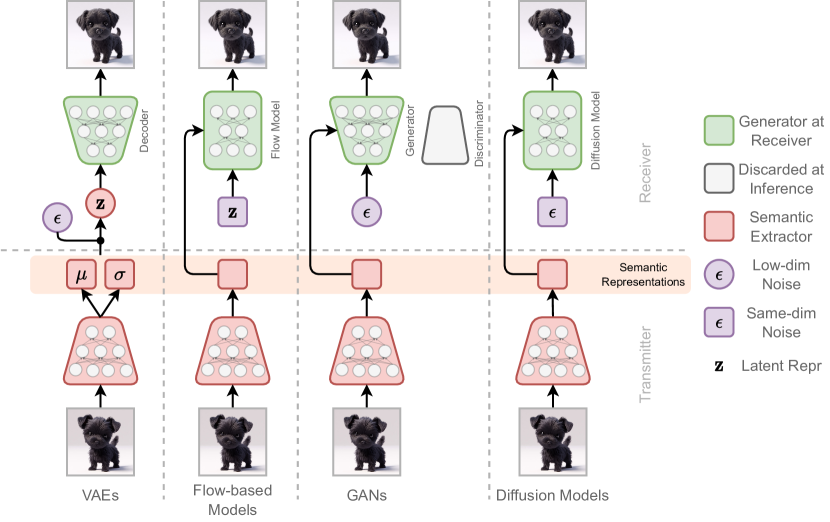
- 意味通信における生成モデルアーキテクチャを分類する(VAEs、Flow-based、GANs、Diffusion)。
- Weaverベースの意味通信フレームワークにおける受信側での生成を導く中核機構としての意味条件付けを説明する。
- 意味表現と条件付けが、劣化したチャネル下での再構成品質と頑健性に与える影響を説明する。
実験結果
リサーチクエスチョン
- RQ1ビット回復を超えるために、深層生成モデルを意味通信に統合するにはどうすればよいか?
- RQ2意味通信におけるVAEs、flowモデル、GANs、diffusionモデルの長所と限界は何か?
- RQ3チャネルの非完璧性の下で、意味条件付けは生成品質にどう影響するか?
- RQ4意味通信に生成モデルを用いるとどのようなアーキテクチャの転換(モジュラー対エンドツーエンド)が生じるか?
- RQ56G時代のネットワークにおける意味タスクのための生成AI活用に伴う将来のアプリケーションと課題は何か?
主な発見
- 生成モデルは、正確なビット回復を伴わずに意味圧縮と内容の再生成を可能にし、コスト効率の高い通信を実現する。
- VAEs、flowモデル、GANs、そしてdiffusionモデルは、意味タスクにおける圧縮、サンプリング速度、学習の安定性においてトレードオフを提供する。
- 意味条件付けは重要であり、正確な条件付けは生成を送信された意味と一致させる一方、不完全な条件付けは出力を劣化させうる。
- 生成モデルはOSIスタック内で非エンドツーエンドのモジュラーアーキテクチャを支援し、デノイジング、復元、逆問題を可能にする。
- 新興のアプリケーションには、コンテンツ作成、マルチモーダル生成、個別化およびマルチユーザー通信、LLM支援ワークフローなどが含まれる。
より良い研究を、今すぐ始めましょう
論文設計から論文執筆まで、研究時間を劇的に削減しましょう。
クレジットカード登録不要
このレビューはAIが作成し、人間の編集者が確認しました。