
[論文レビュー] Generative Pre-trained Transformer: A Comprehensive Review on Enabling Technologies, Potential Applications, Emerging Challenges, and Future Directions
本論文はGPTモデルを概観し、その進化、アーキテクチャ、実現技術、応用、課題、将来の方向性を詳述します。GPT-1からGPT-4を要約し、マルチモーダル機能と倫理的配慮について論じます。
The Generative Pre-trained Transformer (GPT) represents a notable breakthrough in the domain of natural language processing, which is propelling us toward the development of machines that can understand and communicate using language in a manner that closely resembles that of humans. GPT is based on the transformer architecture, a deep neural network designed for natural language processing tasks. Due to their impressive performance on natural language processing tasks and ability to effectively converse, GPT have gained significant popularity among researchers and industrial communities, making them one of the most widely used and effective models in natural language processing and related fields, which motivated to conduct this review. This review provides a detailed overview of the GPT, including its architecture, working process, training procedures, enabling technologies, and its impact on various applications. In this review, we also explored the potential challenges and limitations of a GPT. Furthermore, we discuss potential solutions and future directions. Overall, this paper aims to provide a comprehensive understanding of GPT, enabling technologies, their impact on various applications, emerging challenges, and potential solutions.
研究の動機と目的
- Generative Pre-trained Transformer (GPT) モデルの進化とアーキテクチャを説明する。
- GPTモデルを可能にする実現技術を特定する。
- 産業全体の潜在的な応用を調査し、現在の課題と制限を強調する。
- 注目すべきGPTプロジェクト、評価、今後の研究方向性について論じる。
提案手法
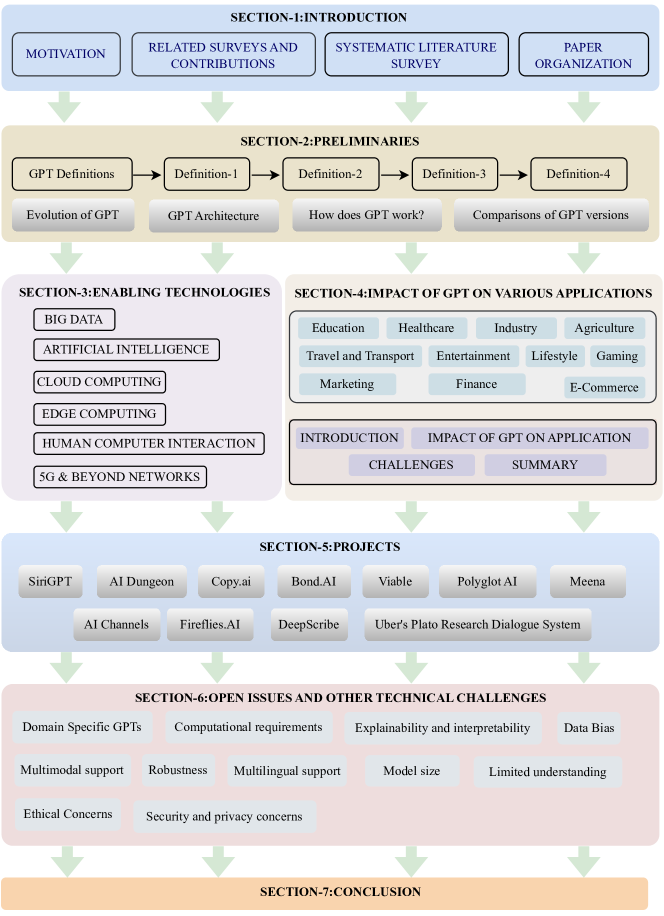
- 査読付きジャーナルと高品質の会議資料の体系的文献調査。
- GPTバージョン(GPT-1からGPT-4)とそのアーキテクチャの特徴、データセット、トークンの比較。
- トランスフォーマーをベースとしたアーキテクチャ、事前学習と微調整のワークフローの説明。
- 実現技術(ビッグデータ、AI、クラウド、エッジコンピューティング、5G、HCI)と、それらがGPT開発における役割の分析。
- 応用、プロジェクト、未解決課題、将来の方向性についての議論。
- パラメータ、データセット、欠点を含むGPTバージョンの表形式比較。
実験結果
リサーチクエスチョン
- RQ1GPT‑1 から GPT‑4 までのGPTモデルの主要なアーキテクチャ要素と進化的マイルストーンは何か?
- RQ2GPTモデルを支える実現技術は何で、性能とデプロイメントにどう影響しますか?
- RQ3分野を超えたGPTの主な応用、利点、制限は何か?
- RQ4GPTの展開に伴う課題、リスク、倫理的配慮は何か、提案される将来の方向性は何か?
主な発見
- GPTモデルは自己注意を用いるトランスフォーマーアーキテクチャに基づき、大規模なテキストコーパスでの事前学習を行い、その後下流タスクの微調整を行う。
- GPT‑1、GPT‑2、GPT‑3、GPT‑3.5、GPT‑4は能力が拡大しており、GPT‑4はマルチモーダル機能と拡張されたコンテキストウィンドウ(8192 および 32768 トークン)を提供する。
- GPTモデルはビッグデータとディープラーニングを活用し、言語モデリング、翻訳、要約、コード生成、質問応答などのタスクを可能にする。
- 特定された実現技術にはビッグデータ、AI、クラウドコンピューティング、エッジコンピューティング、5Gネットワーク、ヒューマン-コンピュータインタラクションが含まれ、それぞれデータアクセス、スケーラビリティ、使いやすさに寄与する。
- 本論文は機会、実世界の応用、注目すべきGPTプロジェクトを強調しつつ、データプライバシー、バイアス、出力制御、高い計算コストなどの課題も詳述している。
- 従来の調査と比較して、本研究はGPTの進化、アーキテクチャ、実現技術、将来の研究方向の総合的な総括を提供する。
より良い研究を、今すぐ始めましょう
論文設計から論文執筆まで、研究時間を劇的に削減しましょう。
クレジットカード登録不要
このレビューはAIが作成し、人間の編集者が確認しました。