
[論文レビュー] Geographic Location Encoding with Spherical Harmonics and Sinusoidal Representation Networks
この論文は、球面調和関数の埋め込みと Sinusoidal Representation Networks (SirenNets) を組み合わせたグローバルな位置エンコーダを提案し、特に極地域で強力な性能を示すとともに、SirenNets が学習済み DFS 埋め込みとして機能することを主張します。
Learning representations of geographical space is vital for any machine learning model that integrates geolocated data, spanning application domains such as remote sensing, ecology, or epidemiology. Recent work embeds coordinates using sine and cosine projections based on Double Fourier Sphere (DFS) features. These embeddings assume a rectangular data domain even on global data, which can lead to artifacts, especially at the poles. At the same time, little attention has been paid to the exact design of the neural network architectures with which these functional embeddings are combined. This work proposes a novel location encoder for globally distributed geographic data that combines spherical harmonic basis functions, natively defined on spherical surfaces, with sinusoidal representation networks (SirenNets) that can be interpreted as learned Double Fourier Sphere embedding. We systematically evaluate positional embeddings and neural network architectures across various benchmarks and synthetic evaluation datasets. In contrast to previous approaches that require the combination of both positional encoding and neural networks to learn meaningful representations, we show that both spherical harmonics and sinusoidal representation networks are competitive on their own but set state-of-the-art performances across tasks when combined. The model code and experiments are available at https://github.com/marccoru/locationencoder.
研究の動機と目的
- リモートセンシング、生態学、疫学などの領域で頑健な地理的位置表現を動機づける。
- 球状地球上での DFS ベースの埋め込みによるアーティファクトを特に極近傍で対処する。
- 球面調和関数 (SH) に基づく位置埋め込みを提案し、それを Sinusoidal Representation Networks (SirenNets) と組み合わせる。
- 合成データと実データの多様なデータセット(補間、分類、多変量回帰)を横断して SH+SirenNet を体系的に評価する。
提案手法
- グローバルな位置エンコーディングを、訓練可能な重み w_l^m と最大次数 L を用いた SH 基底関数 Y_l^m で定義する(式 3)。
- 球面上の f(λ,φ) を SH の加重和として表し、重みをニューラルネットワーク(線形層またはより複雑なネット)で学習する。
- Sinusoidal Representation Networks (SirenNets) をニューラルバックボーンとして採用し、SH 埋め込みからの複雑な写像を学習させ、SirenNet を学習済み DFS 埋め込みとして解釈する。
- SH と SirenNet を、DFS ベースの埋め込み(Wrap、Grid、SphereC、SphereM など)と複数のタスクで比較する。
- 解析的/事前計算済み SH 実装を提供し、DFS ベースの手法と比較した計算効率について論じる。
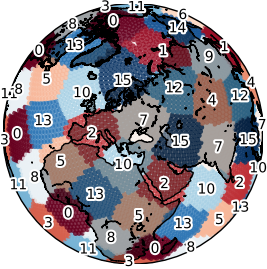
実験結果
リサーチクエスチョン
- RQ1球面調和関数埋め込みとニューラルネットは、グローバルな地理位置タスクで DFS ベースのエンコディングを上回るのか。
- RQ2SH 埋め込みと SirenNets の組み合わせは、合成データ、気候データ、陸海データ、iNaturalist を含む多様なデータセットに対して、他の NN アーキテクチャと比較してどうか。
- RQ3SH 埋め込みは DFS ベースのエンコーディングで見られる極地のアーティファクトを低減し、極域予測を改善できるのか。
- RQ4大きな SH 次数に対する解析解/事前計算 vs 閉形式の SH 実装の計算トレードオフは何か。
主な発見
- SH 埋め込みは、単純な Linear 層を含むネットワークを含めて頑健に動作し、データセット間で高い精度を達成する。
- SirenNet は一貫して高い性能を発揮し、SH と組み合わせると iNaturalist や checkerboard データセットを含む複数のタスクで新しい最先端を達成する。
- SH 埋め込みは DFS ベースのエンコーディングで見られる極地アーティファクトを大幅に緩和し、極付近で安定した性能を維持する。
- ERA5 の多変量補間では、SH with FcNet が本研究で最良の結果を達成し、SH+SirenNet もタスクを横断して競争力を示した。
- SH エンコーディングは、地理データの地全球的に定義され、極地に優しい暗黙的ニューラル表現の学習を可能にし、従来の DFS ベース手法を重要な場面で上回る。
より良い研究を、今すぐ始めましょう
論文設計から論文執筆まで、研究時間を劇的に削減しましょう。
クレジットカード登録不要
このレビューはAIが作成し、人間の編集者が確認しました。