
[論文レビュー] GNNUERS: Fairness Explanation in GNNs for Recommendation via Counterfactual Reasoning
GNNUERS は、特徴レベルの説明を超えて、GNNベースのレコメンデーションシステムにおける不当なユーザ-アイテム相互作用を特定する、革新的な反事実的説明フレームワークである。同フレームワークは、二部グラフ構造を摂動させることで、人種的・性的・年齢的属性に起因するレコメンデーション効用の不平等を最小化する。GNNUERS は、4つの実世界データセット上で3つの最先端のGNNモデルに対して、性別や年齢に基づく公平性の不平等に関連する相互作用パターンを明らかにし、不当なレコメンデーションを効果的に説明した。
Nowadays, research into personalization has been focusing on explainability and fairness. Several approaches proposed in recent works are able to explain individual recommendations in a post-hoc manner or by explanation paths. However, explainability techniques applied to unfairness in recommendation have been limited to finding user/item features mostly related to biased recommendations. In this paper, we devised a novel algorithm that leverages counterfactuality methods to discover user unfairness explanations in the form of user-item interactions. In our counterfactual framework, interactions are represented as edges in a bipartite graph, with users and items as nodes. Our bipartite graph explainer perturbs the topological structure to find an altered version that minimizes the disparity in utility between the protected and unprotected demographic groups. Experiments on four real-world graphs coming from various domains showed that our method can systematically explain user unfairness on three state-of-the-art GNN-based recommendation models. Moreover, an empirical evaluation of the perturbed network uncovered relevant patterns that justify the nature of the unfairness discovered by the generated explanations. The source code and the preprocessed data sets are available at https://github.com/jackmedda/RS-BGExplainer.
研究の動機と目的
- GNNベースのレコメンデーションシステムにおける不当性の説明可能性の欠如、特に特徴レベルの説明を超えるものに焦点を当てる。
- ユーザーやアイテムの特徴ではなく、特定のユーザ-アイテム相互作用を通じて不当性を説明する手法を開発する。
- システム設計者が、保護された属性集団と保護されていない属性集団の間の差異を引き起こす相互作用を理解できるようにする。
- 最小限の相互作用の削除によってより公平なレコメンデーションを達成する反事実的フレームワークを提供する。
- グラフトポロジーに根ざした説明を実現し、ユーザ-アイテム相互作用ネットワークの二部構造を活用する。
提案手法
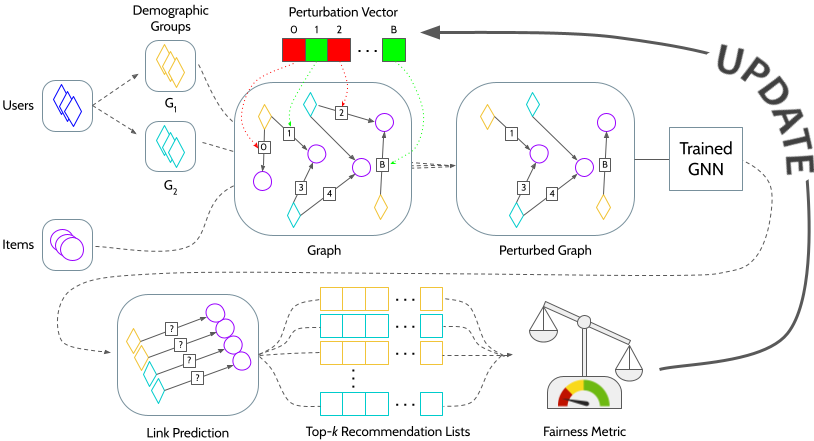
- ユーザの不当性の説明を反事実的問題として定式化:保護されたグループと保護されていないグループ間の効用差を最小化する元の二部グラフの摂動版を特定する。
- ユーザ-アイテム相互作用を、ユーザとアイテムをノードとする二部グラフのエッジとして表現し、エッジの削除を摂動ベクトルでモデル化する。
- エッジ削除の微分可能リラクゼーションを用いて摂動ベクトルを最適化し、公平性の不平等を最小化するように、人種的・性的・年齢的属性のパラメータに従う。
- GNNのトポロジカル構造を活用し、どの相互作用を削除するとより公平なレコメンデーションが得られるかを特定する。エッジレベルの変更に焦点を当てる。
- グラフの性質(例:次数、ダイアド数、逆地図距離)を統合し、同定されたエッジを解釈し、人間が理解可能な説明を合成する。
- 3つの最先端のGNNベースのレコメンデーションモデルを4つの実世界データセットに適用し、効用差の指標を用いて公平性の向上を検証する。
実験結果
リサーチクエスチョン
- RQ1GNNベースのレコメンデーションシステムにおける不当なレコメンデーションの原因となっている、特定のユーザ-アイテム相互作用は何か?
- RQ2ユーザーやアイテムの特徴に依存せずに、反事実的グラフ摂動がGNNにおける不当性を効果的に説明できるか?
- RQ3同定された相互作用は、ユーザの人気度やネットワークの近接性といったグラフの構造的性質とどのように関連しているか?
- RQ4GNNUERS は、性別や年齢などのレコメンデーション効用の差をどれだけ低減できるか?同時に、レコメンデーション品質を維持できるか?
- RQ5このフレームワークは、異なるGNNアーキテクチャや複数の属性集団を含む公平性設定に一般化可能か?
主な発見
- GNNUERS は、3つの最先端のGNNベースのモデルにおいて、レコメンデーションの公平性を向上させるために、特定のユーザ-アイテム相互作用の削除を成功裏に同定した。
- 本手法により、ML-1Mデータセットにおける不当性は、ニッチな映画を好む、孤立した男性で、相互作用頻度が低いことが原因であることが明らかになった。
- LFM-1Kデータセットでは、低次数・低近接性の女性と、高次数・高近接性の男性の組み合わせが、不当性の原因となっており、構造的バイアスの兆候である。
- 実証的評価により、摂動を加えたグラフが一貫した不当性のパターンを示し、グラフトポロジーとユーザ行動に基づいた説明が得られた。
- GNNUERS は、MovieLens や Last.FM を含む4つの実世界データセットで、異なる属性集団の分布を持つ状況においても、強固な性能を示した。
- GNNUERS は、特徴レベルの説明を超えた、解釈可能でエッジレベルの説明を提供し、公平性の是正に向けた実行可能なインサイトを提供した。

より良い研究を、今すぐ始めましょう
論文の読解から最終レビューまで、研究時間を劇的に削減しましょう。
クレジットカード登録不要
このレビューはAIが作成し、人間の編集者が確認しました。