
[論文レビュー] Gravitational imaging through a triple source plane lens: revisiting the $Λ$CDM-defying dark subhalo in SDSSJ0946+1006
本研究は、多バンドHSTおよびVLT-MUSEデータを用いて、三重の源面平面を持つレンズSDSSJ0946+1006を再分析し、以前に報告されたΛCDM予測と整合しないとされた暗黒準銀河団の存在を再評価する。5.9σの準銀河団が検出され、質量log₁₀(M/M☉) = 9.2⁺⁰.⁴₋₀.¹、濃度log₁₀c = 2.4⁺⁰.⁵₋₀.³であり、現在はCDMシミュレーションと整合的であるが、検出の有意水準が源の正則化スキームに極めて敏感であることが強調されている。
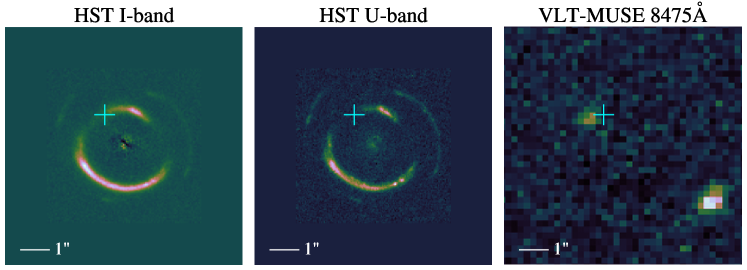
The $Λ$CDM paradigm successfully explains the large-scale structure of the Universe, but is less well constrained on sub-galactic scales. Gravitational lens modelling has been used to measure the imprints of dark substructures on lensed arcs, testing the small-scale predictions of $Λ$CDM. However, the methods required for these tests are subject to degeneracies among the lens mass model and the source light profile. We present a case study of the unique compound gravitational lens SDSSJ0946+1006, wherein a dark, massive substructure has been detected, whose reported high concentration would be unlikely in a $Λ$CDM universe. For the first time, we model the first two background sources in both I- and U-band HST imaging, as well as VLT-MUSE emission line data for the most distant source. We recover a lensing perturber at a $5.9σ$ confidence level with mass $\log_{10}(M_\mathrm{sub}/M_{\odot})=9.2^{+0.4}_{-0.1}$ and concentration $\log_{10}c=2.4^{+0.5}_{-0.3}$. The concentration is more consistent with CDM subhalos than previously reported, and the mass is compatible with that of a dwarf satellite galaxy whose flux is undetectable in the data at the location of the perturber. A wandering black hole with mass $\log_{10}(M_\mathrm{BH}/M_{\odot})=8.9^{+0.2}_{-0.1}$ is a viable alternative model. We systematically investigate alternative assumptions about the complexity of the mass distribution and source reconstruction; in all cases the subhalo is detected at around the $\geq5σ$ level. However, the detection significance can be altered substantially (up to $11.3σ$) by alternative choices for the source regularisation scheme.
研究の動機と目的
- 三重の源面平面を持つレンズSDSSJ0946+1006に以前報告された暗黒準銀河団の存在と性質を、ΛCDM予測と矛盾するとされたものについて再評価すること。
- 新規の多波長データを用いて、準銀河団の高い濃度と質量が冷たい暗黒物質(CDM)シミュレーションと整合するかを調査すること。
- 特に源再構築と正則化スキームに起因する系統的不確実性を考慮したレンズモデリングにおける準銀河団検出の頑健性を評価すること。
- 暗黒準銀河団を仮定せず、レンズ歪みを説明できる代替質量モデル(例えば、移動するブラックホール)が存在するかを検討すること。
- 強力レンズモデリングにおける準銀河団検出の有意水準とベイズ的証拠に与える源の正則化(勾配対曲率)の影響を評価すること。
提案手法
- 近い2つの源(s1およびs2)のIバンドおよびUバンドHST画像と、遠方の源(s3)のVLT-MUSE発光線データを統合してレンズモデリングを実施する。
- 主レンズのパラメトリックマクロモデルと、暗黒摂動子を検出するための非パラメトリック準銀河団モデルを採用する。
- ベイズ的証拠と有意水準のテスト(χ²と事後分布サンプリングを用いて)を用いて、複数のモデルバリアントにおける準銀河団検出を評価する。
- 源の正則化スキームを系統的に変化させ、勾配ベース(ファイドシャル)と曲率ベースの正則化を比較し、検出有意水準への影響を評価する。
- マクロレンズの高次モーメント(3次および4次)を含め、s1の楕円度を可変にすることで、モデルの頑健性をテストする。
- レンズ歪みを再現できるかどうかを比較することで、代替質量モデル(移動するブラックホールを含む)を検討し、暗黒準銀河団を仮定しないで同様の結果を得られるかを検証する。
実験結果
リサーチクエスチョン
- RQ1多バンドおよび多機器データを用いて再分析した場合、SDSSJ0946+1006に以前報告された暗黒準銀河団はまだΛCDM予測と整合しないのか?
- RQ2源の正則化(勾配対曲率)の選択が、強力レンズモデリングにおける準銀河団検出の有意水準にどのように影響するか?
- RQ3質量log₁₀(M/M☉) ≈ 8.9⁺⁰.²₋₀.¹の移動するブラックホールが、暗黒準銀河団と同等のレンズ歪みを説明できるか?
- RQ4マクロモデルの複雑さ(例えば、高次モーメント、楕円度)を変化させた場合、準銀河団検出はどの程度頑健か?
- RQ5以前の主張とは対照的に、現在の準銀河団の質量と濃度は、ΛCDMシミュレーションの予測とどの程度整合しているか?
主な発見
- 5.9σの有意水準で暗黒準銀河団が検出され、質量log₁₀(M/M☉) = 9.2⁺⁰.⁴₋₀.¹、濃度log₁₀c = 2.4⁺⁰.⁵₋₀.³であり、現在は2.0σcのCDMシミュレーションと整合的である。
- この準銀河団の質量は、その位置に光が検出不能な矮小衛星銀河と一致する。
- 源再構築に用いる正則化スキーム(曲率対勾配)によって、検出有意水準は著しく変化し、最大で11.3σまで変動する。
- 曲率正則化では有意水準が高くなるが、ベイズ的証拠は明確にファイドシャルの勾配正則化スキームを好む。
- マクロモデルに高次モーメントと可変な楕円度を含めても、準銀河団検出の結果は顕著に変わらず、最良のモデルでも検出は6σ以上に保たれる。
- 質量log₁₀(M/M☉) = 8.9⁺⁰.²₋₀.¹の移動するブラックホールは、暗黒準銀河団モデルの代替として妥当であるが、証拠上は好まれない。
より良い研究を、今すぐ始めましょう
論文の読解から最終レビューまで、研究時間を劇的に削減しましょう。
クレジットカード登録不要
このレビューはAIが作成し、人間の編集者が確認しました。