
[論文レビュー] Heterogeneous network approach to predict individuals' mental health
本研究では、スマートフォン、ウェアラブル(フィットビット)、アンケートデータを統合した異種情報ネットワーク(HIN)フレームワークを提案し、推薦システム(RS)およびノード分類(NC)手法を用いてうつ病および不安を予測する。最も優れた性能を示した手法であるデュアルマトリックス因子分解(DMF)は、従来のロジスティック回帰およびランダムベースラインを上回り、HIN上での推薦システムが、精神的健康予測においてノード分類よりも優れていることを示した。
Depression and anxiety are critical public health issues affecting millions of people around the world. To identify individuals who are vulnerable to depression and anxiety, predictive models have been built that typically utilize data from one source. Unlike these traditional models, in this study, we leverage a rich heterogeneous data set from the University of Notre Dame's NetHealth study that collected individuals' (student participants') social interaction data via smartphones, health-related behavioral data via wearables (Fitbit), and trait data from surveys. To integrate the different types of information, we model the NetHealth data as a heterogeneous information network (HIN). Then, we redefine the problem of predicting individuals' mental health conditions (depression or anxiety) in a novel manner, as applying to our HIN a popular paradigm of a recommender system (RS), which is typically used to predict the preference that a person would give to an item (e.g., a movie or book). In our case, the items are the individuals' different mental health states. We evaluate four state-of-the-art RS approaches. Also, we model the prediction of individuals' mental health as another problem type - that of node classification (NC) in our HIN, evaluating in the process four node features under logistic regression as a proof-of-concept classifier. We find that our RS and NC network methods produce more accurate predictions than a logistic regression model using the same NetHealth data in the traditional non-network fashion as well as a random-approach. Also, we find that the best of the considered RS approaches outperforms all considered NC approaches. This is the first study to integrate smartphone, wearable sensor, and survey data in an HIN manner and use RS or NC on the HIN to predict individuals' mental health conditions.
研究の動機と目的
- 単一のデータタイプに依存する精神的健康予測モデルの限界を克服するため、多様なデータソースを統合すること。
- 精神的健康予測を、異種情報ネットワーク(HIN)上での推薦システム(RS)問題としてモデル化する革新的なアプローチを開発すること。
- RSおよびノード分類(NC)手法がHIN上で示す性能を、従来の非ネットワークモデルおよびランダムベースラインと比較して評価すること。
- 身体活動、ウェルネス、性格特性などの異なるデータモダリティが、精神的健康アウトカムの予測にどの程度の相対的寄与をしているかを明らかにすること。
- 多様なデータソースを統合したHIN構造を用いて、個々の特徴を予測する汎用的なフレームワークを確立すること。
提案手法
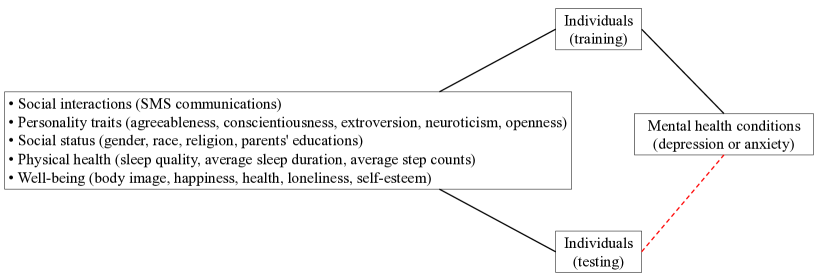
- スマートフォンの操作ログ、フィットビットウェアラブルセンサデータ、アンケートベースの特性データから成るNetHealth研究データを、異なるノード型およびエッジ型を持つ異種情報ネットワーク(HIN)としてモデル化した。
- 精神的健康予測タスクを、個人を「ユーザー」とし、うつ病・不安状態を「予測対象のアイテム」として扱う推薦システム(RS)問題に再定式化した。
- HIN構造に基づく精神的健康状態の予測能力を評価するために、4つの最先端のRS手法(デュアルマトリックス因子分解を含む)を評価した。
- ノード分類(NC)手法のプロトタイプ比較として、HINから抽出したノード特徴を用いたロジスティック回帰を用いたNC手法4つも評価した。
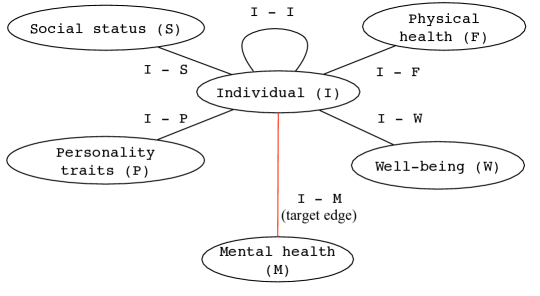
- HINは複数のエッジタイプを有し、個人から社会的相互作用(S)、身体活動(F)、ウェルネス(W)、性格特性(P)へのリンクを設け、マルチモーダルデータ統合を可能にした。
- 性能評価には標準指標(AUC、F1スコア、正答率)を用い、統計的有意性はp値で評価した。
実験結果
リサーチクエスチョン
- RQ1異種情報ネットワーク(HIN)は、スマートフォン、ウェアラブル、アンケートデータといった多様なデータソースを効果的に統合し、精神的健康予測を向上させることができるか?
- RQ2HIN上での推薦システム(RS)パラダイムは、従来のノード分類(NC)や非ネットワークモデルと比較して、うつ病および不安の予測においてより優れているか?
- RQ3身体活動(F)とウェルネス(W)など、異なるデータモダリティの組み合わせ(例:F+W)の中で、どの組み合わせが、うつ病および不安予測において最も高い正確性を示すか?
- RQ4HINを用いた精神的健康予測の文脈において、異なるRSおよびNC手法の予測性能はどのように比較されるか?
- RQ5データセットにおけるうつ病と不安を併存する人々の重複についての洞察は、両者の予測パターンの類似性と相違性をどのように説明できるか?
主な発見
- デュアルマトリックス因子分解(DMF)による推薦システム手法が、全評価指標で最高の性能を示し、他のすべてのRSおよびNC手法、および非ネットワーク型ロジスティック回帰ベースラインを上回った。
- うつ病予測において最も正確だったのは、Fitbitデータとウェルネスデータの組み合わせ(FW)であり、不安予測において最も優れたのは、性格特性とウェルネスの組み合わせ(PW)であった。
- DMF手法は非ネットワーク型ロジスティック回帰モデルを著しく上回ったことから、ネットワークベースのモデリングが予測力の向上に寄与することが示された。
- うつ病と不安を併存する人々の間に統計的に有意な重複(51名)が確認された(p < 0.05)、これは両条件における予測パターンの類似性を説明する要因である可能性がある。
- FW組み合わせは不安予測においても第2位の性能を示し、身体的健康とウェルネスが両条件の予測において強力な予測要因であることを示唆している。
- DMFと非ネットワークモデルの予測結果に有意な重複がなかったことから、さらなる性能向上のためのアンサンブル学習の可能性が示唆された。
より良い研究を、今すぐ始めましょう
論文の読解から最終レビューまで、研究時間を劇的に削減しましょう。
クレジットカード登録不要
このレビューはAIが作成し、人間の編集者が確認しました。