
[論文レビュー] HICEM: A High-Coverage Emotion Model for Artificial Emotional Intelligence
HICEMは、多言語の単語埋め込みの非教師付きクラスタリングから導かれた15の離散的状態カテゴリーを用いた高カバレッジ感情モデルを提案する。6言語で1,720の感情概念をほぼ最大限のカバレッジでカバーしつつ、ラベルの重複を最小限に抑える。このモデルは、既存の感情モデルに比べてカバレッジ効率が高く、感情モデルの評価に意味的類似度を用いた体系的枠組みを提供する。
As social robots and other intelligent machines enter the home, artificial emotional intelligence (AEI) is taking center stage to address users' desire for deeper, more meaningful human-machine interaction. To accomplish such efficacious interaction, the next-generation AEI need comprehensive human emotion models for training. Unlike theory of emotion, which has been the historical focus in psychology, emotion models are a descriptive tools. In practice, the strongest models need robust coverage, which means defining the smallest core set of emotions from which all others can be derived. To achieve the desired coverage, we turn to word embeddings from natural language processing. Using unsupervised clustering techniques, our experiments show that with as few as 15 discrete emotion categories, we can provide maximum coverage across six major languages--Arabic, Chinese, English, French, Spanish, and Russian. In support of our findings, we also examine annotations from two large-scale emotion recognition datasets to assess the validity of existing emotion models compared to human perception at scale. Because robust, comprehensive emotion models are foundational for developing real-world affective computing applications, this work has broad implications in social robotics, human-machine interaction, mental healthcare, and computational psychology.
研究の動機と目的
- 自然な人間-機械間対話に対応できる、高カバレッジでラベルの重複が少ない人工感情知能(AEI)のための感情モデルを開発すること。
- 既存の感情モデルには十分なカバレッジがなく、または過剰に重複するラベルを含むという限界を是正すること。
- 多数の感情概念に対する意味的類似度を用いた、データ駆動型の体系的評価手法を提供すること。
- 複数の文化にわたる人間の感情経験の全範囲を代表できる最小限の感情コアセットを同定すること。
提案手法
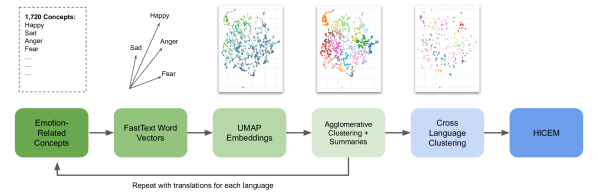
- アラビア語、中国語、英語、フランス語、スペイン語、ロシア語の6言語で1,720の感情概念に対してFastText単語埋め込みを用いる。
- 非教師付きクラスタリング(UMAPおよびk-meansを用いて)により、感情概念を意味的に整合性のあるクラスタにグループ化する。
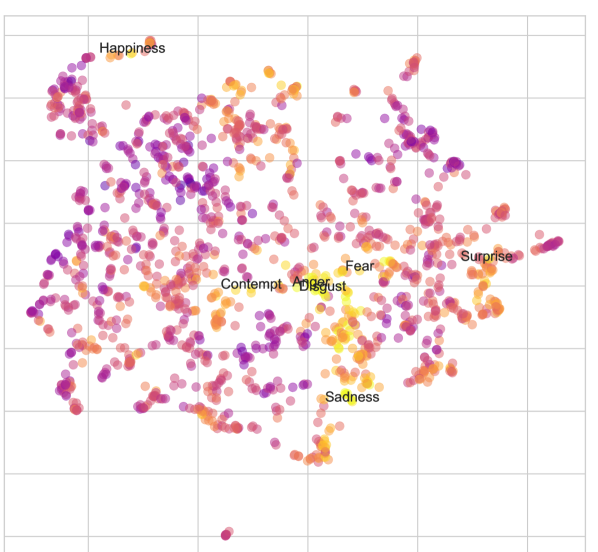
- UMAPを用いて次元削減を行い、グローバルな意味的構造を保持するとともに、モデルのカバレッジを可視化する。
- 感情概念ベクトルとモデルクラスターセンタの間の最大対数コサイン類似度を用いて、モデルのカバレッジを定量的に評価する。
- 同じ意味的類似度指標を用いて、既存モデル(例:エクマン、プラッチク、GoEmotions)とのカバレッジを比較することで、モデル品質を検証する。
- 各クラスタの中央ベクトルを用いて、各感情ラベルの代表的要約語を生成する。
実験結果
リサーチクエスチョン
- RQ1最小限の離散的状態カテゴリーが、多様な言語と感情概念において最大カバレッジを達成できるか?
- RQ2既存の感情モデルのカバレッジは、単語埋め込みに対する意味的類似度で測定した人間の感情認識と比べてどの程度か?
- RQ3ラベルの重複を最小限に抑えつつ、人間の感情空間のカバレッジを最大化する最適な感情成分数は何か?
- RQ4多言語の単語埋め込みとクラスタリング技術により、文化的に普遍的な感情コアセットを同定できるか?
- RQ5連続的次元モデル(例:VAD)と比較して、HICEMはAEIアプリケーションにおけるカバレッジと実用的有用性の面で優れているか?
主な発見
- HICEM(15成分)は、6つの主要言語で1,720の感情概念をほぼ最大カバレッジでカバーし、プラッチクの32ラベルホイールよりも優れた性能を示す。
- 既存モデル、特にGoEmotions(28ラベル)やコーウェンの27ラベルモデルと比較して、顕著にラベルの重複が少ない。
- HICEM-15はプラッチクモデルと同等のカバレッジを達成しているが、成分数が半分であるため、より優れた効率性を示している。
- 分析の結果、エクマンの7つの基本感情を含む既存の感情モデルはカバレッジが不十分であり、感情空間の大部分が未カバーであることが判明した。
- 単語埋め込みとクラスタリング技術により、文化的および言語的に一貫性を持つ15の感情成分からなる普遍的コアセットが同定された。
- 本研究は、連続的次元モデル(例:VAD)がHICEMと補完的であることを確認し、将来的なデータ収集において支配的である必要はないと示唆している。
より良い研究を、今すぐ始めましょう
論文の読解から最終レビューまで、研究時間を劇的に削減しましょう。
クレジットカード登録不要
このレビューはAIが作成し、人間の編集者が確認しました。