
[論文レビュー] Hidden Markov modeling of single particle diffusion with stochastic tethering
本稿では、2次元単一粒子軌道から、直接測定できない一時的テイターリング状態および拡散係数、テイターリング率、閉じ込め領域などの物理的パラメータを推定するため、交互最大化アルゴリズムを用いた隠れマルコフモデル(HMM)を提案する。この手法は、最も確率の高い隠れ状態系列を特定するために鞍点近似を用い、多様な状態領域において初期化に強く、合成データによる検証を経て信頼性の高いパラメータ推定を実現する。
The statistics of the diffusive motion of particles often serve as an experimental proxy for their interaction with the environment. However, inferring the physical properties from the observed trajectories is challenging. Inspired by a recent experiment, here we analyze the problem of particles undergoing two-dimensional Brownian motion with transient tethering to the surface. We model the problem as a Hidden Markov Model where the physical position is observed, and the tethering state is hidden. We develop an alternating maximization algorithm to infer the hidden state of the particle and estimate the physical parameters of the system. The crux of our method is a saddle-point-like approximation, which involves finding the most likely sequence of hidden states and estimating the physical parameters from it. Extensive numerical tests demonstrate that our algorithm reliably finds the model parameters, and is insensitive to the initial guess. We discuss the different regimes of physical parameters and the algorithm's performance in these regimes. We also provide a ready-to-use open source implementation of our algorithm.
研究の動機と目的
- テイターリングが直接測定できない実験的2次元粒子軌道から、隠れたテイターリング状態と物理的パラメータを推定する課題に対処すること。
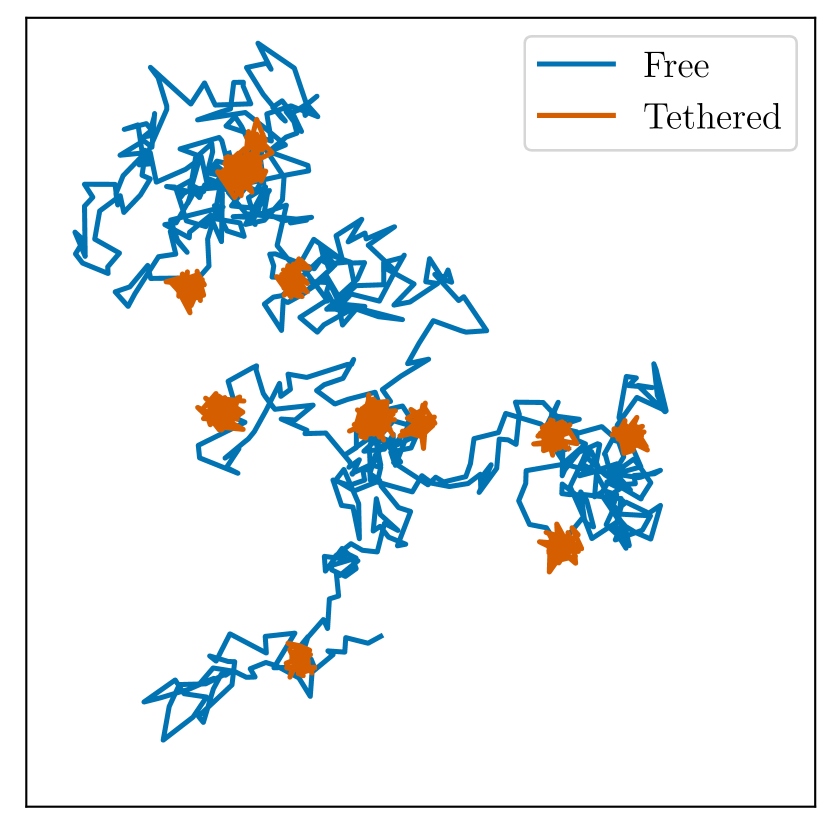
- 一時的テイターリングを、自由状態では正規拡散、テイターリング状態ではオルンシュタイン=ウーレンベック力学を示す2状態連続時間マルコフ過程としてモデル化すること。
- 希なノイズの多い軌道データから、拡散係数、テイターリング/アンテイターリング率、有効閉じ込め領域を推定する計算的に効率的なアルゴリズムを開発すること。
- 初期化に強く、短時間および長時間のテイターリングを含むさまざまな物理的状態領域に適用可能であることを保証すること。
- 実験的データ解析に実用的に利用可能な、自由でオープンソースの実装を提供すること。
提案手法
- 観測された位置を可視変数、テイターリング状態(自由/テイターリング)を隠れ変数とする隠れマルコフモデルとしてシステムをモデル化する。
- テイターリング($\tau_0$)およびアンテイターリング($\tau_1$)イベントの待ち時間を指数分布でモデル化する連続時間マルコフ連鎖を用いる。
- テイターリング状態では、状態依存の調和ポテンシャルを有するオルンシュタイン=ウーレンベック過程を用い、その支配的比 $k/\gamma$ で記述する。
- 交互に最尤推定法によりモデルパラメータを更新するアルゴリズムを適用し、Viterbiに類似した探索により最も確率の高い隠れ経路を推定する。
- 全隠れ経路の和を、最も確率の高い経路の尤度に置き換えることで鞍点近似を実装し、計算複雑度を低減する。
- 遷移確率およびダイナミクスの調整により、他の拡散タイプや非ポアソン的テイターリングへの一般化を可能とし、必要に応じてトップ-K個の最も確率の高い経路への拡張をオプションで提供する。
![Figure 1: A snapshot of an experimental microscopy video of peptide-coated microparticles, in a system similar to that of Chakraborty et. al. [ 9 ] . The colored curve represents the top-right particle’s recorded trajectory in the 320 seconds preceding the snapshot. The trajectory is colored based o](https://ar5iv.labs.arxiv.org/html/2308.01100/assets/x1.png)
実験結果
リサーチクエスチョン
- RQ1テイターリングが直接観測できない状況下で、2次元単一粒子軌道から隠れマルコフモデルが一時的テイターリング状態を効果的に推定できるか?
- RQ2さまざまなパラメータ領域において、アルゴリズムは拡散係数、テイターリング/アンテイターリング率、閉じ込め領域といった主要な物理的パラメータをどれほど正確に推定できるか?
- RQ3アルゴリズムは初期化に対してどれほど頑健で、ノイズやサンプリングレートの変動に対して感受的か?
- RQ4最も確率の高い経路を用いた鞍点近似は、全経路統合と比較して信頼性のあるパラメータ推定をもたらすか?
- RQ5最小限の修正で、非ポアソン的テイターリングや異常拡散に対しても本手法を一般化できるか?
主な発見
- アルゴリズムは、多様な物理的状態領域において、拡散係数、テイターリング/アンテイターリング率、閉じ込め領域といったすべてのモデルパラメータを高い精度で回復できた。
- 初期化に強く、初期パラメータの初期値にかかわらず一貫した性能を示した。
- 時間刻み $\Delta t$ がテイターリング状態の緩和時間と同等またはそれ以上であっても、アルゴリズムは正確な推定を維持し、ダウンサンプリングによっても精度が保たれた。
- トップ-K経路拡張(K=100まで)は推定精度に顕著な改善をもたらさず、最も確率の高い経路は概ね類似しており、テイターリング/アンテイターリング時間の微小な摂動の違いにとどまった。
- 一部のケースでは、短時間のテイターリングまたは自由状態の間隔が存在しないことも正しく同定でき、統計モデルおよび軌道の特性と整合的であった。
より良い研究を、今すぐ始めましょう
論文の読解から最終レビューまで、研究時間を劇的に削減しましょう。
クレジットカード登録不要
このレビューはAIが作成し、人間の編集者が確認しました。