
[論文レビュー] High-efficiency single-photon source above the loss-tolerant threshold for efficient linear optical quantum computing
本論文は、可調整可能な開放マイクロ共振腔における共鳴励起された量子ドット単光子源を報告し、エンドツーエンドのシステム効率がロス耐性閾値を上回り、純度と同一性が高いことを示す。
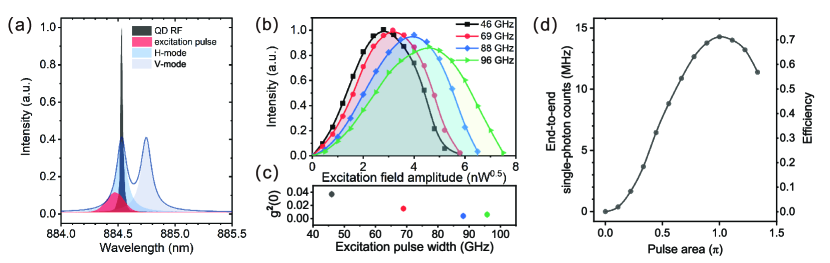
Photon loss is the biggest enemy for scalable photonic quantum information processing. This problem can be tackled by using quantum error correction, provided that the overall photon loss is below a threshold of 1/3. However, all reported on-demand and indistinguishable single-photon sources still fall short of this threshold. Here, by using tailor shaped laser pulse excitation on a high-quantum efficiency single quantum dot deterministically coupled to a tunable open microcavity, we demonstrate a high-performance source with a single-photon purity of 0.9795(6), photon indistinguishability of 0.9856(13), and an overall system efficiency of 0.712(18), simultaneously. This source for the first time reaches the efficiency threshold for scalable photonic quantum computing. With this source, we further demonstrate 1.89(14) dB intensity squeezing, and consecutive 40-photon events with 1.67 mHz count rate.
研究の動機と目的
- 高効率の単光子源で光子損失を克服し、スケーラブルな光子量子計算を推進する。
- 高純度・高同一性・高全体効率を同時に達成するオンデマンド単光子源を実証する。
- 得られた効率がフォールトトレラントな線形光学量子計算のためのロス耐性閾値を超えることを示す。
提案手法
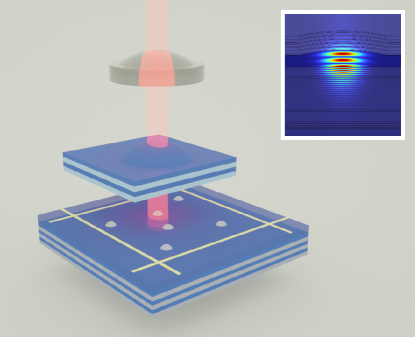
- 可調整可能な開放マイクロ共振腔にデターミスティックに結合した単一量子ドットを共鳴励起するよう、テーラー形状のレーザーパルス励起を用いる。
- 偏光選択励起と発光収集を可能にするモード分裂共振腔を用いる。
- 励起帯域を狭め、コヒーレントな量子ドットと共振腔の結合を最大化するために4fパルス整形を実装する。
- Hanbury Brown and Twiss (HBT) を用いて純度を測定し、非後選択的 Hong-Ou-Mandel (HOM) 干渉計で同一性を測定し、多光子イベントの補正を含む。
- エンドツーエンドの計数から検出器効率とリピートレートを考慮してシステム効率を定量化し、0.712(18)のベンチマークを達成する。
実験結果
リサーチクエスチョン
- RQ1量子ドット単光子源が高純度・高同一性・エンドツーエンド効率を同時に達成し、ロス耐性閾値を超えることができるか?
- RQ2開放型キャビティの可調性とパルス整形は共鳴励起効率と光子統計にどのような影響を与えるか?
- RQ3高効率・ほぼ変換限界の源に対して、時間遅延に伴う同一性の限界はどこにあるか?
主な発見
- 単光子純度0.9795(6)。
- 同一性0.9856(13)。
- システム効率0.712(18)。
- πパルス励起下での強度スクイージング1.89(14) dB。
- 1.67 mHzの計数率で40連続光子イベントを観測。
- スケーラブルな光子量子計算のためのロス耐性閾値を超えることの義務。
より良い研究を、今すぐ始めましょう
論文設計から論文執筆まで、研究時間を劇的に削減しましょう。
クレジットカード登録不要
このレビューはAIが作成し、人間の編集者が確認しました。