
[論文レビュー] How baryons appear in low-energy QCD: Domain-wall Skyrmion phase in strong magnetic fields
本稿は、強い磁場下における低エネルギーQCDにおけるモデルに依存しない解析的遷移を提案する:バリオン化学ポテンシャル μ_B ≥ μ_c ≈ 1.03 GeV のとき、手術的ソリトン格子(CSL)相がドメインウォールスカイリオン相に転移する。ソリトン表面に二次元のスカイリオンが出現し、内部が量子化され、電荷を帯びたパイオン凝縮に起因する持続的超電導電流を示す3次元バリオンとして振る舞う。これは、重イオン衝突で実現可能な新しいバリオン相を提供する。
Low-energy dynamics of QCD can be described by pion degrees of freedom in terms of the chiral perturbation theory(ChPT). A chiral soliton lattice(CSL), an array of solitons, is the ground state due to the chiral anomaly in the presence of a magnetic field larger than a certain critical value at finite density. Here, we show in a model-independent and fully analytic manner (at the leading order of ChPT) that the CSL phase transits to a {\it domain-wall Skyrmion phase} when the chemical potential is larger than the critical value $μ_{ m c} = 16πf_π^2/3m_π \sim 1.03 \;\; { m GeV}$ with the pion's decay constant $f_π$ and mass $m_π$, which can be regarded as the nuclear saturation density. There spontaneously appear stable two-dimensional Skyrmions or lumps on a soliton surface, which can be viewed as three-dimensional Skyrmions carrying even baryon numbers from the bulk despite no Skyrme term. They behave as superconducting rings with persistent currents due to a charged pion condensation, and areas of the rings' interiors are quantized. This phase is in scope of future heavy-ion collider experiments.
研究の動機と目的
- スカイリオン項に依存しない低エネルギーQCDにおけるバリオンの生成機構を理解すること。
- 強い磁場および有限なバリオン密度の下で、新たなバリオン相を同定すること。
- 高化学ポテンシャルにおける手術的ソリトン格子(CSL)からドメインウォールスカイリオン相へのモデルに依存しない解析的遷移を確立すること。
- 手術的異常および電荷を帯びたパイオン凝縮が、ソリトン表面に存在する二次元スカイリオンの安定化に果たす役割を明確にすること。
提案手法
- 電磁気的および手術的異常を含むパイオンの有効ラグランジアンを用いた、一階の手術的摂動理論(ChPT)における解析的導出。
- 中性パイオンの異常的磁場結合を通じてシン・ゴードン模型への写像を行い、ドメインウォール解を可能にする。
- 三次元のバリオン数密度をシン・ゴードンソリトン数および二次元のラムプ位相的荷重密度に分解する。
- メロモーフィック関数を用いてk-ラムプ配置を記述し、磁束およびスピノル構造に起因するエネルギー寄与を評価するためのWess-Zumino-Witten(WZW)項を計算する。
- ゴールドストーン=ウィルツェク電流を用い、有効作用における手術的異常と磁場結合を関連付ける。
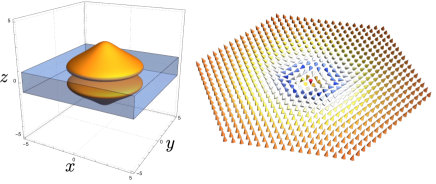
- エネルギー関数を評価し、バリオン数密度が二つの異なる位置でピークを示すことを示し、安定なスカイリオン的構造の形成を裏付ける。
実験結果
リサーチクエスチョン
- RQ1強い磁場および有限なバリオン密度の下で、スカイリオン項が存在しない低エネルギーQCDにおいて、バリオンはどのように生成されるか?
- RQ2高化学ポテンシャルにおける手術的ソリトン格子(CSL)から新たなバリオン相への相転移の性質は何か?
- RQ3ソリトン表面に二次元スカイリオンがどのように形成され、その位相的および物理的特徴は何か?
- RQ4電荷を帯びたパイオン凝縮は、これらの構造の安定化および持続的電流の発生にどのように寄与するか?
- RQ5この新しい相におけるバリオン数密度の分布はどのようなものか?また、スカイリオンコアの量子化はどのような要因によって決定されるか?
主な発見
- バリオン化学ポテンシャルが μ_c = 16πf_π²/(3m_π) ≈ 1.03 GeV を超えると、手術的ソリトン格子(CSL)相がドメインウォールスカイリオン相に転移する。これは核の飽和密度に対応する。
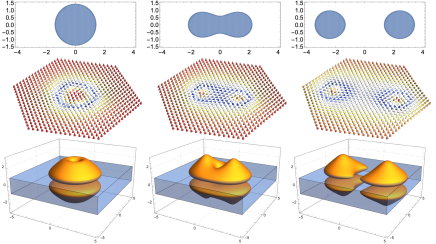
- 安定な二次元スカイリオン(ラムプ)がソリトン表面に自発的に形成され、位相的に安定で、量子化されたバリオン数を有する。
- スカイリオンはスカイリオン項が存在しないにもかかわらず、体積的観点からは三次元スカイリオンとして振る舞う。
- 電荷を帯びたパイオン凝縮に起因し、スカイリオン内部に量子化された磁束を持つ持続的超電導電流が存在する。
- バリオン数密度はz方向(ソリトン平面に垂直)に二重ピーク構造を示し、全積分値が2q(x,y)に一致する。これにより、スカイリオン荷重の二次元性が確認される。
- エネルギー関数は b_{k-1} = 0 を好む傾向を示しており、メロモーフィック関数で記述されるラムプの非一様性が最小となる状態が、最もエネルギーが低いスカイリオン状態であることを示唆する。
より良い研究を、今すぐ始めましょう
論文の読解から最終レビューまで、研究時間を劇的に削減しましょう。
クレジットカード登録不要
このレビューはAIが作成し、人間の編集者が確認しました。