
[論文レビュー] How FaR Are Large Language Models From Agents with Theory-of-Mind?
本稿では、大規模言語モデル(LLMs)が社会的状況における心の理論(ToM)の推論を戦略的行動に変換できるかを評価する新しいベンチマーク「Thinking for Doing(T4D)」を紹介する。また、将来の出来事の予測と行動の効果性の吟味に焦点を当てた、ゼロショットプロンプティングフレームワーク「Foresee and Reflect(FaR)」を提案し、GPT-4の性能をT4Dで50%から71%まで向上させた。これは、Chain-of-Thought や Self-Ask よりも顕著に優れている。
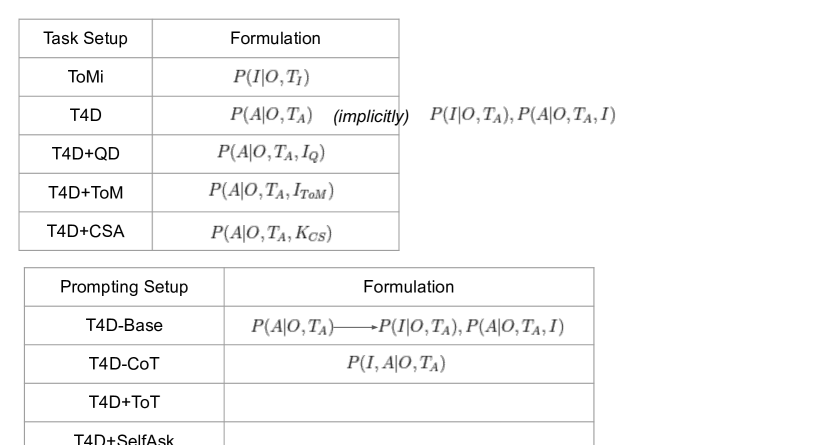
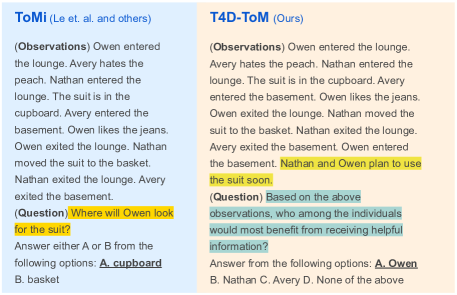
"Thinking is for Doing." Humans can infer other people's mental states from observations--an ability called Theory-of-Mind (ToM)--and subsequently act pragmatically on those inferences. Existing question answering benchmarks such as ToMi ask models questions to make inferences about beliefs of characters in a story, but do not test whether models can then use these inferences to guide their actions. We propose a new evaluation paradigm for large language models (LLMs): Thinking for Doing (T4D), which requires models to connect inferences about others' mental states to actions in social scenarios. Experiments on T4D demonstrate that LLMs such as GPT-4 and PaLM 2 seemingly excel at tracking characters' beliefs in stories, but they struggle to translate this capability into strategic action. Our analysis reveals the core challenge for LLMs lies in identifying the implicit inferences about mental states without being explicitly asked about as in ToMi, that lead to choosing the correct action in T4D. To bridge this gap, we introduce a zero-shot prompting framework, Foresee and Reflect (FaR), which provides a reasoning structure that encourages LLMs to anticipate future challenges and reason about potential actions. FaR boosts GPT-4's performance from 50% to 71% on T4D, outperforming other prompting methods such as Chain-of-Thought and Self-Ask. Moreover, FaR generalizes to diverse out-of-distribution story structures and scenarios that also require ToM inferences to choose an action, consistently outperforming other methods including few-shot in-context learning.
研究の動機と目的
- 大規模言語モデルが社会的状況における心の理論の推論を、実行可能な意思決定に橋渡しできるかを評価すること。
- 明示的なプロンプトなしで、暗黙の心の状態の推論に基づく行動を取れないLLMsの根本的課題を特定すること。
- ToMに基づく行動選択のための、ゼロショットプロンプティングフレームワークを設計すること。
- 提案手法の一般化能力を、標準的な誤り信念テストを超えた多様な物語構造と社会的状況においてテストすること。
提案手法
- モデルが物語ベースの社会的状況における推論された心の状態に基づいて適切な行動を選択する必要がある、ゼロショット評価パラダイム「T4D」を提案。
- ToMiベンチマークからの物語を観察-行動ペアに変換し、心の理論のテストに適した誤り信念構造を保持。
- 「FaR(Foresee and Reflect)」を導入。2段階の推論プロンプト:まず将来の出来事の予測(Foresee)、次に行動の効果性の評価(Reflect)。
- 構造化されたプロンプティングにより、モデルが暗黙の推論を特定し、行動の将来の結果を吟味したうえで行動を選択するよう誘導。
- アブレーションスタディを用いて、ForeseeおよびReflectの各コンponentの貢献を分離し、それらの必要性を検証。
- FaRを分布外の物語構造(D1, D2, D3)およびFaux Pasシナリオで評価し、標準的なToMi物語を超えた一般化能力をテスト。
実験結果
リサーチクエスチョン
- RQ1大規模言語モデルは、社会的状況における心の理論の推論を戦略的行動に変換できるか。それとも、正確な心の状態の推論ができても行動を取らないのか?
- RQ2推論が明示的にプロンプトされない場合、特に推論が暗黙のうちに存在する際、LLMsが行動選択において示す主な推論的ギャップは何か?
- RQ3FaRのような構造化された推論フレームワークは、心の理論を要する行動選択タスクにおけるゼロショット性能を向上させるか?
- RQ4FaRは、Faux Pasや多人称の対話など、多様な物語構造や社会的状況にどれほど一般化できるか?
- RQ5FaRは予測コンponentの品質にどれほど感受性を示すか。ノイズの多い入力は性能を低下させるか?
主な発見
- GPT-4はT4Dベンチマークで50%の正確性にとどまり、人間の性能(95%以上の一致)と比べて顕著なギャップを示しており、強力なToM推論を有しながらも行動選択に失敗していることを示している。
- LLMsの主な課題は、明示的なプロンプトなしで関連する暗黙の心の状態の推論を特定することであり、推論自体の能力の欠如ではない。
- FaRにより、GPT-4のT4D性能は50%から71%まで向上し、Chain-of-Thought、Self-Ask、Tree-of-Thoughtを顕著に上回った。
- アブレーションスタディの結果、ForeseeおよびReflectの両コンponentが不可欠であることが判明。それぞれを省いた場合、性能は17点および12点低下した。
- FaRは分布外の物語構造(D1, D2, D3)に対しても効果的に一般化し、全テストモデルおよび物語タイプで最高の正確性を達成した。
- Faux Pasシナリオでは、FaRはGPT-4で76%の正確性を達成し、ベースライン手法(例:Self-Askで43%)を大きく上回り、新規の社会的推論タスクへの強力な一般化能力を示した。
より良い研究を、今すぐ始めましょう
論文の読解から最終レビューまで、研究時間を劇的に削減しましょう。
クレジットカード登録不要
このレビューはAIが作成し、人間の編集者が確認しました。