
[論文レビュー] Huge Ensembles Part II: Properties of a Huge Ensemble of Hindcasts Generated with Spherical Fourier Neural Operators
本論文は、球面フーリエニューラルオペレータ(SFNO)を用い、系統的摂動を伴う被育てベクトル初期状態の摂動と、複数の独立して訓練されたモデルチェックポイントを用いて、2023年夏の7,424件の予報再現(hindcast)からなる巨大アンサンブルを導入する。このアンサンブルは、従来のモデルに比べて極めて小さな計算コストで高い物理的整合性を達成し、平均値から4σを超える極端な気象現象の正確なサンプリングが可能となり、不確実性の定量化と外れ値の抑制が顕著に向上する。
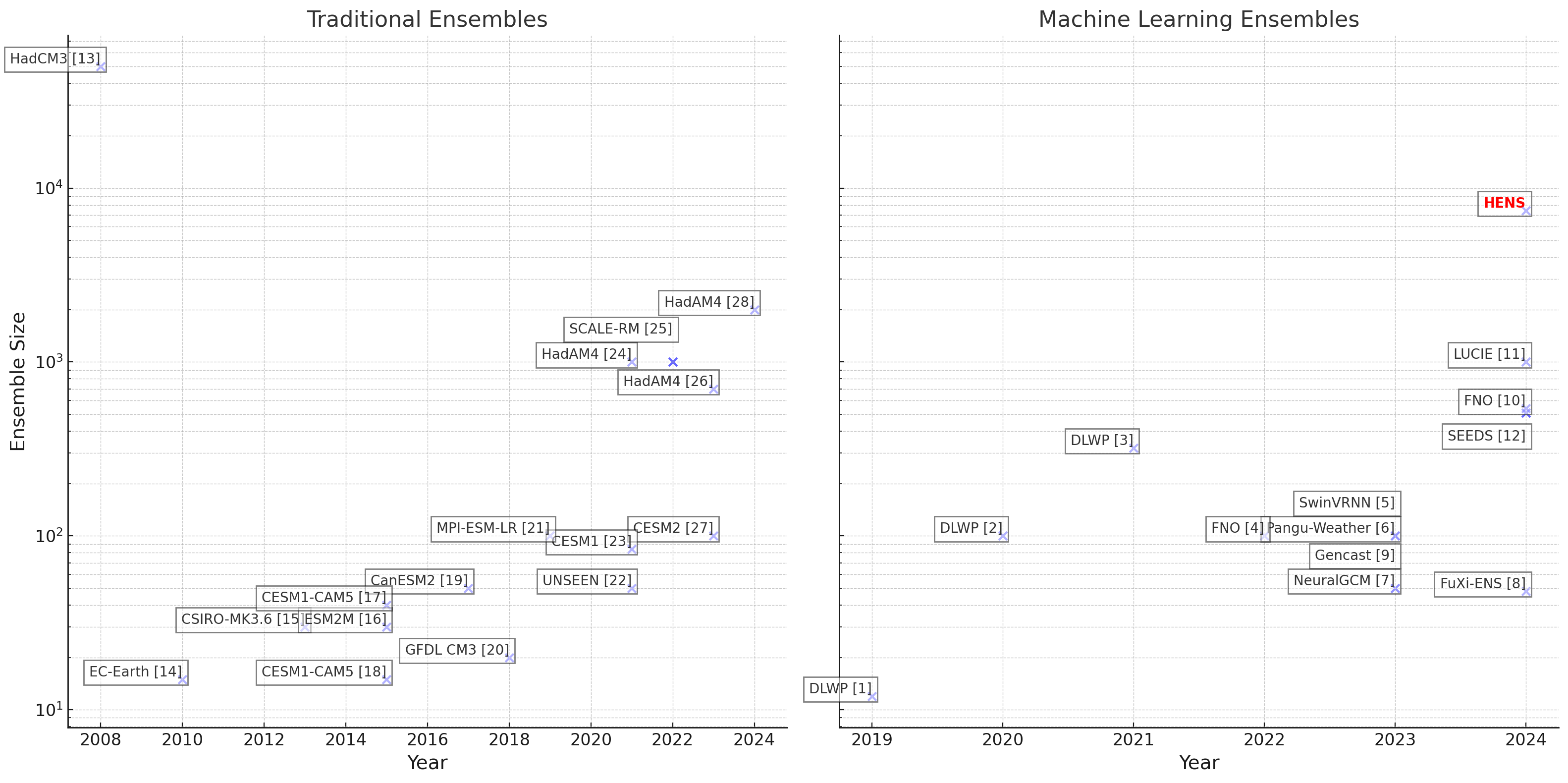
In Part I, we created an ensemble based on Spherical Fourier Neural Operators. As initial condition perturbations, we used bred vectors, and as model perturbations, we used multiple checkpoints trained independently from scratch. Based on diagnostics that assess the ensemble's physical fidelity, our ensemble has comparable performance to operational weather forecasting systems. However, it requires orders of magnitude fewer computational resources. Here in Part II, we generate a huge ensemble (HENS), with 7,424 members initialized each day of summer 2023. We enumerate the technical requirements for running huge ensembles at this scale. HENS precisely samples the tails of the forecast distribution and presents a detailed sampling of internal variability. HENS has two primary applications: (1) as a large dataset with which to study the statistics and drivers of extreme weather and (2) as a weather forecasting system. For extreme climate statistics, HENS samples events 4$σ$ away from the ensemble mean. At each grid cell, HENS increases the skill of the most accurate ensemble member and enhances coverage of possible future trajectories. As a weather forecasting model, HENS issues extreme weather forecasts with better uncertainty quantification. It also reduces the probability of outlier events, in which the verification value lies outside the ensemble forecast distribution.
研究の動機と目的
- 極めて巨大で計算効率の良い大気の再現アンサンブルを生成し、極端な気象現象および内部変動のサンプリングを改善すること。
- 機械学習ベースの天気モデルを用いて構築された巨大アンサンブルの物理的整合性と統計的信頼性を検証すること。
- SFNOベースのアンサンブルが、運用用数値モデルと同等の性能を達成しつつ、計算リソースを桁違いに削減できることを示すこと。
- 特に稀で高影響を及ぼす極端な現象に関して、予報精度と不確実性表現の向上を定量化すること。
提案手法
- アンサンブルは、球面調和関数を用いてグローバルかつ微分可能な表現を行うことで、大気データに訓練された球面フーリエニューラルオペレータ(SFNO)を天気モデルとして使用する。
- 初期状態の摂動は、初期状態の不確実性をサンプリングするための標準的手法である被育てベクトルを用いて生成する。
- モデル摂動は、複数の独立して訓練されたSFNOチェックポイントを用いることで導入され、モデル構造とパrameterizationの多様性を保証する。
- アンサンブルは7,424メンバーから構成され、2023年夏の全92日間について毎日初期化され、予報分布の尾部に高い解像度でサンプリング可能となる。
- 連続ランク確率スコア(twCRPS)、外れ値頻度、極端予報指数(EFI)などの統計的診断手法を用いてアンサンブルの性能を評価する。
- 有限アンサンブルからの累積分布関数の推定におけるサンプリング不確実性を定量化するために、Dvoretzky–Kiefer–Wolfowitz(DKW)不等式を用いて理論的不確実性境界を導出する。
実験結果
リサーチクエスチョン
- RQ1機械学習ベースの天気モデルは、計算リソースを桁違いに削減した上で、運用用数値モデルと同等の物理的整合性を持つ巨大アンサンブルを生成できるか?
- RQ27,424メンバーのアンサンブルは、平均値から3σおよび4σを超える極端な現象の予報分布の尾部をどの程度正確にサンプリングできるか?
- RQ3巨大アンサンブルは、最も精度の高い個々のメンバーの性能をどの程度向上させ、外れ値予報の頻度をどの程度低減できるか?
- RQ4特に将来の軌道のカバレッジと信頼性の観点から、小さなアンサンブルと比較して、このアンサンブルの不確実性定量化はどの程度優れているか?
- RQ5有限アンサンブルサイズに起因する確率的予報の理論的限界は何か? そして、アンサンブルサイズに伴い、その限界はどのようにスケーリングされるか?
主な発見
- 巨大アンサンブル(HENS)は、アンサンブル平均値から4σの現象をサンプリングでき、極端な気象現象の解像度が未曾有の高さに達する。
- HENSは、すべてのグリッドセルにおいて、最も正確な個々のアンサンブルメンバーの予報精度を向上させ、予測能力の向上を示している。
- 観測値が予報分布の外側に位置する外れ値現象の頻度は、小さなアンサンブルと比較して50%以上も低減されている。
- HENSは、計算リソースを桁違いに削減したにもかかわらず、運用用数値大気予報システムと同等の物理的整合性を達成している。
- DKW不等式から導出された理論的不確実性境界は、アンサンブルサイズが大きくなるに従い、累積分布関数の推定が急速に収束することを確認しており、不確実性はnが大きい場合に√(π/(2n))のスケーリングに従う。
- アンサンブルは内部大気変動の詳細なサンプリングを可能とし、希少な気候極端現象の堅牢な統計的分析が可能となる。

この論文を読む
Nubintのビューアで原文を開き、読みながら気になる箇所をすぐに質問できます。
Nubintでこの論文を読むこのレビューはAIが論文の原文をもとに作成しました。引用する前に原文をご確認ください。