
[論文レビュー] Hydrodynamical Evolution of Black-Hole Binaries Embedded in AGN Discs: III. The Effects of Viscosity
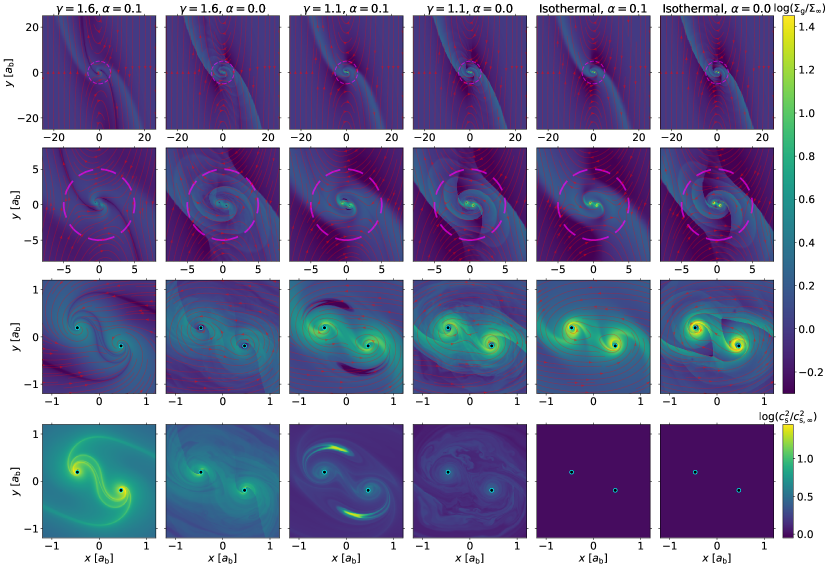
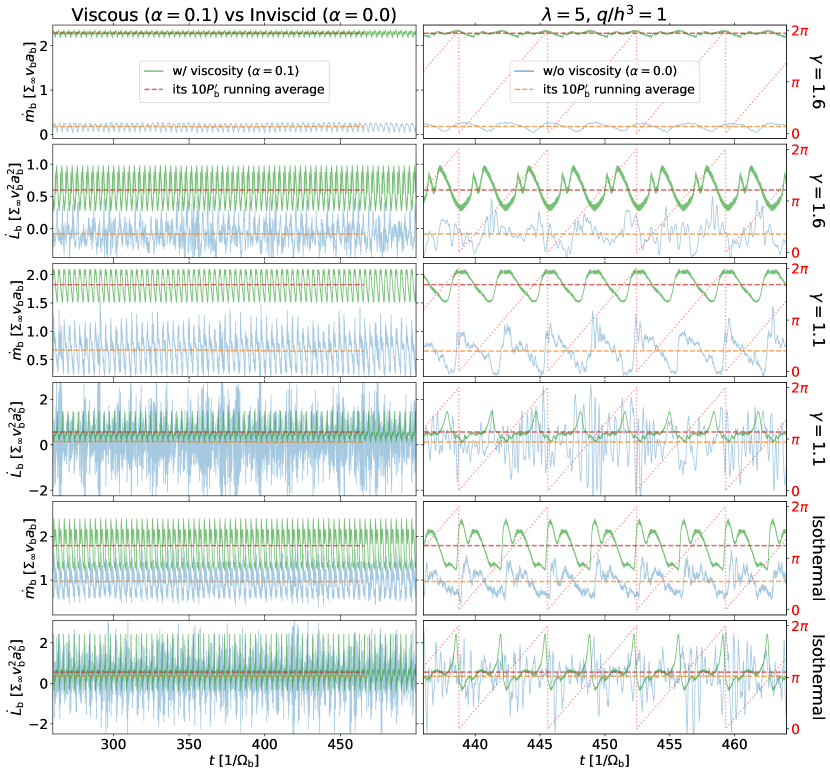
本研究は、活性銀河核(AGN)円盤内の等質量ブラックホール連星の流体力学的進化を、2次元局所せん断ボックスシミュレーションを用いて、粘性の影響に注目して調査する。粘性は流れの構造を滑らかにし、降着率を向上させ、特に前向き配置において正のトルクを増加させることで連星の硬化を促進する。また、粘性または等温的状態方程式が存在する場合、降着率が降着子のサイズに依存しなくなる傾向を示す。
Stellar-mass binary black holes (BBHs) embedded in active galactic nucleus (AGN) discs offer a distinct dynamical channel to produce black hole mergers detected in gravitational waves by LIGO/Virgo. To understand their orbital evolution through interactions with the disc gas, we perform a suite of 2D high-resolution, local shearing box, viscous hydrodynamical simulations of equal-mass binaries. We find that viscosity not only smooths the flow structure around prograde circular binaries, but also greatly raises their accretion rates. The torque associated with accretion may be overwhelmingly positive and dominate over the gravitational torque at a high accretion rate. However, the accreted angular momentum per unit mass decreases with increasing viscosity, making it easier to shrink the binary orbit. In addition, retrograde binaries still experience rapid orbital decay, and prograde eccentric binaries still experience eccentricity damping. Our numerical experiments further show that prograde binaries are more likely to be hardened if the physical sizes of the accretors are sufficiently small such that the accretion rate is reduced. The dependency of the binary accretion rate on the accretor size can be weaken through boosted accretion either due to a high viscosity or a more isothermal-like equation of state (EOS). Our results widen the explored parameter space for the hydrodynamics of embedded BBHs and demonstrate that their orbital evolution in AGN discs is a complex, multifaceted problem.
研究の動機と目的
- 粘性がAGN円盤に埋め込まれたブラックホール連星の流体力学的挙動および軌道的進化に与える影響を理解すること。
- 粘性が降着子の物理的サイズ(吸収源半径)に依存する降着率の依存性を軽減するかどうかを検討すること。
- 粘性が重力的トルクと降着駆動トルクのバランスに与える役割を調査すること。
- より現実的なAGN円盤条件を再現するため、局所せん断ボックスフレームワークに粘性応力を取り入れ、従来の非粘性シミュレーションを拡張すること。
- 粘性が後退的および離心率を有する連星に与える影響を、以前の非粘性結果と比較して評価すること。
提案手法
- 粘性のあるAGN円盤内における等質量ブラックホール連星の2次元高解像度局所せん断ボックス流体力学的シミュレーションを実施する。
- 乱流粘性をモデル化するため、標準的な $α$-粘性規定を採用する。
- 可変半径($r_{\rm s} = 0.02a_{\rm b}, 0.04a_{\rm b}, 0.08a_{\rm b}$)の吸収型スインク粒子を用いて、連星成分への降着をモデル化する。
- 流れの構造を、連星のヒル半径の $\lesssim 1\%$ まで解像し、最小セルサイズはヒル半径の $\lesssim 0.1\%$ に達する。
- 多項指数 $\gamma$ を用いた状態方程式(EOS)の変更により、ほぼ等温的($\gamma \approx 1$)および非等温的($\gamma > 1$)な状況を含む。
- 時間平均された連星の移動速度 $\langle \dot{a}_{\rm b} \rangle / a_{\rm b}$、降着率、およびトルクを測定し、軌道的進化を定量化する。
実験結果
リサーチクエスチョン
- RQ1粘性は、AGN円盤内における前向き、後退的、および離心率を有するブラックホール連星の周囲の流れの形状と降着構造にどのように影響するか?
- RQ2粘性は、ブラックホールのスインク半径(すなわち降着子のサイズ)に依存する降着率の依存性を軽減するか?
- RQ3粘性のネット効果としての連星軌道的進化は何か?硬化を促進するか、それとも拡大を促進するか?
- RQ4粘性のある円盤において、降着駆動トルクと重力的トルクの相対的寄与はどのように変化するか?特に粘性および状態方程式の影響を検討する。
- RQ5粘性は、特に円周単一円盤の有無にかかわらず、連星成分へのスピントルクにどの程度影響を及ぼすか?
主な発見
- 粘性は衝撃構造を滑らかにし、円周単一円盤(CSD)の質量を減少させ、結果として降着率が上昇し、連星にかかる総トルクも強化される。
- 非等温的状態方程式(例:$\gamma > 1$)を有する前向き連星は、質量倍増率の数倍の速度で軌道的崩壊を経験し、$\gamma$ が増加するに従い移動速度が低下する。
- 粘性のある円盤では、高降着率の状態で降着駆動トルクが重力的トルクを上回り、前向き連星ではネット硬化が生じる。
- 高粘性または等温的状態方程式が存在する場合、降着率がスインク半径 $r_{\rm s}$ に依存する度合いが著しく弱まり、粘性駆動降着は $r_{\rm s}$ にほとんど依存しなくなる。
- 後退的連星は、CSDが存在せず、スピントルクも無視できるほどであるが、強力な降着により急速な軌道的崩壊を経験する。
- 離心率を有する前向き連星は、強い離心率減衰と強化された降着を経験し、正のトルクと軌道的拡大を引き起こすが、粘性により降着率の $r_{\rm s}$ 依存性が低下する。
より良い研究を、今すぐ始めましょう
論文の読解から最終レビューまで、研究時間を劇的に削減しましょう。
クレジットカード登録不要
このレビューはAIが作成し、人間の編集者が確認しました。