
[論文レビュー] Hyperdimensional Computing for ADHD Classification using EEG Signals
The paper applies hyperdimensional computing with a spatio-temporal encoder to classify ADHD from resting-state EEG, achieving 88.9% accuracy, outperforming DNN benchmarks with far less training data.
Following the recent interest in applying the Hyperdimensional Computing paradigm in medical context to power up the performance of general machine learning applied to biomedical data, this study represents the first attempt at employing such techniques to solve the problem of classification of Attention Deficit Hyperactivity Disorder using electroencephalogram signals. Making use of a spatio-temporal encoder, and leveraging the properties of HDC, the proposed model achieves an accuracy of 88.9%, outperforming traditional Deep Neural Networks benchmark models. The core of this research is not only to enhance the classification accuracy of the model but also to explore its efficiency in terms of the required training data: a critical finding of the study is the identification of the minimum number of patients needed in the training set to achieve a sufficient level of accuracy. To this end, the accuracy of our model trained with only $7$ of the $79$ patients is comparable to the one from benchmarks trained on the full dataset. This finding underscores the model's efficiency and its potential for quick and precise ADHD diagnosis in medical settings where large datasets are typically unattainable.
研究の動機と目的
- Investigate ADHD classification from EEG using Hyperdimensional Computing (HDC).
- Develop a generalized spatio-temporal HDC encoder that can work across multiple patients without patient-specific training.
- Evaluate training data efficiency by identifying the minimum number of patients needed for competitive accuracy.
- Compare HDC performance against standard deep learning baselines (SVM, CNN, LSTM).
- Promote a lightweight, efficient diagnostic approach suitable for clinical settings.
提案手法
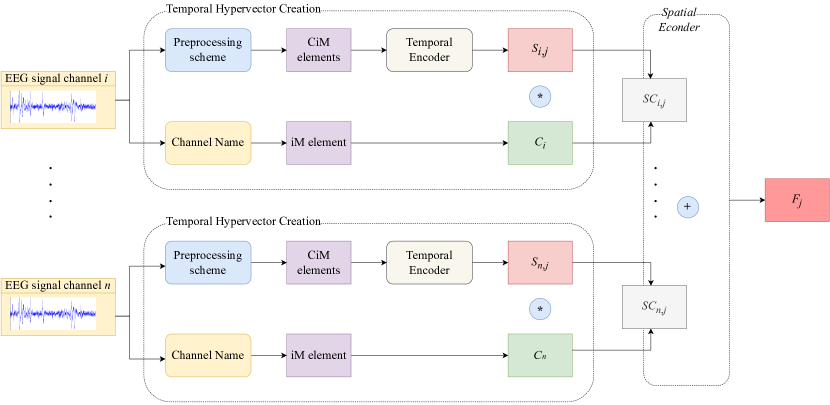
- Encode EEG signals into high-dimensional space using a two-part spatio-temporal encoder (spatial HV binding across channels and temporal n-gram HV permutation).
- Use an orthogonal channel-specific item memory (iM) and a continuous item memory (CiM) for quantizing signal levels.
- Create class prototypes in associative memory and classify by cosine similarity to prototypes (one-shot learning for prototypes).
- Partition data into train/test sets across all patients to enhance generalization rather than patient-specific training.
- Downsample EEG from 256 Hz to 32 Hz and segment into 1-second n-grams (32-dimensional HVs per n-gram) to capture temporal structure.
- Train with 59 patients and test with 20 patients, evaluating per-n-gram classifications and aggregating to per-patient decisions.

実験結果
リサーチクエスチョン
- RQ1Can HDC with a generalized spatio-temporal encoder achieve ADHD vs. control classification from resting-state EEG?
- RQ2Does HDC require fewer training samples than traditional DNNs to reach competitive accuracy?
- RQ3How does the proposed encoder handle spatial-temporal information to improve robustness and efficiency?
- RQ4How does HDC performance compare to SVM, CNN, and LSTM baselines on the same dataset?
- RQ5What preprocessing and data reduction steps are sufficient to retain diagnostic information for ADHD classification?
主な発見
| Model | Accuracy (%) | F1-Score | Precision | Recall |
|---|---|---|---|---|
| SVM-ADHD | 70.7±0.05 | 0.712±0.003 | 0.708±0.004 | 0.716±0.002 |
| CNN-ADHD | 71.4±0.01 | 0.720±0.002 | 0.715±0.003 | 0.727±0.001 |
| LSTM-ADHD | 72.2±0.01 | 0.731±0.003 | 0.729±0.002 | 0.733±0.003 |
| ADHDC | 88.9±0.02 | 0.875±0.004 | 0.850±0.005 | 0.904±0.003 |
- HDC-based ADHDC model achieved 88.9% accuracy on the test set, outperforming all three DNN benchmarks.
- ADHDC yielded 0.875 F1-score, 0.850 precision, and 0.904 recall on the ADHD vs. control task.
- Compared to SVM (70.7%), CNN (71.4%), and LSTM (72.2%), ADHDC provides substantially higher performance.
- The model was trained on 59 patients and tested on 20, indicating strong data efficiency.
- The approach demonstrates rapid training and low computational demands with minimal preprocessing.
より良い研究を、今すぐ始めましょう
論文設計から論文執筆まで、研究時間を劇的に削減しましょう。
クレジットカード登録不要
このレビューはAIが作成し、人間の編集者が確認しました。