
[論文レビュー] Identification of hadronic tau lepton decays using a deep neural network
本論文では、CMS検出器におけるヒッグス粒子崩壊や新しい物理現象探索におけるヒッグス粒子崩壊の識別性能を向上させるため、畳み込み層を用いて候補の周辺の全再構築粒子を準垂直断面積-方位角角度(η-φ)空間で処理する深層ニューラルネットワーク(DNN)ベースのアルゴリズム、DeepTauを提案する。この手法により、特定のバックグラウンド拒否率のもとで真のタウの効率が10–30%向上し、π⁰中間子を含む三本枝崩壊や、うまく再構築されないチャージドハドロンを含む、従来除外されていた崩壊モードの再構築も可能になる。
A new algorithm is presented to discriminate reconstructed hadronic decays of tau leptons ($τ_\mathrm{h}$) that originate from genuine tau leptons in the CMS detector against $τ_\mathrm{h}$ candidates that originate from quark or gluon jets, electrons, or muons. The algorithm inputs information from all reconstructed particles in the vicinity of a $τ_\mathrm{h}$ candidate and employs a deep neural network with convolutional layers to efficiently process the inputs. This algorithm leads to a significantly improved performance compared with the previously used one. For example, the efficiency for a genuine $τ_\mathrm{h}$ to pass the discriminator against jets increases by 10-30% for a given efficiency for quark and gluon jets. Furthermore, a more efficient $τ_\mathrm{h}$ reconstruction is introduced that incorporates additional hadronic decay modes. The superior performance of the new algorithm to discriminate against jets, electrons, and muons and the improved $τ_\mathrm{h}$ reconstruction method are validated with LHC proton-proton collision data at $\sqrt{s} =$ 13 TeV.
研究の動機と目的
- LHCにおける陽子-陽子衝突において、クォーク/グルーオンジェット、電子、ミューオンなどのバックグラウンド源からの真のハドロン的タウ崩壊(τh)の識別を改善すること。
- 従来の多変量解析(MVA)およびしきい値ベースの識別子がジェット、電子、ミューオンを別々に処理し、高レベルの入力変数のみを用いていたという制限を解消すること。
- 三本枝崩壊(π⁰中間子を含む)や部分的に再構築されないチャージドハドロンなど、追加のτh崩壊モードを含めることで再構築効率を向上させること。
- 空間的不変性を持つ畳み込み処理を用いて、一度にすべての主要なバックグラウンド源に対してτh候補を分類する統合的でエンドツーエンドのディープラーニングフレームワークを構築すること。
- 13 TeV LHC陽子-陽子衝突データを用いて新しいアルゴリズムの性能を検証し、信号効率とバックグラウンド拒否性能の両面で優れた性能を示すこと。
提案手法
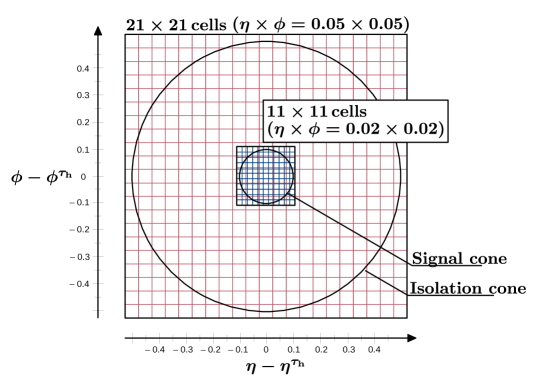
- 候補の周辺の全再構築粒子を準垂直断面積-方位角(η-φ)空間で処理する、畳み込み層を備えた深層ニューラルネットワーク(DNN)を採用し、平行移動不変性を活用する。
- 入力特徴量には、高レベル変数(例:横運動量の合計)と、τh軸に近い全粒子の原始的粒子レベル情報(例:pT、η、φ、電荷)を含める。
- 2次元畳み込み層を用いて、粒子のη-φ分布における局所的パターンを抽出し、空間的特徴抽出のための画像認識技術に類似した手法を採用する。
- ジェット、電子、ミューオンからの分類を同時に実行するための統合的分類目的関数を用いてDNNを学習する。
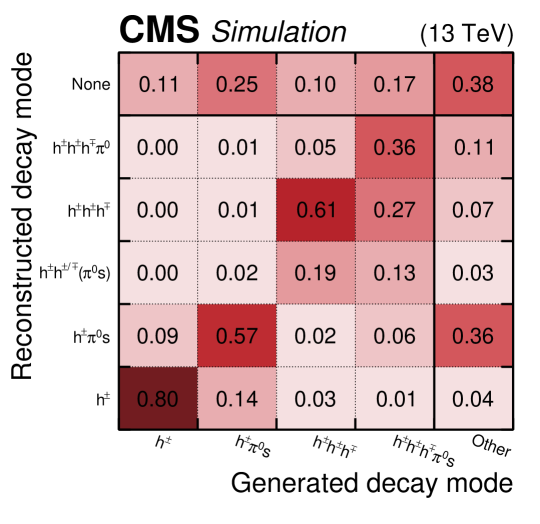
- π⁰中間子を含む三本枝τh崩壊(全τh崩壊の7.4%)および1つのチャージドハドロンがトラックやハドロンとして再構築されない場合を含む、新しい再構築チェーンにDNNを統合する。
- 実データでの検証前に、シミュレートされたイベントを用いてネットワーク構造と学習手順を最適化する。
実験結果
リサーチクエスチョン
- RQ1ジェット、電子、ミューオンのそれぞれに対して別々に処理していた従来の識別子と比較して、統合的ディープニューラルネットワークがハドロン的タウ崩壊の識別効率を向上させられるか?
- RQ2η-φ空間で畳み込み層を用いて、周囲の全再構築粒子を処理することで、バックグラウンド源からの識別性能がどの程度向上するか?
- RQ3従来除外されていたτh崩壊モード(π⁰中間子を含む三本枝崩壊や部分的に再構築されないチャージドハドロン)を含めた新しい再構築手法が、τh識別の全体的な効率と純度に与える影響は何か?
- RQ4固定されたバックグラウンド拒否率のもとで、DNNベースのDeepTauアルゴリズムを用いることで、従来のMVAベースの手法に比べて信号効率にどの程度の向上が得られるか?
- RQ5√s = 13 TeVの実LHC衝突データに適用した場合、新しいアルゴリズムはロバスト性と一貫性を保っているか?
主な発見
- DeepTauアルゴリズムは、従来のMVAベースの識別子と比較して、クォークおよびグルーオンジェットの拒否率を一定に保ったもとで、真のハドロン的タウレプトン崩壊の効率が10–30%向上した。
- DNNベースの手法は、密度の高い粒子入力を用いて複雑な非線形パターンを学習できるため、電子やミューオンを含むすべてのカテゴリでバックグラウンド拒否性能が顕著に向上した。
- π⁰中間子を含む三本枝τh崩壊および部分的に再構築されないチャージドハドロンの取り込みにより、従来見逃されていた崩壊モードが回復され、全体の再構築効率が向上した。
- 実13 TeV陽子-陽子衝突データを用いた検証により、実験的条件下でもアルゴリズムのロバスト性と従来手法を上回る性能が確認された。
- 周囲の粒子のη-φマップに畳み込み層を適用することで、従来の高レベル変数ベースの手法よりも、τh崩壊のトポロジー的特徴をより効果的に捉えることができた。
- DeepTauアルゴリズムは現在、CMSの分析チェーンに統合されており、ヒッグス粒子や新しい物理現象に関連するハドロン的タウ崩壊を含む探索において、感度の向上が実現されている。
より良い研究を、今すぐ始めましょう
論文の読解から最終レビューまで、研究時間を劇的に削減しましょう。
クレジットカード登録不要
このレビューはAIが作成し、人間の編集者が確認しました。