
[論文レビュー] Identifying and Explaining the Resilience of Ecological Networks
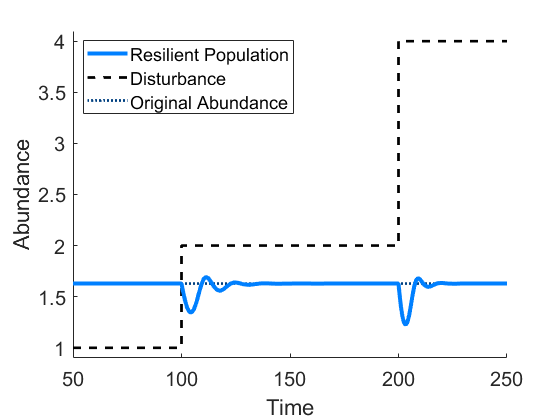
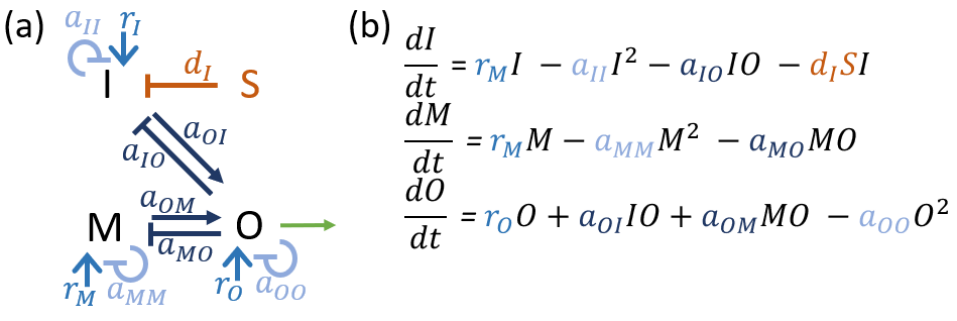
本研究では、生化学的レギュラトリーネットワークの手法を応用し、一般化されたロトカ=ヴォリエーラ枠組み下での三種相互作用生態ネットワークにおいて、撹乱後に種の豊度が正確に元の水準に戻る、強靭性(完全な適合性)を示す構造的メカニズムを同定・解明する。20,000以上の可能なネットワーク構造のうち23のネットワークがこの強靭性を示すことが判明し、逐次的一方向の相互作用と種内競争を含む構造的モチーフが、その主要なメカニズムであることが明らかになった。
Resilient ecological systems will be better able to maintain their structure and function in the emerging Anthropocene. Estimating the resilience of different systems will therefore provide valuable insight for conservation decision-makers, and is a priority goal of resilience theory. Current estimation methods rely on the accurate parameterisation of ecosystem models, or the identification of important motifs in the structure of the ecological system network. However, both of these methods face significant empirical and theoretical challenges. In this paper, we adapt tools developed for the analysis of biochemical regulatory networks to prove that a form of resilience - robust perfect adaptation - is a property of particular ecological networks, and to explain the specific process by which the ecosystem maintains its resilience. We undertake an exhaustive search for robust perfect adaptation across all possible three-species ecological networks, under a generalised Lotka-Volterra framework. From over 20,000 possible network structures, we identify 23 network structures that are capable of robust perfect adaptation. The resilient properties of these networks provide important insights into the potential mechanisms that could promote resilience in ecosystems, and suggest new avenues for measuring and understanding the property of ecological resilience in larger, more realistic socioecological networks.
研究の動機と目的
- 種の豊度が撹乱前の水準に正確に回復する、完全な適合性と呼ばれるレジリエンスを示す生態ネットワーク構造を同定すること。
- 動的パラメータに依存するのではなく、構造的性質に注目することで、生態モデルにおけるパrameter推定の困難さを克服すること。
- 生化学的反応ネットワーク理論からの手法を応用し、生態ネットワークにおけるレジリエンスの機構的基盤を解明すること。
- 完全適合性を示すネットワークモチーフが、社会的生態系における保全管理やエコシステム設計にどのように役立つかを検討すること。
- より大規模かつ現実的生態ネットワークにおける同様の強靭構造を同定する基盤を構築すること。
提案手法
- 一般化されたロトカ=ヴォリエーラ枠組み下で、すべての可能な三種生態ネットワークトポロジーを網羅的に調査した。
- グレブナー基底計算を含む代数的手法を用い、強靭な完全適合性を満たす解析的条件を特定した。
- 刺激に基づく撹乱モデルを用いて撹乱をシミュレートし、元の状態への回復行動を評価した。
- すべてのパrameter値に関わらず、対象となる種の豊度が正確に撹乱前の水準に戻るネットワークモチーフを同定した。
- 一方向相互作用の連鎖や種内競争項の含まれる、強靭なネットワークの構造的特徴を分析した。
- 数値シミュレーションによる結果の妥当性を検証し、完全適合性のダイナミクスの正確性と振動挙動の有無を確認した。
実験結果
リサーチクエスチョン
- RQ1一般化されたロトカ=ヴォリエーラモデル下で、どの三種生態ネットワーク構造が強靭な完全適合性を示すか?
- RQ2生態系において、強靭な完全適合性と一貫して関連する構造的特徴やネットワークモチーフは何か?
- RQ3一方向相互作用と種内競争は、完全適合性のメカニズムにどのように寄与しているか?
- RQ4すべての集団に同時に影響を与える撹乱が、強靭な完全適合性を支持できるか。その理由は何か?
- RQ5生化学的ネットワークで用いられる解析フレームワークは、生態ネットワークにおけるレジリエンス同定にどの程度適応可能か?
主な発見
- 20,000以上の可能な三種ネットワーク構造のうち、23のネットワークが強靭な完全適合性を示すことが同定された。
- すべての強靭なネットワークに、一方的相互作用の連鎖(ある種が他の種に影響を与えるが、逆に影響を受けない)が存在した。
- すべての強靭なネットワークに種内競争項が含まれており、振動ダイナミクスの安定化に重要な役割を果たした。
- すべての集団に直接影響を与える撹乱を伴うネットワークでは、完全適合性を達成できず、グローバルショックに対するバッファリングの限界が示された。
- 同定されたモチーフは非常に強い振動的挙動を示し、連続する確率的撹乱に対して脆弱性が高まった。
- グレブナー基底計算に基づく解析フレームワークは、正確なパラメータ値が不要であるにもかかわらず、レジリエンスを的確に同定でき、生態モデル化における主要な実務的課題を克服した。
より良い研究を、今すぐ始めましょう
論文の読解から最終レビューまで、研究時間を劇的に削減しましょう。
クレジットカード登録不要
このレビューはAIが作成し、人間の編集者が確認しました。