
[論文レビュー] Imaging inter-valley coherent order in magic-angle twisted trilayer graphene
この論文は走査トンネル顕微鏡法を用いて magic-angle twisted trilayer graphene (MATTG) における電子対称性破れを観察し、ドーピング依存の inter-valley coherent Kekulé オーダーとその非整数比螺旋変調を明らかにする。
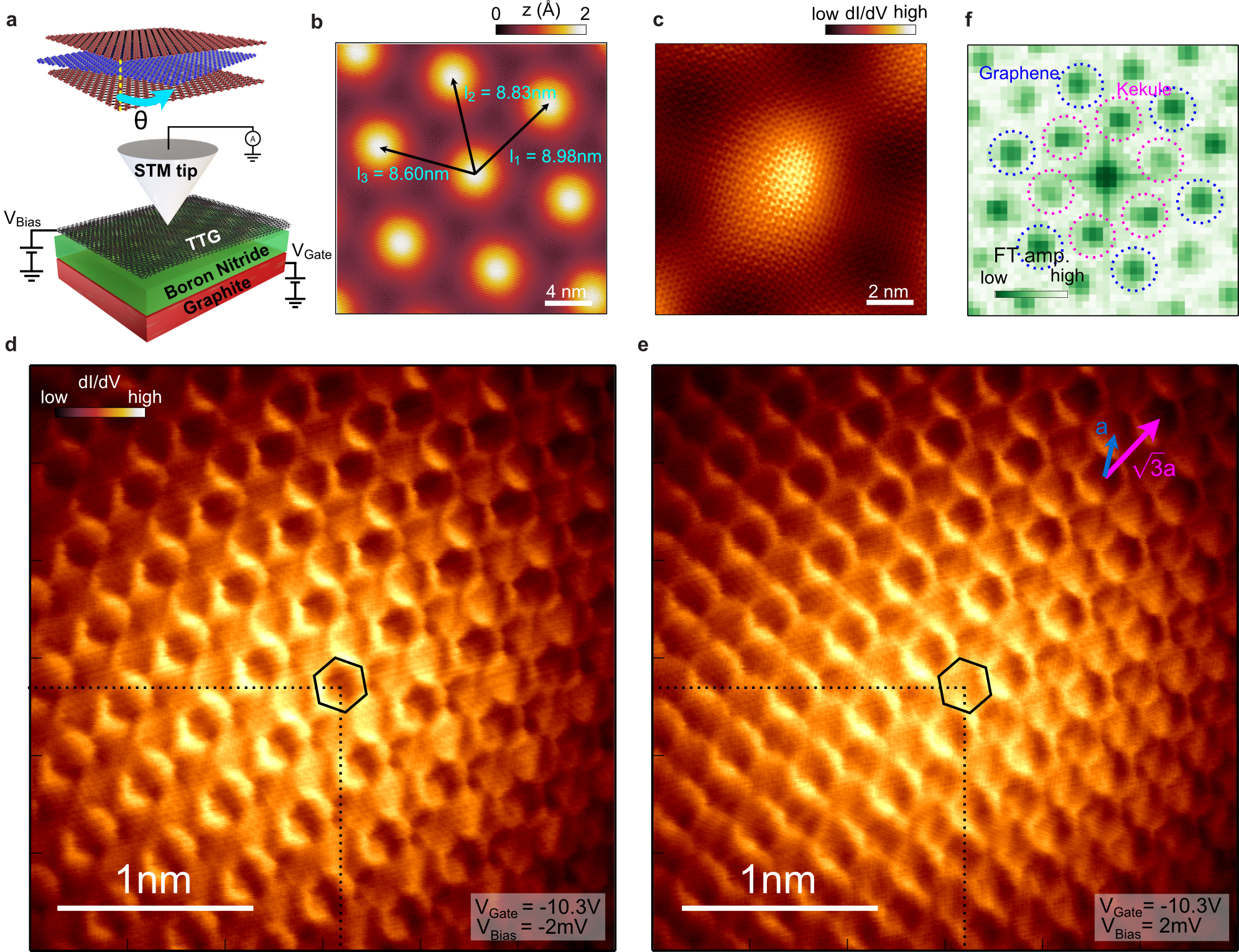
Magic-angle twisted trilayer graphene (MATTG) exhibits a range of strongly correlated electronic phases that spontaneously break its underlying symmetries. The microscopic nature of these phases and their residual symmetries stands as a key outstanding puzzle whose resolution promises to shed light on the origin of superconductivity in twisted materials. Here we investigate correlated phases of MATTG using scanning tunneling microscopy and identify striking signatures of interaction-driven spatial symmetry breaking. In low-strain samples, over a filling range of about 2-3 electrons or holes per moiré unit cell, we observe atomic-scale reconstruction of the graphene lattice that accompanies a correlated gap in the tunneling spectrum. This short-scale restructuring appears as a Kekulé supercell -- implying spontaneous inter-valley coherence between electrons -- and persists in a wide range of magnetic fields and temperatures that coincide with the development of the gap. Large-scale maps covering several moiré unit cells further reveal a slow evolution of the Kekulé pattern, indicating that atomic-scale reconstruction coexists with translation symmetry breaking at the much longer moiré scale. We employ auto-correlation and Fourier analyses to extract the intrinsic periodicity of these phases and find that they are consistent with the theoretically proposed incommensurate Kekulé spiral order. Moreover, we find that the wavelength characterizing moiré-scale modulations monotonically decreases with hole doping away from half-filling of the bands and depends only weakly on the magnetic field. Our results provide essential insights into the nature of MATTG correlated phases in the presence of strain and imply that superconductivity emerges from an inter-valley coherent parent state.
研究の動機と目的
- Magic-angle twisted trilayer graphene (MATTG) における対称性破れ電子相の実空間署名を同定する。
- IVC (inter-valley coherent) オーダーが STM データにどのように現れ、電子ギャップとどのように関連するかを特徴づける。
- Kekulé様オーダーの波数、ドーピング依存性、ひずみ感度を MATTG で決定する。
- 空間的変調と場/温度依存性を通じて可能な IVC シナリオ(T-IVC vs IKS)を区別する。
提案手法
- 高分解能の STM/dI/dV マッピングを、低ひずみの MATTG を magic angle 近傍の 1.60° で、ゲーティングを用いて filling ν を可変化させながら実施する。
- フーリエ解析を用いて Kekulé 型の単位セル拡大を同定し、FTスペクトルのサテライトピークから q_Kekulé を抽出する。
- Kekulé 自己相関と領域ごと FT フィルタリングを適用して、モアレースケール領域にわたる歪みの空間的進展を調べる。
- 観測された波数とパターンを理論的 IKS(非整数 Kekulé 螺旋)および T-IVC シナリオと比較し、異種ひずみを考慮する。
- ゲート電圧、バイアス電圧、温度、磁場の依存性を調べ、再構成の電子起源を確認する。
実験結果
リサーチクエスチョン
- RQ1MATTG は STM LDOS マップに Kekulé様の格子三重化を示す inter-valley coherent order を持つか,有証拠を示すか?
- RQ2波数 q_Kekulé とその filling、ひずみ、磁場依存性はどのようで、IKS 予測とどう比較されるか?
- RQ3ゼロ場サインと場依存性に基づいて、STM 測定は MATTG の IVC 相(IKS vs T-IVC)を区別できるか?
- RQ4異方性ひずみが観測された IVC 関連パターンとモアレ格子との可換性にどのように影響するか?
主な発見
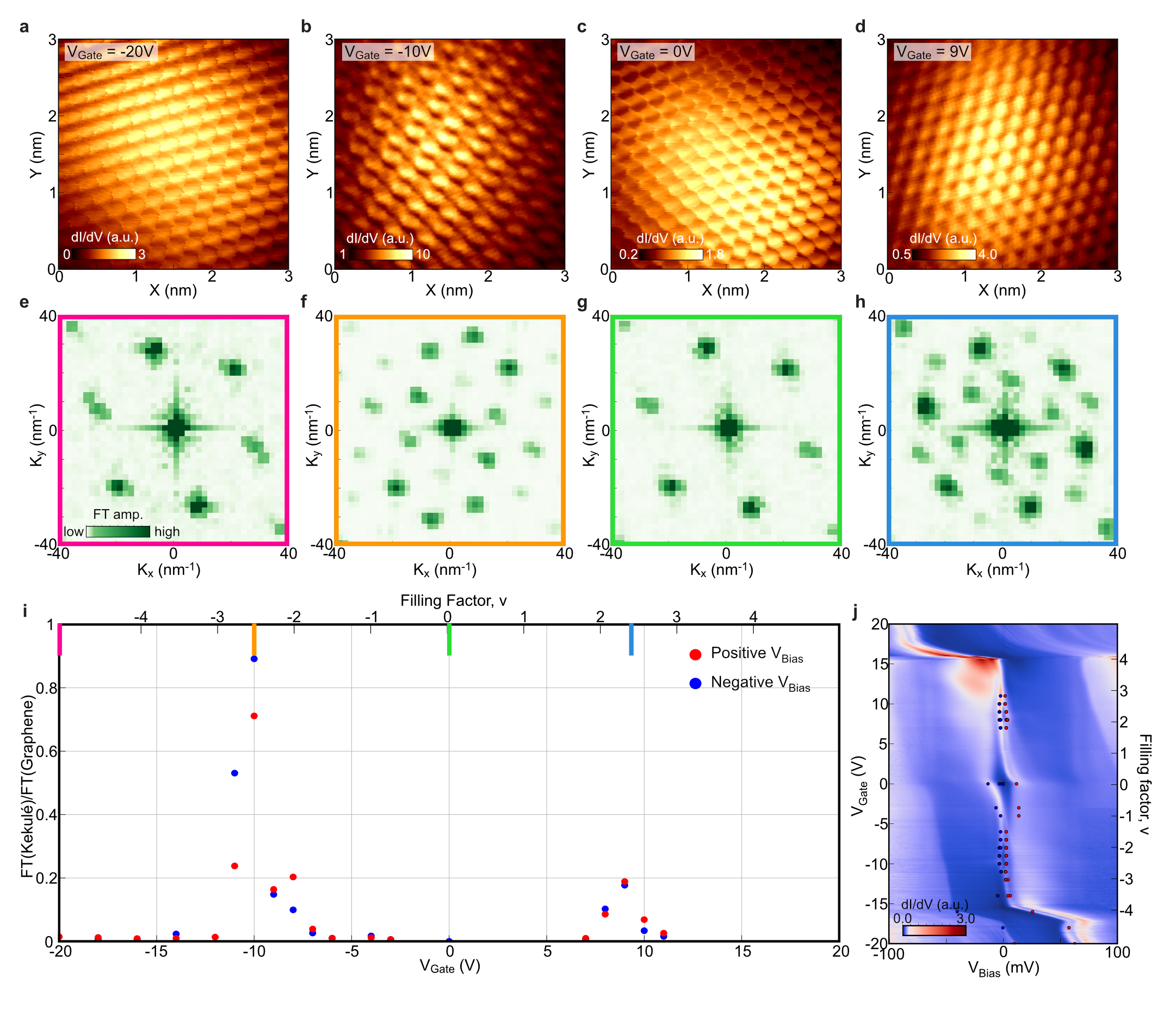
- Kekulé型の格子三重化パターンが、 fillings が -3<ν<-2 および 2<ν<3 のdI/dVマップに現れ、inter-valley coherenceを示唆する。
- Kekulé パターンは中性付近および遠縁バンドには現れず、その強度は相関ギャップと連動し、場と温度の範囲を越えて持続する。
- Fourier解析は Kekulé 変調波数 q_Kekulé を示し、モアレポテンシャルと一般に非整合で、ホールドーピングに伴って小さくなったり大きくなったりし、整合点付近でモアレブリル平方境界を横切る。
- 自己相関および FTフィルタ解析はモアレ単位セルスケールの並進対称性破れと、Kekuléパターンの数モアレ単位セルにわたるゆっくりとした進化を示し、IKS型オーダーと整合的である。
- 抽出された q_Kekulé は heterostrain を含めた IKS 理論と整合し、ホールドーピングに対する実験傾向とも一致し、MATTG における超伝導の親となる inter-valley nesting による螺旋秩序を支持する。
- 追加観察として、FT マップに条状の sash 特徴が見られ、C3 対称性の破れとグラフェン結合の方向性を示唆するネマティック傾向を charge neutrality 近傍で示唆する。
より良い研究を、今すぐ始めましょう
論文の読解から最終レビューまで、研究時間を劇的に削減しましょう。
クレジットカード登録不要
このレビューはAIが作成し、人間の編集者が確認しました。