
[論文レビュー] Implications of the NANOGrav results for primordial black holes and Hubble tension
論文はNANOGravの確率的重力波信号をインフレーション期に形成されたPBHと結び付け、PBH熱力学をGW周波数から導出し、PBH蒸発と実効ハッブル率をハッブル緊張と結び付ける。
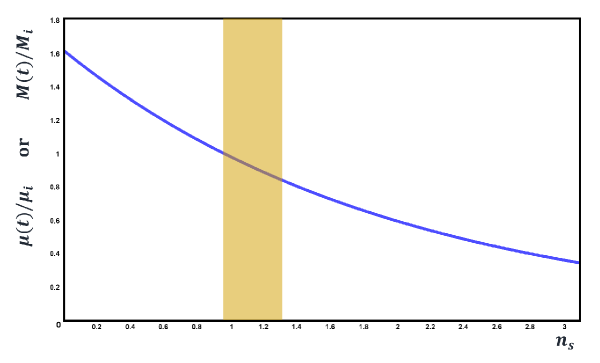
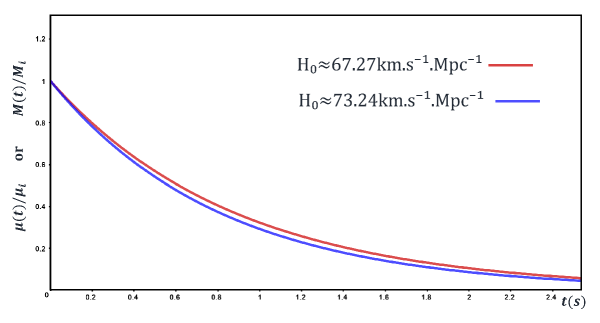
The purpose of this work is to investigate the formation and evaporation of the primordial black holes in the inflationary scenarios. Thermodynamic parameters such as mass, temperature and entropy are expressed in terms of NANOGrav frequency. By numerical calculations we show that the constraint on the mass range $10^{-5}kg-10^{50}kg$ is well confirmed. We discuss the relation between the redshift and the probability for gravitational wave source populations. A new parameter associated with the frequency and Hubble rate is presented, by which for the spectral index $n_{s}\approx 0.996$ and the Hubble constant $H_{0}\approx 67.27km.s^{-1}.Mpc^{-1}$, the effective Hubble constant is calculated to be $H_{eff,0}\approx 73.24km.s^{-1}.Mpc^{-1} $ which is compatible with the observational data. We make a comparison between the Hubble tension and the primordial perturbations and the expression of the mass loss rate, chemical potential and central charge needed to describe the Hawking evaporation will be established.
研究の動機と目的
- NANOGravの確率的GW信号とインフレーション中に形成されたPBHsとの関係を動機づける。
- PBHの熱力学量(質量、温度、エントロピー)をGW周波数の函數として表す。
- PBH形成と蒸発がインフレーション動力学とHubble tensionにどのように関連するかを調べる。
- GW周波数とHubble rateに結びつく新しいパラメータを導入し、H0測定を調和させる。
- PBH熱力学における化学ポテンシャルと中心電荷を用いたゲージ/重力双対性の観点を議論する。
提案手法
- PBH質量をGW周波数に関連付ける M ~ c^3/G · N/(16π^2 f) および f = PBHsの放出周波数 (Eq. 2.9).
- T ∝ 1/M でPBH温度を計算し、T = (2πħ f)/s および s = kB N (Eq. 2.6, 2.8) を通じてインフレーションの指数Nと結ぶ。
- ε_Hとηからスペクトル指数n_sを得るための遅いロー/インフレーションの枠組みを導出 (Eq. 3.5).
- 有効ハッブル率 H_eff = H + N H_f を定義し、それを n_s と宇宙データ (Eq. 3.6, 3.7) に関連づける。
- PBH質量喪失をHawking蒸発でモデル化し、それを進化するH_effと結びつける (Eq. 4.10–4.13).
- 化学ポテンシャル μ を中心電荷 C に共役させる開レイアウトのフレームワークを導入 (Eq. 5.2–5.4).
実験結果
リサーチクエスチョン
- RQ1インフレーション期に形成されたPBHsはNANOGravの確率的GW背景を説明できるか?
- RQ2PBH熱力学をGW周波数の函數として表現することは何を意味し、PBH質量と温度にどう影響するか?
- RQ3インフレーションとホログラフィックな枠組みは局所的およびCMB測定と整合する実効ハッブル定数を生み出すか?
- RQ4n_sはPBH物理とHubble tensionを結びつける上でどんな役割を果たすか?
主な発見
- PBH質量はGW周波数と逆比例のスケールで、f ≈ 5.5 nHz が分析で示唆されるPBH質量に対応 (Table 1 discussion).
- PBHsは非常に低温で、冷たい暗黒物質解釈と一致する。
- n_s ≈ 0.996 に対して実効ハッブル定数 H_eff,0 ≈ 73.24 km/s/Mpc が得られ、いくつかの局所測定と一致。
- n_s、H_eff,0、Nの間の関係を導出し、インフレーション擾動とHubble tensionの間の潜在的な結びつきを提供。
- 周波数依存の速度で定量化されるHawking蒸発による質量損失がPBHとH_effの進化に影響を与える。
- ホログラフィックな視点は化学ポテンシャル μと中心電荷 C を導入し、PBH熱力学を境界/体の双対性に結びつける。
より良い研究を、今すぐ始めましょう
論文設計から論文執筆まで、研究時間を劇的に削減しましょう。
クレジットカード登録不要
このレビューはAIが作成し、人間の編集者が確認しました。