
[論文レビュー] Improving Generative Model-based Unfolding with Schrödinger Bridges
SBUnfold は Schrödinger Bridges を用いて拡散ベースの生成マッピングを学習し、OmniFold と IcINN の長所を統合して展開を行い、合成 Z+jets データセットで最先端法に対してデータが限られた場合に特に性能が向上することを示す。
Machine learning-based unfolding has enabled unbinned and high-dimensional differential cross section measurements. Two main approaches have emerged in this research area: one based on discriminative models and one based on generative models. The main advantage of discriminative models is that they learn a small correction to a starting simulation while generative models scale better to regions of phase space with little data. We propose to use Schroedinger Bridges and diffusion models to create SBUnfold, an unfolding approach that combines the strengths of both discriminative and generative models. The key feature of SBUnfold is that its generative model maps one set of events into another without having to go through a known probability density as is the case for normalizing flows and standard diffusion models. We show that SBUnfold achieves excellent performance compared to state of the art methods on a synthetic Z+jets dataset.
研究の動機と目的
- 差分断面の機械学習ベースの展開を促進・改善するため、識別的モデルと生成的モデルの長所を組み合わせる。
- ソース密度が既知でなくてもマッピングできるように Schrödinger Bridges を用いて SBUnfold を開発する。
- Synthetic Z+jets データセット に対して SBUnfold を OmniFold および IcINN (cINN) と比較評価する。
- データ量の変動に対する頑健性とデータ効率を検証するため、データ利用可能性を変化させた場合の性能を評価する。
提案手法
- シュレディンガー橋と拡散モデルおよび SB 理論との関連を説明する。
- IcINN の E-ステップを Schrödinger Bridge ベースの輸送に置換して展開ワークフローに SB を統合する。
- 再構成レベル入力から生成器レベル分布へ向けて、検出器レベルの観測値をデノイズする拡散プロセスを用いる。
- 確率的サンプリングと決定論的 (ODE) サンプリングの枠を比較し、単純さのために決定論的変種を選択する。
- Pythia 生成のシミュレーションで学習し、Herwig ベースの疑似データセットに対する展開品質を EMD や三角判別器などの指標で評価する。
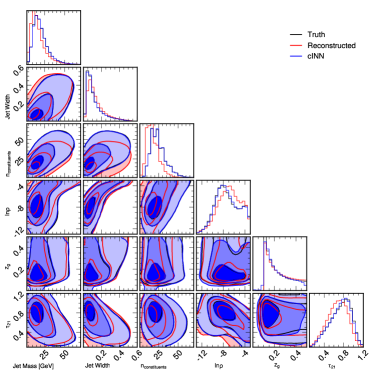
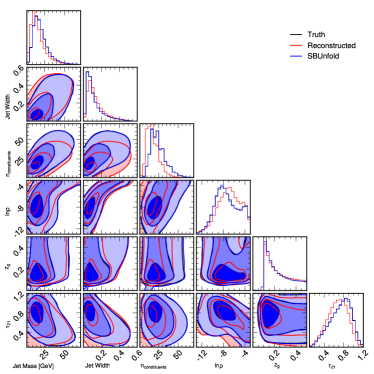
実験結果
リサーチクエスチョン
- RQ1シュレディンガー橋は、展開における検出器レベルとジェネレーター–レベルの分布間をデータ効率良く正確に輸送できるか。
- RQ2SBUnfold は OmniFold (データ駆動の E-ステップ) と IcINN (シミュレーション駆動の E-ステップ) の実用的長所を保持しつつ、それらの弱点を緩和できるか。
- RQ3データ利用可能性が異なる状況(データサンプルの削減など)で SBUnfold は cINN および OmniFold に対してどのような性能を示すか。
主な発見
- SBUnfold は、複数のジェット観測量において、unbinned earth mover’s distance (EMD) を一貫して低く抑え、しばしば三角判別値も lower にする。
- SBUnfold は鋭い特徴を持つ分布の再現性を改善し、再構成レベルイベントから推定された情報量豊富な事前分布の恩恵を受ける。
- データが乏しい場合において、OmniFold よりも頑健な性能を示し、データが限られる状況での劣化を緩和する。
- Herwig を疑似データとして用いた場合、SBUnfold はジェネレーター・レベル分布への一致度を cINN およびいくつかの場合で OmniFold よりも高く達成し、6つのジェット観測量に対して Step 1 での OmniFold を含む場合でも同様の傾向を示す。
- Migration マトリクスは SBUnfold が再構成イベントに対して小さく、対角寄りの補正を適用することを示しており、穏やかな展開を想起させる。
より良い研究を、今すぐ始めましょう
論文設計から論文執筆まで、研究時間を劇的に削減しましょう。
クレジットカード登録不要
このレビューはAIが作成し、人間の編集者が確認しました。