
[論文レビュー] Improving the open cluster census. II. An all-sky cluster catalogue with Gaia DR3
本研究では、Gaia DR3データとHDBSCANクラスタリングアルゴリズムを用いて、これまでで最も大きな全天オープンクラスターデータベースを構築した。7,167個の星集合が検出され、そのうち2,387個が文献に記載のない新規候補である。光度色図とベイズ分類を用いてクラスタを検証し、位置・年齢・減光量・距離を推定した。一方、Gaiaデータでの検出不能性により、多くの文献に記載されたクラスタが実在しない可能性が高いと判明した。
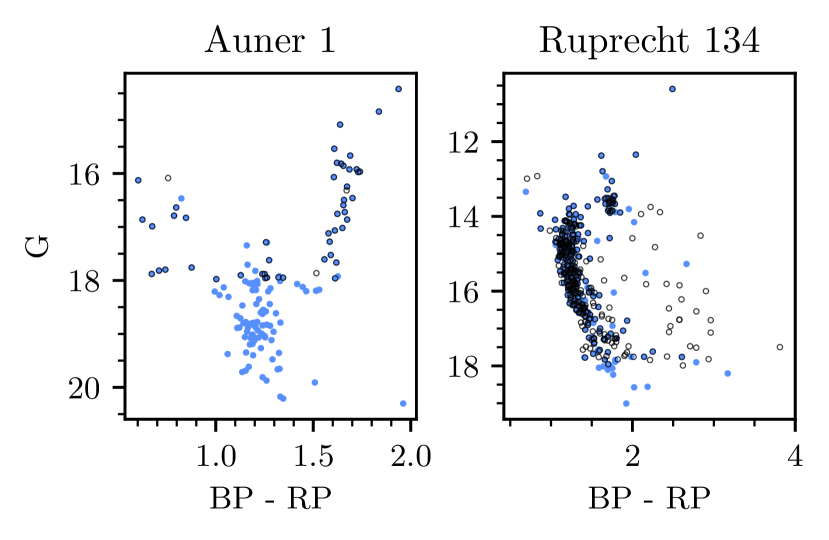
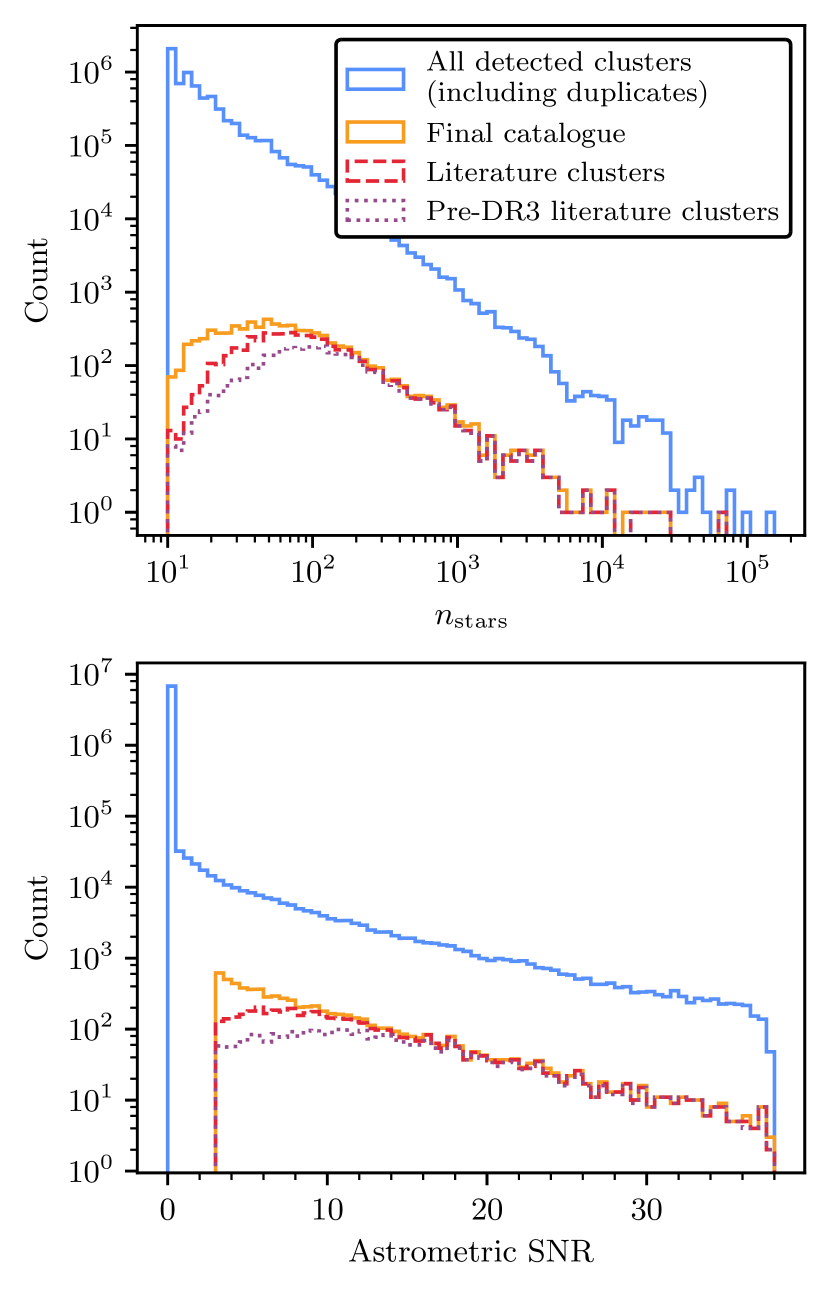
Data from the Gaia satellite are revolutionising our understanding of the Milky Way. With every new data release, there is a need to update the census of open clusters. We aim to conduct a blind, all-sky search for open clusters using 729 million sources from Gaia DR3 down to magnitude $G\sim20$, creating a homogeneous catalogue of clusters including many new objects. We used the Hierarchical Density-Based Spatial Clustering of Applications with Noise (HDBSCAN) algorithm to recover clusters. We validated our clusters using a statistical density test and a Bayesian convolutional neural network for colour-magnitude diagram classification. We inferred basic astrometric parameters, ages, extinctions, and distances for the clusters in the catalogue. We recovered 7167 clusters, 2387 of which are candidate new objects and 4782 of which crossmatch to objects in the literature, including 134 globular clusters. A more stringent cut of our catalogue contains 4105 highly reliable clusters, 739 of which are new. Owing to the scope of our methodology, we are able to tentatively suggest that many of the clusters we are unable to detect may not be real, including 1152 clusters from the Milky Way Star Cluster (MWSC) catalogue that should have been detectable in Gaia data. Our cluster membership lists include many new members and often include tidal tails. Our catalogue's distribution traces the galactic warp, the spiral arm structure, and the dust distribution of the Milky Way. While much of the content of our catalogue contains bound open and globular clusters, as many as a few thousand of our clusters are more compatible with unbound moving groups, which we will classify in an upcoming work. We have conducted the largest search for open clusters to date, producing a single homogeneous star cluster catalogue which we make available with this paper.
研究の動機と目的
- Gaia DR3の7億2,900万個の天体(G ~ 20等まで)を用いて、全天にわたる盲目的なオープンクラスター探索を実施すること。
- 年齢、減光量、距離といった天体物理学的パラメータを推定した、一貫性があり統計的に検証された星集合のデータベースを構築すること。
- 従来報告されたオープンクラスターの信頼性を、Gaia DR3データにおける検出可能性をテストすることで評価すること。
- 統計的および光度的解析を用いて、束縛されたオープンクラスターと非束縛の移動群を区別すること。
- 高度なクラスタリングおよび機械学習技術を用いて、銀河系のオープンクラスターの網羅性と純度を向上させること。
提案手法
- HDBSCANアルゴリズムを用いて、全天にわたるGaia DR3の位置・距離および光度データに対して密度に基づく空間クラスタリングを実施した。
- 信頼性の低い測定を除外するため、Gaia天体に品質カットを適用し、高精度な位置・距離および光度測定に焦点を当てた。
- 空間的過剰密度の有意性を評価するための統計的密度検定を、クラスタ候補の検証に実装した。
- 色-等級図の分類にベイズ畳み込みニューラルネットワークを用い、クラスタ候補に信頼性スコアを割り当てた。
- ベイズ推論を用いて光度データに等時曲線をフィットさせ、クラスタパラメータ(年齢、減光量、距離)を推定した。
- 誤検出を除去し、メンバー割り当てリストを精緻化するための複数ステップのポストプロセッシングパイプラインを用い、潮汐尾の検出も含めた。
実験結果
リサーチクエスチョン
- RQ1銀河系に実際に存在するオープンクラスターの真の数は何か? そして、現在のデータベースにまだ検出されていないものはどれくらいあるのか?
- RQ2HDBSCANアルゴリズムは、高い感度と低い誤検出率で、全天にわたってオープンクラスターを信頼性高く回復できるか?
- RQ3なぜ多くのクラスターがGaia以前のデータベースに記載されているが、Gaia DR3データでは検出できないのか? これはそれらのクラスターの実在性にどのような含意をもたらすか?
- RQ4検出されたクラスターの多くは、渦巻き腕、湾曲、チリ分布といった銀河系構造をどれほどよくトレースしているか?
- RQ5Gaiaデータと光度的診断を用いて、束縛されたオープンクラスターと非束縛の移動群をどのように区別できるか?
主な発見
- 本研究では合計7,167個の星集合を回復したが、そのうち2,387個は文献に記載のない新規候補クラスタであった。
- 文献と照合した4,782個のクラスタのうち、ミレニアム・ウェイブ・スターチャンク(MWSC)データベースに記載された1,152個はGaia DR3で検出可能であるはずだったが、検出されなかった。これは、それらが実在のクラスタでない可能性を示唆している。
- きびしい基準を適用した4,105個のクラスタは非常に信頼性が高く、そのうち739個が新規であり、中央値のCMD分類スコアが0.5以上、SN比が5σ以上であった。
- データベースの空間的および年齢的分布は、銀河系の渦巻き腕、銀河の湾曲、チリ分布をよく再現しており、既知の銀河系の形状と整合的であった。
- 新しく検出された多くのクラスタは、束縛されたオープンクラスターではなく非束縛の移動群に適合する傾向が強く、今後のバーリアの定理を用いた力学的解析の必要性を示唆している。
- 本データベースは、Gaia以前に報告された多くのクラスタが実在しない可能性が高く、単に減光による検出困難さのためではなく、星の配置(アステリズム)や実在しないものである可能性を示している。
より良い研究を、今すぐ始めましょう
論文の読解から最終レビューまで、研究時間を劇的に削減しましょう。
クレジットカード登録不要
このレビューはAIが作成し、人間の編集者が確認しました。