
[論文レビュー] In-situ vs accreted Milky Way globular clusters: a new classification method and implications for cluster formation
本論文は、全エネルギーと角運動量のz成分を用い、[Al/Fe]比で補正することで、銀河の円盤に形成された(in-situ)か、付加された(accreted)かを分類する新しい手法を提案する。この手法は、in-situ および accreted のGCを効果的に分離し、空間的・運動的・化学的性質の顕著な違いを明らかにした。in-situ GCは円盤に似た分布を示し、[Fe/H] ≈ −1.3 から −1.0 の間で回転速度にスピンアップの兆候を示しており、これは約11.7–12.7 Gyr前、円盤形成期に形成されたことを示唆している。
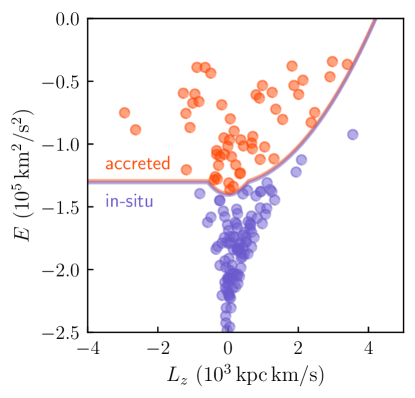
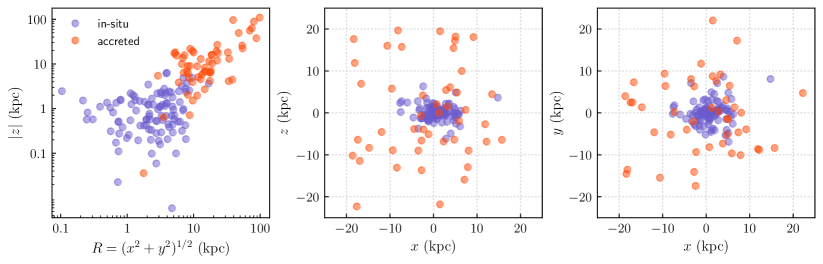
We present a new scheme for the classification of the in-situ and accreted globular clusters (GCs). The scheme uses total energy $E$ and $z$-component of the orbital angular momentum and is calibrated using [Al/Fe] abundance ratio. We demonstrate that such classification results in the GC populations with distinct spatial, kinematic, and chemical abundance distributions. The in-situ GCs are distributed within the central 10 kpc of the Galaxy in a flattened configuration aligned with the MW disc, while the accreted GCs have a wide distribution of distances and a spatial distribution close to spherical. In-situ and accreted GCs have different $ m [Fe/H]$ distributions with the well-known bimodality present only in the metallicity distribution of the in-situ GCs. Furthermore, the accreted and in-situ GCs are well separated in the plane of $ m [Al/Fe]-[Mg/Fe]$ abundance ratios and follow distinct sequences in the age--$ m [Fe/H]$ plane. The in-situ GCs in our classification show a clear disc spin-up signature -- the increase of median $V_ϕ$ at metallicities $ m [Fe/H]\approx -1.3÷-1$ similar to the spin-up in the in-situ field stars. This signature signals the MW's disc formation, which occurred $\approx 11.7-12.7$ Gyrs ago (or at $z\approx 3.1-5.3$) according to GC ages. In-situ GCs with metallicities of $ m [Fe/H]\gtrsim -1.3$ were thus born in the Milky Way disc, while lower metallicity in-situ GCs were born during early, turbulent, pre-disc stages of the evolution of the Galaxy and are part of its Aurora stellar component.
研究の動機と目的
- 全エネルギー(E)と軌道的角運動量のz成分(Lz)のみを用いて、銀河の円盤に形成された(in-situ)か、付加された(accreted)かを識別する、信頼性の高いデータ駆動型分類スキームの開発。
- [Al/Fe]比を用いて分類を補正し、形成環境やクラスター起源のトレーサーとしての役割を果たす。
- in-situ および accreted のGC集団の空間的・運動的・化学的差異を調査する。
- in-situ GCに観測された運動的傾向が、銀河の円盤形成期および初期進化段階とどのように関連しているかを解明する。
- 宇宙論的シミュレーション(FIRE-2)と照合することで、分類の妥当性を検証し、銀河形成モデルと整合性を確認する。
提案手法
- 分類は、ガウスデータに含まれる全エネルギー(E)と軌道的角運動量のz成分(Lz)に基づく。これらは、すべての銀河GCに対して利用可能である。
- 分類は、in-situ([Al/Fe]が高い)と accreted([Al/Fe]が低い)の区別に用いられる[Al/Fe]比を用いて補正される。
- クラスターは、E–Lz平面における位置に基づき、化学組成データから得られた意思決定境界を用いてin-situまたはaccretedに割り当てられる。
- 分類手法は、FIRE-2宇宙論的シミュレーションを用いてテストされ、観測データと比較してin-situおよびaccreted GCの半径分布および速度分布を検証する。
- 特にω Cen や NGC 6273 などの異常を示すクラスターに対しては、[Mg/Fe]や[Al/Fe]などの追加の組成比を用いて分類を精緻化する。
- 統計的妥当性評価により、in-situ クラスターの誤分類率は≤10%と推定され、既知の外れ値はカタログで明示されている。
実験結果
リサーチクエスチョン
- RQ1全エネルギーと角運動量のみを用いて、銀河の円盤に形成された(in-situ)か、付加された(accreted)かを信頼性を持って分類できるか?
- RQ2in-situ および accreted のGCの空間的・運動的・化学的性質にどのような差異があり、それらは定量的に評価できるか?
- RQ3in-situ GCは、特定の金属量における円盤形成の運動的兆候(例:回転速度のスピンアップ)を示すか?
- RQ4観測されたin-situおよびaccreted GCの分布は、銀河形成の宇宙論的シミュレーションの予測と整合性を示すか?
- RQ5[Al/Fe]や[Mg/Fe]などの組成比は、クラスターの起源を区別し、分類を精緻化するのにどの程度有効か?
主な発見
- in-situ GCは銀河中心の10 kpc以内に閉じ込められ、円盤に合わせた平坦な空間的分布を示す一方、accreted GCはほぼ球対称な分布を示す。
- in-situ GC集団は[Fe/H]で二峰性の金属量分布を示し、ピークは[Fe/H] ≈ −1.3 から −1.0 の間にあるが、accreted 集団は一峰性で金属量が低い分布を示す。
- in-situ GCは明確なスピンアップの兆候を示す:中央値Vϕは[Fe/H] ≈ −1.3 から −1.0 の間で増加し、in-situ の場星と観測された運動的傾向と一致する。
- 円盤形成の年齢は、in-situ GCのスピンアップのタイミングに基づき、約11.7–12.7 Gyr前(z ≈ 3.1–5.3)に制限される。
- in-situ および accreted GCは、[Al/Fe]–[Mg/Fe]組成平面で明確に分離しており、異なる形成環境を示す明確なシーケンスが存在する。
- 金属量をマッチングさせた場合、Milky Wayにおけるin-situおよびaccreted GCの半径分布および速度分布は、FIRE-2シミュレーションにおけるin-situおよびaccreted星粒子の分布とよく一致しており、GCがガス豊富かつ合体が頻発する時代に形成されたというモデルを支持する。
より良い研究を、今すぐ始めましょう
論文の読解から最終レビューまで、研究時間を劇的に削減しましょう。
クレジットカード登録不要
このレビューはAIが作成し、人間の編集者が確認しました。