
[論文レビュー] Inner-IoU: More Effective Intersection over Union Loss with Auxiliary Bounding Box
Inner-IoU は、IoU 損失を計算する際にスケーラブルな比率を持つ補助境界ボックスを導入し、既存の IoU ベースの損失と統合した場合に収束と一般化を改善します。
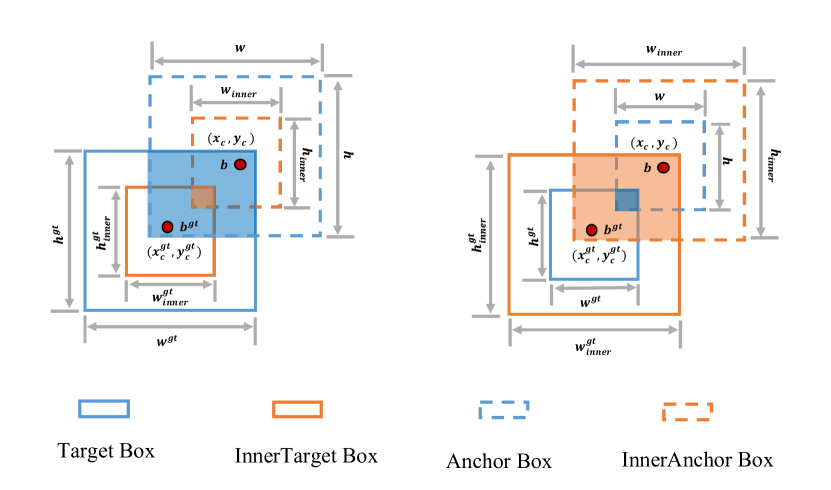
With the rapid development of detectors, Bounding Box Regression (BBR) loss function has constantly updated and optimized. However, the existing IoU-based BBR still focus on accelerating convergence by adding new loss terms, ignoring the limitations of IoU loss term itself. Although theoretically IoU loss can effectively describe the state of bounding box regression,in practical applications, it cannot adjust itself according to different detectors and detection tasks, and does not have strong generalization. Based on the above, we first analyzed the BBR model and concluded that distinguishing different regression samples and using different scales of auxiliary bounding boxes to calculate losses can effectively accelerate the bounding box regression process. For high IoU samples, using smaller auxiliary bounding boxes to calculate losses can accelerate convergence, while larger auxiliary bounding boxes are suitable for low IoU samples. Then, we propose Inner-IoU loss, which calculates IoU loss through auxiliary bounding boxes. For different datasets and detectors, we introduce a scaling factor ratio to control the scale size of the auxiliary bounding boxes for calculating losses. Finally, integrate Inner-IoU into the existing IoU-based loss functions for simulation and comparative experiments. The experiment result demonstrate a further enhancement in detection performance with the utilization of the method proposed in this paper, verifying the effectiveness and generalization ability of Inner-IoU loss. Code is available at https://github.com/malagoutou/Inner-IoU.
研究の動機と目的
- 標準 IoU 損失の限界を特定するため、境界ボックス回帰プロセスを分析する。
- 制御可能なスケール比を持つ補助境界ボックスを用いる Inner-IoU 損失を提案する。
- 検出器/データセット全体で、既存の IoU ベース損失と統合することで一般化を示す。
- 既存の IoU ベースの損失と比較して、より速い収束と改善された検出指標を示す。
提案手法
- 高 IoU サンプルと低 IoU サンプルに対する IoU ベース回帰のダイナミクスと勾配を分析する。
- 比率パラメータでスケールされた補助境界ボックスを用いて算出される Inner-IoU 損失を定義する。
- ratio < 1 が高 IoU サンプルの回帰に有利で、ratio > 1 が低 IoU サンプルの回帰に有利であることを示す。
- 既存の損失(L_Inner-GIoU, L_Inner-DIoU, L_Inner-CIoU, L_Inner-EIoU, L_Inner-SIoU)と L_Inner-IoU を統合する。
- 標準的な検出器/データセットでのシミュレーションと比較実験を実施して性能を評価する。
実験結果
リサーチクエスチョン
- RQ1スケール比を持つ補助境界ボックスは IoU ベースの境界ボックス回帰の収束速度を改善できますか?
- RQ2既存の IoU ベース損失と組み合わせた場合、Inner-IoU は検出器やデータセットを超えて一般化しますか?
- RQ3実践上、どの ratio 設定が高 IoU サンプルと低 IoU サンプルの回帰を最適化しますか?
- RQ4Inner-IoU を使用した場合、AP50 と mAP50:95 に検出可能な向上が示されますか?
主な発見
- Inner-IoU は高 IoU サンプルには小さめの補助ボックスを、低 IoU サンプルには大きめの補助ボックスを使用することで、より速い収束を達成します。
- CIoU および SIoU との統合は、評価設定でベースラインよりも高い AP50 および mAP50:95 を達成します。
- VOC で YOLOv7-tiny の場合、Inner-CIoU および Inner-SIoU が CIoU および SIoU のベースラインより AP50 および mAP50:95 の向上を示します。
- AI-TOD で YOLOv5s の場合、Inner-SIoU(ratio > 1)は SIoU と比較して AP50 および mAP50:95 を改善し、小さなターゲットへの頑健性を示します。
- シミュレーション結果は、高 IoU サンプル(ratio < 1)についてより速い収束、低 IoU サンプル(ratio > 1)について回帰の改善を示します。
- 本手法は検出器とピクセルサイズを跨いで強い一般化を示し、報告された実験で sota 相当の性能を達成します。

より良い研究を、今すぐ始めましょう
論文の読解から最終レビューまで、研究時間を劇的に削減しましょう。
クレジットカード登録不要
このレビューはAIが作成し、人間の編集者が確認しました。