
[論文レビュー] Interlayer Coupling Driven High-Temperature Superconductivity in La$_3$Ni$_2$O$_7$ Under Pressure
本論文はLa3Ni2O7の圧力下における二層t-Jモデルを導出し、層間結合 J_perp がd波対称性から層間s波対称性の結合へ転換を駆動し、Tc を劇的に上昇させ得ること、さらには中間パラメータ領域で s+id のTRSB 状態の可能性を示す。
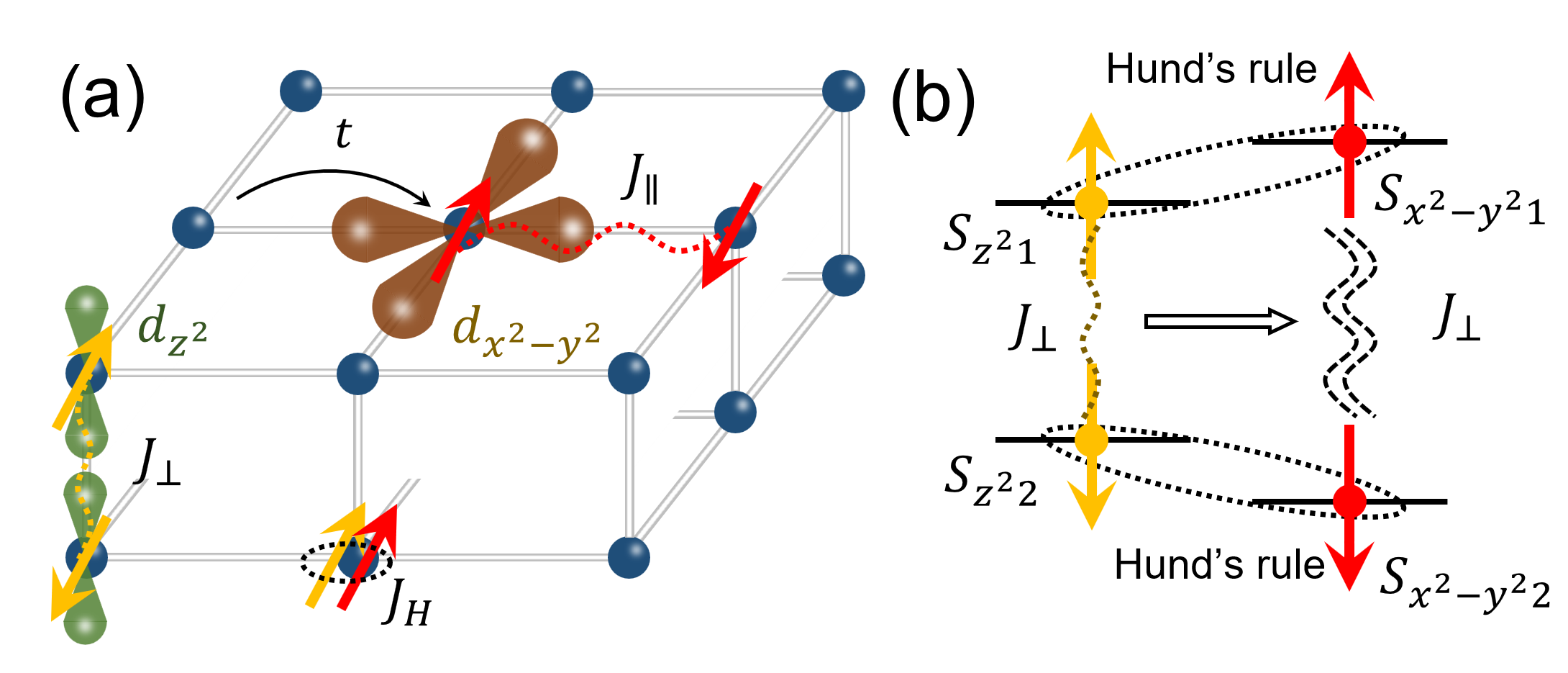
The newly discovered high-temperature superconductivity in La$_3$Ni$_2$O$_7$ under pressure has attracted a great deal of attentions. The essential ingredient characterizing the electronic properties is the bilayer NiO$_2$ planes coupled by the interlayer bonding of $3d_{z^2}$ orbitals through the intermediate oxygen-atoms. In the strong coupling limit, the low energy physics is described by an intralayer antiferromagnetic spin-exchange interaction $J_{\parallel}$ between $3d_{x^2-y^2}$ orbitals and an interlayer one $J_{\perp}$ between $3d_{z^2}$ orbitals. Taking into account Hund's rule on each site and integrating out the $3d_{z^2}$ spin degree of freedom, the system reduces to a single-orbital bilayer $t$-$J$ model based on the $3d_{x^2-y^2}$ orbital. By employing the slave-boson approach, the self-consistent equations for the bonding and pairing order parameters are solved. Near the physically relevant $\frac{1}{4}$-filling regime (doping $δ=0.3\sim 0.5$), the interlayer coupling $J_{\perp}$ tunes the conventional single-layer $d$-wave superconducting state to the $s$-wave one. A strong $J_{\perp}$ could enhance the inter-layer superconducting order, leading to a dramatically increased $T_c$. Interestingly, there could exist a finite regime in which an $s+id$ state emerges.
研究の動機と目的
- La3Ni2O7の圧力下における高Tc超伝導の理解を動機づけ、層間結合の役割を特定する。
- Ni 3d軌道間のHund’s rule結合を組み込んだ強く相関した二層モデルを構築する。
- 層間結合が結合対称性をd-waveから層間s-waveへ変化させ Tc を高め得ることを示す。
- 中間的なパラメータ領域でTRSBのs+id相が起こる可能性を予測する。
- 圧力下での実験的文脈および電子/ホールドーピ doping の可能性に理論的パラメータを関連づける。
提案手法
- H = H_parallel + H_perp を用いてNi系ユニットの二軌道二層t-J-J_Hモデルを構築する。
- 3d_z^2スピン自由度を消去して、3d_x2-y2スピン間の層間S=1/2交換 J_perpを有効化する。
- スレーブボゾン平均場理論を適用してスピノンとホロンをデカップリングし、ホロン縮退によりRVB結合からTcを与える。
- 層内および層間結合・対称化の秩序パラメータ(chiとDelta、Delta_zおよびDelta_x/yを含む)を導入し、自己無矛盾に解く。
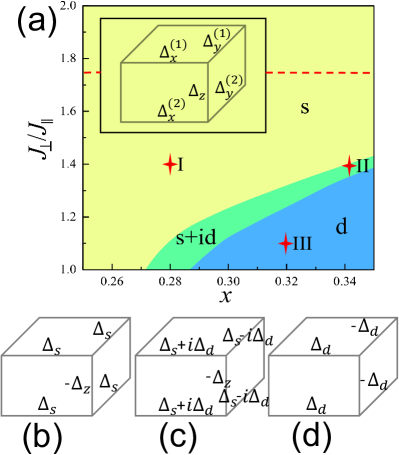
- 充填 x および比率 J_perp/J_parallel に対する基底状態の結合を解析し、s-wave, d-wave, およびs+id領域を写像する。
- 現実的な LNOパラメータ(J_perp/J_parallel ~ 1.75)を層間s-wave対称性の出現とTcの増大に結びつける。
実験結果
リサーチクエスチョン
- RQ1圧力下のLa3Ni2O7で層間結合 J_perp は超伝導を高めるか?
- RQ2層間比 J_perp/J_parallel は二層t-Jモデルの結合対称性にどう影響するか?
- RQ3Hund’s rule結合は層間相互作用を有効な層間結合チャネルへ伝達し得るか?
- RQ4TRSBのs+id結合が現れるパラメータ領域はあるか?
- RQ5現実的なLNOパラメータは圧力下でのTcと結合対称性に何を意味するか?
主な発見
- 層間結合 J_perp は関連するドーピング領域で単一層のd-wave結合を層間s-wave結合に変換する。
- Tc は J_perp/J_parallel の増加に伴い劇的に増加し、J_perp > J_parallel の場合に圧力下の高Tcと一致する。
- 現実的な LNO パラメータ(J_perp/J_parallel ≈ 1.75)の場合、結合は層間s-waveで Delta_z が Delta_x/y を支配する。
- パラメータ空間の狭い領域に、s-waveとd-wave領域の間にTRSBのs+id結合状態が存在する。
- 電子ドーピングは Tc をさらに高めると予測され、頂上酸素の欠陥(J_perpを低下させる)が超伝導を抑制する。
より良い研究を、今すぐ始めましょう
論文設計から論文執筆まで、研究時間を劇的に削減しましょう。
クレジットカード登録不要
このレビューはAIが作成し、人間の編集者が確認しました。