
[論文レビュー] Introduction to Arithmetic Coding -- Theory and Practice
この章は算術符号化を導入し、その理論、最適性、および固定精度算術、適応符号化、複雑性の考慮を含む実装面を扱います。
This introduction to arithmetic coding is divided in two parts. The first explains how and why arithmetic coding works. We start presenting it in very general terms, so that its simplicity is not lost under layers of implementation details. Next, we show some of its basic properties, which are later used in the computational techniques required for a practical implementation. In the second part, we cover the practical implementation aspects, including arithmetic operations with low precision, the subdivision of coding and modeling, and the realization of adaptive encoders. We also analyze the arithmetic coding computational complexity, and techniques to reduce it.
研究の動機と目的
- 算術符号化がエントロピー符号化に対してなぜ効果的であるか、そして多様なデータソースへの適用可能性を説明する。
- 区間と符号値を用いた基本的な算術符号化モデルを提示し、最適性と性質を強調する。
- 固定精度算術、適応符号化、同期の要件を含む実装上の側面を示す。
- 符号化とソースモデリングを分離する方法を示し、計算複雑性を分析する。)
- method_undefined
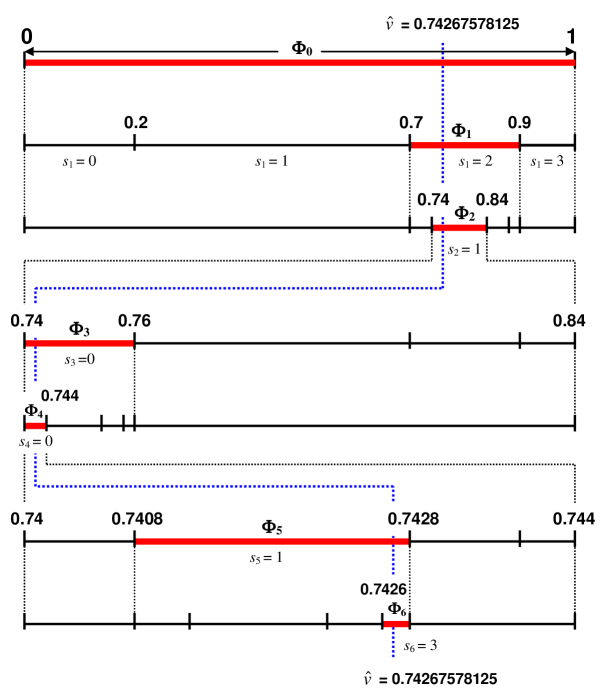
- Describe the encoding process using nested interval updates Phi_k(S) with base b_k and length l_k according to p(s_k) and c(s_k).
- Describe the decoding process using normalized code values to recover symbol sequence via c(s) and p(s) based on observed v.
- Discuss fixed-precision arithmetic and implementation considerations such as carries, renormalization, and output efficiency.
- Explain adaptive coding by updating probability distributions and maintaining synchronization between encoder and decoder (and the importance of exact same rules).
- Analyze arithmetic coding complexity including interval renormalization, symbol search, and cumulative distribution estimation.
提案手法
- データソース、確率、累積分布を定義して、区間ベースの符号化フレームワークを確立する。
- p(s_k)とc(s_k)に基づく基数b_kと長さl_kを用いたネストされた区間更新Phi_k(S)として符号化過程を説明する。
- 観測されたvに基づくc(s)とp(s)を用いて正規化された符号値を使い、シンボル列を復号する過程を説明する。
- キャリー、再正規化、出力効率など固定精度算術と実装上の考慮事項を説明する。
- 確率分布を更新して適応符号化を行い、エンコーダとデコーダの同期を維持する(同じ規則を厳密に共有する重要性)。
- 区間の再正規化、シンボル探索、累積分布の推定を含む算術符号化の複雑性を分析する。
実験結果
リサーチクエスチョン
- RQ1独立同分布(i.i.d.)ソースに対して算術符号化がどのように最適圧縮を達成し、適応的または非i.i.d.なソースに対してはほぼ最適な性能をどのように発揮するのか。
- RQ2固定精度と低複雑性を維持しつつ正確性を保持するための算術符号化の実装上の考慮事項と技術は何か。
- RQ3符号化とソースモデリングの分離が実世界の圧縮アプリケーションの設計と適応性にどのように影響するか。
- RQ4動的(時変)ソースを使用した場合にエンコーダ/デコーダの同期と正確性にどのような影響があるか。
主な発見
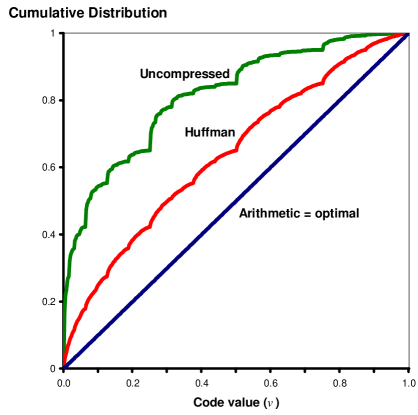
- 算術符号化は漸近的に最適な圧縮を実現し、平均ビット数はソースのエントロピーH(Ω)に近づく。
- コード値は区間[0,1)に一様分布特性を持つ場合、最適な符号化で効率的な表現と復号を可能にする。
- 符号化とソースモデリングには明確な分離があり、確率モデルと符号化エンジンの独立した開発を可能にする。
- エンコーダ/デコーダの同期は特に適応的・動的モデル化の下で正確性のために不可欠であり、同一の規則と精度を共有しなければならない。
- 区間の再スケーリングと固定精度戦略は、複雑性と精度の許容範囲内で実用的な実装を可能にする。
より良い研究を、今すぐ始めましょう
論文の読解から最終レビューまで、研究時間を劇的に削減しましょう。
クレジットカード登録不要
このレビューはAIが作成し、人間の編集者が確認しました。