
[論文レビュー] Investigation of the Anomalous and Topological Hall Effects in Layered Monoclinic Ferromagnet Cr$_{2.76}$Te$_4$
本研究では、強い磁気歪み異方性を示す層状強磁性体であるモノクロイン酸 Cr₂.₇₆Te₄ における異常およびトポロジカルホール効果を調査した。この系は、ずれ散乱に起因する大きな外部異常ホール効果を示し、強い異方性によって安定化される非平面スピン構造に起因する顕著なトポロジカルホール効果を示す。最大で約1.1 μΩ·cm のトポロジカルホール抵抗率が、50 K から150 K の間で観測された。
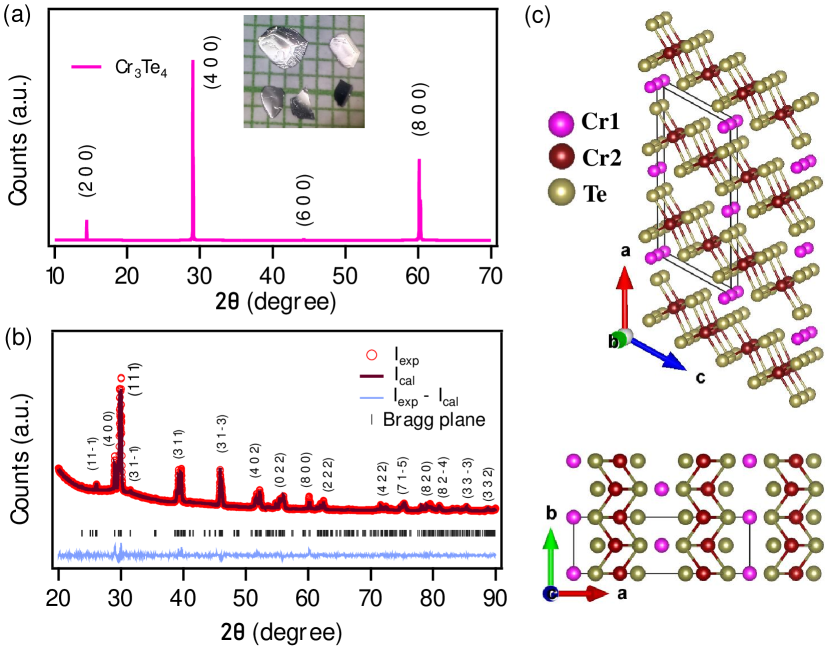
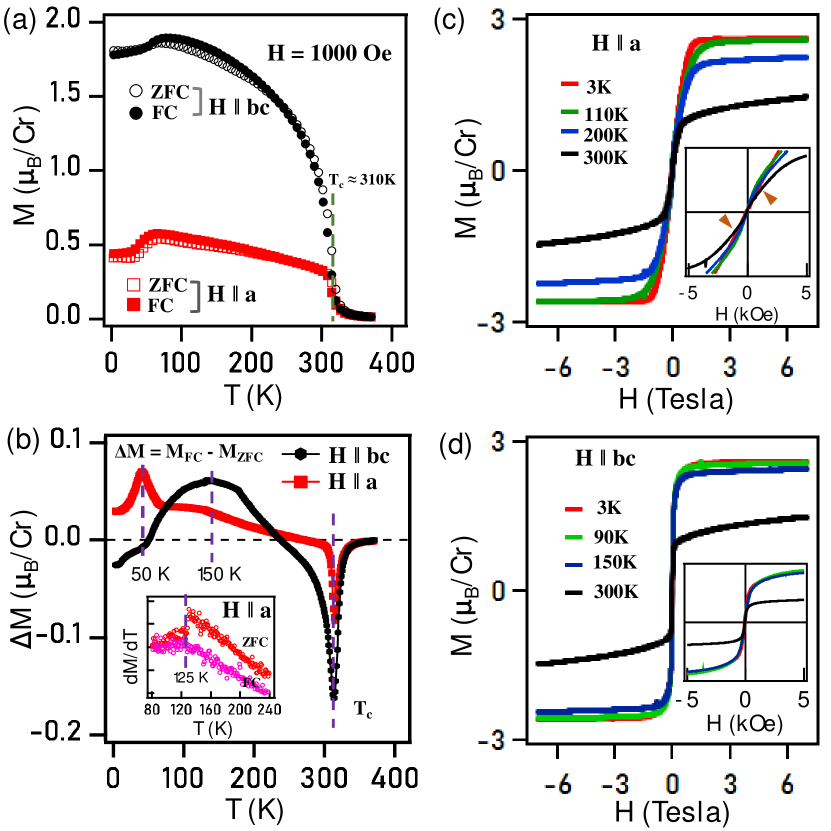
We studied the electrical transport, Hall effect, and magnetic properties of monoclinic layered ferromagnet Cr$_{2.76}$Te$_4$. Our studies demonstrate Cr$_{2.76}$Te$_4$ to be a soft ferromagnet with strong magnetocrystalline anisotropy. Below 50 K, the system shows an antiferromagnetic-like transition. Interestingly, between 50 and 150 K, we observe fluctuating magnetic moments between in-plane and out-of-plane orientations, leading to non-coplanar spin structure. On the other hand, the electrical resistivity data suggest it to be metallic throughout the measured temperature range, except a $kink$ at around 50 K due to AFM ordering. The Rhodes-Wohlfarth ratio $\frac{μ_{eff}}{μ_{s}}=1.89 (>1)$ calculated from our magnetic studies confirms that Cr$_{2.76}$Te$_4$ is an itinerant ferromagnet. Large anomalous Hall effect has been observed due to the skew-scattering of impurities and the topological Hall effect has been observed due to non-coplanar spin-structure in the presence of strong magnetocrystalline anisotropy. We examined the mechanism of anomalous Hall effect by employing the first principles calculations.
研究の動機と目的
- 2次元スピントロニクス材料の候補として、モノクロイン酸 Cr₂.₇₆Te₄ の電気的輸送、ホール効果および磁気的性質を調査すること。
- この層状強磁性体における異常ホール効果(AHE)およびトポロジカルホール効果(THE)の起源を特定すること。
- 磁気歪み異方性およびスピン揺らぎが、非平面スピン構造を安定化させる役割を明らかにすること。
- 磁気的および輸送測定に基づいて、Cr₂.₇₆Te₄ が移動電子的強磁性体であるかどうかを検証すること。
- 実験的ホール応答と、バルク曲率およびスピンテクスチャの第一原理計算の予測を照合すること。
提案手法
- 高品質な単結晶 Cr₂.₇₆Te₄ は、ヨウ素を輸送剤として用いた化学蒸発輸送法(CVT)により成長した。
- X線回折(XRD)およびリートベルト解析を用いて、モノクロイン酸結晶構造および相純度を確認した。
- 電気的抵抗率およびホール測定は、標準的な4端子法を用いて実施し、輸送およびホール応答を抽出した。
- 磁気測定は物理的性質測定システム(PPMS)を用いて実施し、飽和磁場、閉磁界、磁気異方性を決定した。
- 第一原理計算を用いて、フェルミ準位付近のバルク曲率を介した内在的 AHE 捕捉を評価した。
- 磁気歪み異方性エネルギー(Kᵤ)は、磁場依存磁化および抵抗率データから抽出し、トポロジカルホール応答と相関させた。
実験結果
リサーチクエスチョン
- RQ1Cr₂.₇₆Te₄ における大きな異常ホール効果の起源は何か。これは内在的か外部的か?
- RQ2中心対称で逆転対称性を欠くこのモノクロイン酸 CrₓTeᵧ 系で、トポロジカルホール効果は何かの原因によって生じるのか?
- RQ3磁気歪み異方性は、Cr₂.₇₆Te₄ における非平面スピン構造の安定化にどのように寄与するのか?
- RQ450–150 K の温度範囲において、スピン揺らぎが面内および面外方向のスピン配向に果たす役割は何か?
- RQ5実験的ホール応答は、バルク曲率およびスピンキラリティの第一原理予測とどのように一致するか?
主な発見
- Cr₂.₇₆Te₄ は、わずかな閉磁界および強い磁気歪み異方性を示すソフト強磁性体であり、磁化の容易軸は bc 平面に整列している。
- 50 K 未満では、抵抗率の急峻な変化および磁化率の変化により示される反強磁性的転移を示す。
- 50 K から150 K の間、Cr スピンモーメントは面内と面外の方向を動的に遷移しており、動的な非平面スピン構造を示している。
- 全測定温度範囲で電気的抵抗率は金属的であり、約50 K で反強磁性的転移に対応する急峻な変化を示す。
- 50–150 K の範囲で、トポロジカルホール抵抗率は最大で約1.1 μΩ·cm に達し、強いスピンキラリティおよび有限のバルク曲率を示している。
- 第一原理計算では、フェルミ準位付近の非ゼロバルク曲率に起因する内在的 AHE が予測されるが、実験的には外部的ずれ散乱メカニズムが支配的である。
より良い研究を、今すぐ始めましょう
論文の読解から最終レビューまで、研究時間を劇的に削減しましょう。
クレジットカード登録不要
このレビューはAIが作成し、人間の編集者が確認しました。