
[論文レビュー] JADES: A large population of obscured, narrow line AGN at high redshift
本研究はJWST/JADES深域分光測定においてz~10までの42個の狭線型AGN候補(タイプ-2)を同定し、ボリューム放射度L_bolが ≈10^41.3−10^44.9 erg s^-1、ホスト質量が ≈10^7.2−10^9.3 Msun、AGNホストの割合は約20%と推定し、UV光度と星形成傾向への寄与を示す。
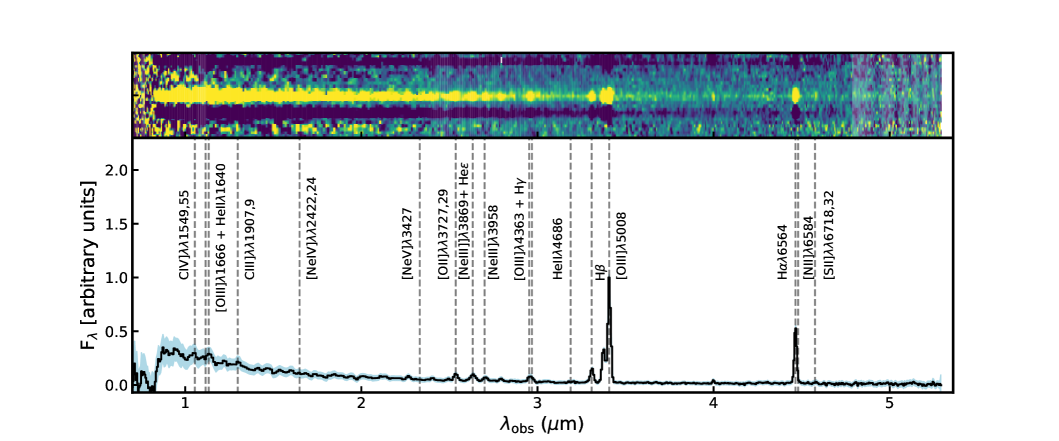
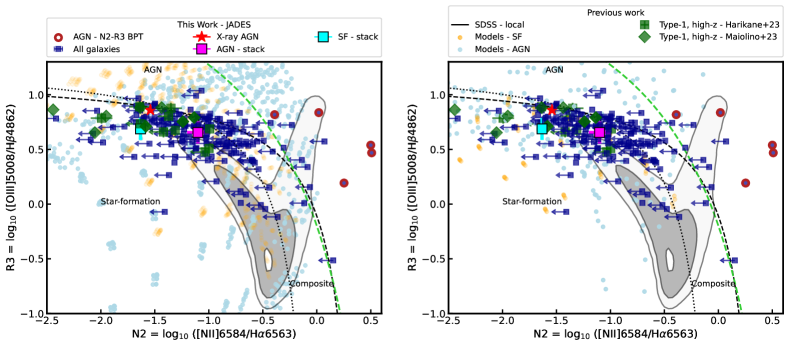
We present the identification of 42 narrow-line active galactic nuclei (type-2 AGN) candidates in the two deepest observations of the JADES spectroscopic survey with JWST/NIRSpec. The spectral coverage and the depth of our observations allow us to select narrow-line AGNs based on both rest-frame optical and UV emission lines up to z=10. Due to the metallicity decrease of galaxies, at $z>3$ the standard optical diagnostic diagrams (N2-BPT or S2-VO87) become unable to distinguish many AGN from other sources of photoionisation. Therefore, we also use high ionisation lines, such as HeII$λ$4686, HeII$λ$1640, NeIV$λ$2422, NeV$λ$3420, and NV$λ$1240, also in combination with other UV transitions, to trace the presence of AGN. Out of a parent sample of 209 galaxies, we identify 42 type-2 AGN (although 10 of them are tentative), giving a fraction of galaxies in JADES hosting type-2 AGN of about $20\pm3$\%, which does not evolve significantly in the redshift range between 2 and 10. The selected type-2 AGN have estimated bolometric luminosities of $10^{41.3-44.9}$ erg s$^{-1}$ and host-galaxy stellar masses of $10^{7.2-9.3}$ M$_{\odot}$. The star formation rates of the selected AGN host galaxies are consistent with those of the star-forming main sequence. The AGN host galaxies at z=4-6 contribute $\sim$8-30 \% to the UV luminosity function, slightly increasing with UV luminosity.
研究の動機と目的
- JADESサーベイの深いJWST/NIRSpecスペクトルからz~12までの深部でタイプ-2AGNを同定する。
- 低金属量と高イオン化パラメータを前提としたUVおよび光学線ダイアグノスティクスを用いて高赤方偏移のAGNと星形成銀河の診断を再評価する。
- Feltre 2016; Gutkin 2016; Nakajima 2022の光電離モデルでAGN選定を較正する。
- AGNとホスト銀河の特性(ボリューム放射度、星形成質量、SFR)を推定する。
- AGNホストがUV光度関数に与える寄与と赤方偏移とともなる変化を評価する。
提案手法
- PRISMおよび複数波長グ레이卜を用いた2つのJADESプログラム(1210 & 3215)による深いJWST/NIRSpec分光。
- pPXFによる連続体および発光線のフィッティング、線群間の運動学を統合し、多重ラインのフラックス比を固定。
- BEAGLEによるSEDフィッティングで、遅延指数SFHとChabrier IMFの下での stell ar質量とSFRを推定。
- 高イオン化UV線(例:Ne IV, Ne V, N V)やUV/光学線を用いて、伝統的なBPT診断を超えた高 z でのAGNを同定。
- 観測された線比を光電離モデル格子(Feltre+2016; Gutkin+2016; Nakajima+2022)と比較し、AGNと星形成領域を区分。
- 必要な線について3σ検出を採用し、N2-R3、S2-R3、He IIベースのダイアグラムなど複数の診断を統合してAGNを選定。
実験結果
リサーチクエスチョン
- RQ1高赤方偏移銀河のうち狭線型(タイプ-2)AGNの割合はどれくらいで、赤方偏移(z≈2–10)とともにどう進化するか。
- RQ2低金属量と高イオン化パラメータがある状況で、rest-frame UVおよび光学線ダイアグノスティクスを用いて高赤方偏移のAGNを星形成銀河と信頼性よく区別できるか。
- RQ3高-zのAGN狭線領域は金属量とイオン化パラメータ全体にわたる光電離モデル予測とどう比較されるか。
- RQ4これらの高赤方偏移型タイプ-2AGNのボリューム放射度、星形成質量、SFRはどれくらいか。
- RQ5z≈4–6におけるAGNホストのUV光度関数への寄与と、UV光度によるその変化はどうなるか。
主な発見
- 209銀河の中から42件のタイプ-2AGN候補を同定し、10件は仮説的なケース、AGNホスト割合は20±3%となった。
- AGNのボリューム放射度L_bolは≈10^41.3–10^44.9 erg s^-1、ホストの星形成質量M_*は≈10^7.2–10^9.3 M_sun。
- AGNホストの星形成速度は星形成主体人口と一致している。
- z=4–6のAGNホストはUV光度関数に対して概ね8–30%の寄与をし、UV光度が高いほど寄与が大きくなる。
- AGN割合はz≈2とz≈10の間で大きな進化を示さない(不確かさ内)。
- 高-zのBPT様ダイアグラムにおけるAGNと星形成銀河の境界線は、低金属量と高イオン化パラメータを考慮して精練された。
この論文を読む
Nubintのビューアで原文を開き、読みながら気になる箇所をすぐに質問できます。
Nubintでこの論文を読むこのレビューはAIが論文の原文をもとに作成しました。引用する前に原文をご確認ください。