
[論文レビュー] JADES + JEMS: A Detailed Look at the Buildup of Central Stellar Cores and Suppression of Star Formation in Galaxies at Redshifts 3 < z < 4.5
本研究では、JADESおよびJEMS調査の多波長JWST/NIRCamおよびHST photometryを用い、z ≈ 3.7における6つの質量の大きな銀河の星族を分析した。その結果、それらの密度の高い中心星族コアは、トゥーモー質量を上回るが、局所的分裂よりもクラスタの合体による形成が likely であることが判明した。また、これらのコアはすでに星形成を抑制しており、高赤方偏移で銀河全体の抑制が始まった兆しなのである。
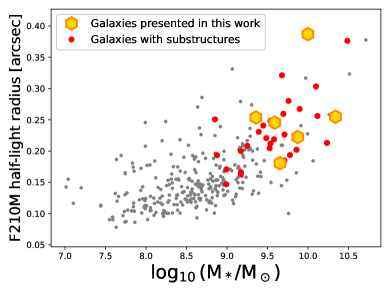
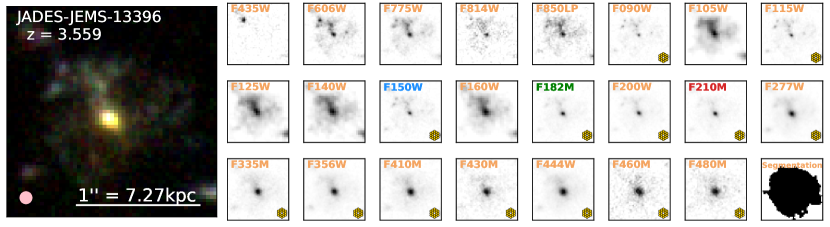
We present a spatially resolved study of stellar populations in 6 galaxies with stellar masses $M_*\sim10^{10}M_\odot$ at $z\sim3.7$ using 14-filter JWST/NIRCam imaging from the JADES and JEMS surveys. The 6 galaxies are visually selected to have clumpy substructures with distinct colors over rest-frame $3600-4100Å$, including a red, dominant stellar core that is close to their stellar-light centroids. With 23-filter photometry from HST to JWST, we measure the stellar-population properties of individual structural components via SED fitting using Prospector. We find that the central stellar cores are $\gtrsim2$ times more massive than the Toomre mass, indicating they may not form via single in-situ fragmentation. The stellar cores have stellar ages of $0.4-0.7$ Gyr that are similar to the timescale of clump inward migration due to dynamical friction, suggesting that they likely instead formed through the coalescence of giant stellar clumps. While they have not yet quenched, the 6 galaxies are below the star-forming main sequence by $0.2-0.7$ dex. Within each galaxy, we find that the specific star formation rate is lower in the central stellar core, and the stellar-mass surface density of the core is already similar to quenched galaxies of the same masses and redshifts. Meanwhile, the stellar ages of the cores are either comparable to or younger than the extended, smooth parts of the galaxies. Our findings are consistent with model predictions of the gas-rich compaction scenario for the buildup of galaxies' central regions at high redshifts. We are likely witnessing the coeval formation of dense central cores, along with the onset of galaxy-wide quenching at $z>3$.
研究の動機と目的
- 質量の大きな高赤方偏移銀河における密度の高い中心星族コアの形成メカニズムを理解すること。
- 高い星形成質量を有するにもかかわらず、これらの銀河で星形成が抑制される理由を調査すること。
- 観測されたコアが局所的形成か、クラスタ移動や合体といった動的プロセスによるものかを特定すること。
- 空間分解されたSEDフィッティングを用いて、コア、クラスタ、スムーズ成分といった異なる構造的成分の星形成歴(SFH)を評価すること。
- 観測された性質が、高赤方偏移銀河進化のためのガス豊富コンパクト化シナリオと整合するかを検証すること。
提案手法
- 3 < z < 4.5の6つの銀河について、HSTからJWSTまでの23フィルターフォトレトメトリを取得し、レストフレーム3600–4100 Åをカバーした。
- Prospectorを用いて空間分解されたSEDフィッティングを実施し、個々の成分の星族特性(質量、年齢、SFR、sSFR)を導出した。
- 結果の妥当性を検証するため、非パラメトリックなディリクレ、遅延-τ、およびパラメトリックモデルの3種類のSFH事前分布を用いた。
- 視覚的検査とアパーチャーフォトレトメトリを用いて構造的成分を定義し、中心コア、クラスタ(C1–C3)、スムーズ成分を含んだ。
- 成分間で星質量表面密度とsSFRを比較し、抑制と構造的進化の程度を評価した。
- 中心コアの局所的分裂の可能性を評価するため、トゥーモー質量基準を評価した。
実験結果
リサーチクエスチョン
- RQ1z ≈ 3.7の銀河における中心星族コアは、局所的分裂か、クラスタ合体といった動的プロセスによって形成されたのであろうか?
- RQ2中心コアはどの程度すでに抑制状態にあり、銀河の他の部分と比較してsSFRはどのように異なるのであろうか?
- RQ3コアの星の年齢は、動的摩擦によるクラスタ内への移動時間スケールと整合的であろうか?
- RQ4観測された星族特性は、高赤方偏移銀河進化のガス豊富コンパクト化シナリオの予測と一致するであろうか?
- RQ5中心コア、クラスタ、スムーズ成分の星形成歴はどのように異なり、銀河全体の抑制にどのような示唆をもたらすであろうか?
主な発見
- 中心星族コアの質量は、トゥーモー質量を2倍以上上回っており、これは局所的分裂による形成ではなく、おそらくクラスタ合体によるものであると示唆している。
- コアの星の年齢は0.4–0.7 Gyrであり、動的摩擦によるクラスタ移動の時間スケールと整合的であるため、クラスタ合体による形成が支持される。
- 銀河はすでに星形成メインシーケンスから0.2–0.7 dex低下しており、早期の抑制が始まっていることが示唆される。
- 中心コアにおける特定星形成率(sSFR)は、広がったスムーズ成分よりも低く、同程度の質量および赤方偏移の抑制済み銀河と同等の星質量表面密度を示している。
- コアの星の年齢は、広がった成分と同等か、あるいはそれよりも若く、最近の形成と継続的な抑制を示唆している。
- 異なるSFH事前分布を用いても、成分の観測されたSFHは質的に変わらず、結果の妥当性が確認された。
この論文を読む
Nubintのビューアで原文を開き、読みながら気になる箇所をすぐに質問できます。
Nubintでこの論文を読むこのレビューはAIが論文の原文をもとに作成しました。引用する前に原文をご確認ください。