
[論文レビュー] JADES NIRSpec Spectroscopy of GN-z11: Lyman-$α$ emission and possible enhanced nitrogen abundance in a $z=10.60$ luminous galaxy
論文は GN-z11 の JWST/NIRSpec 分光を報告し、赤shift z=10.6034 を確認するとともに、Lyman-α 発光を 555 km/s オフセットで明らかにし、高イオン化を示す rest-UV 線診断と nitrogen 増加の可能性を示唆します。 source が星形成か AGN 活動により駆動されているかを議論し、SFR や金属量などの物理的特性を推定します。
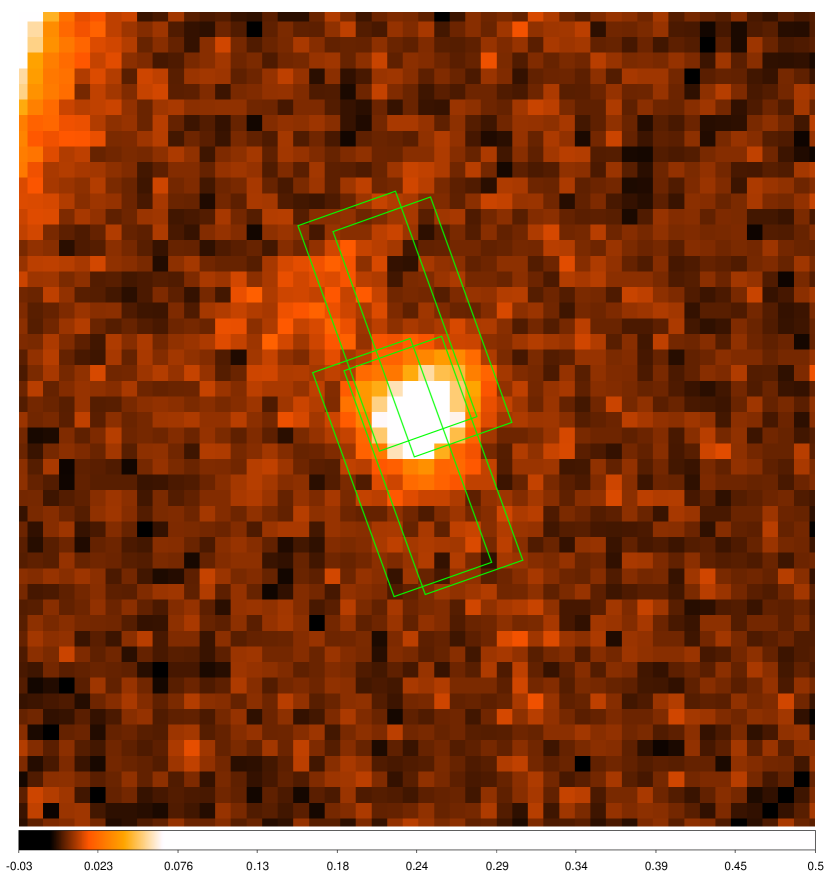
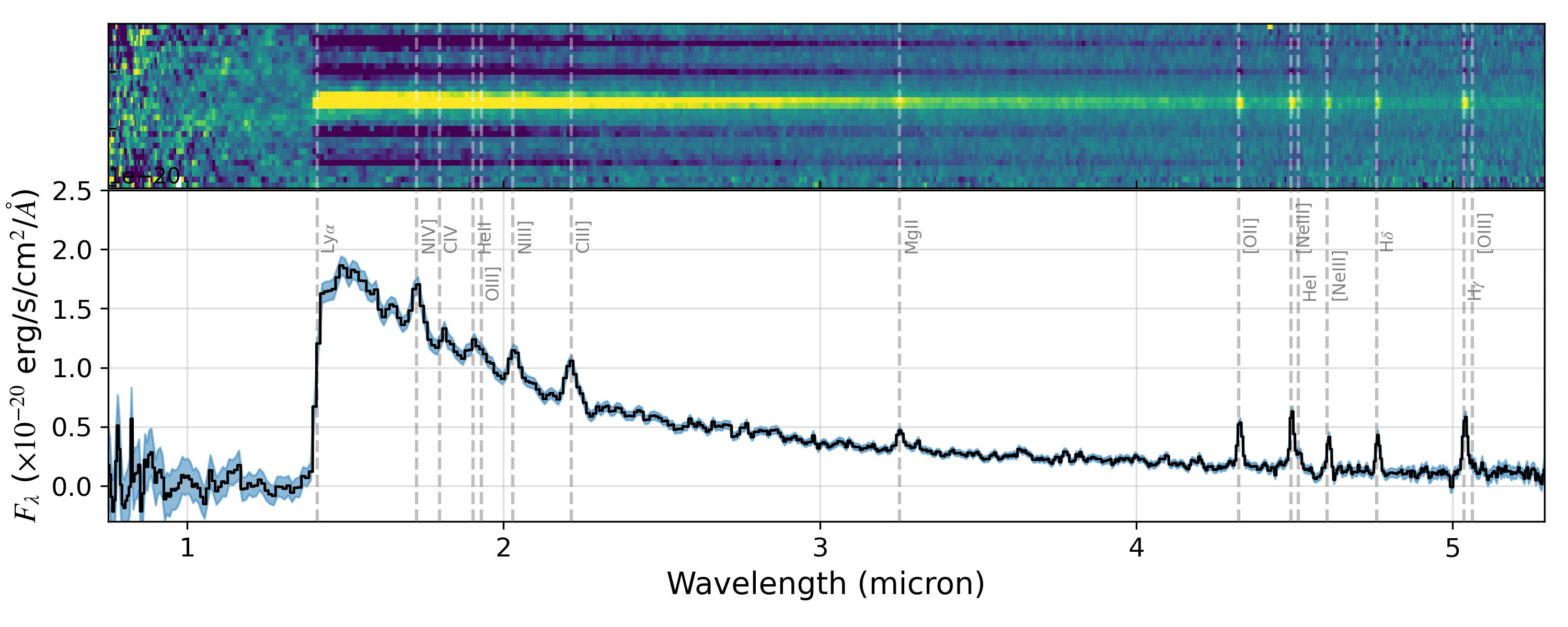
We present JADES JWST/NIRSpec spectroscopy of GN-z11, the most luminous candidate $z>10$ Lyman break galaxy in the GOODS-North field with $M_{UV}=-21.5$. We derive a redshift of $z=10.603$ (lower than previous determinations) based on multiple emission lines in our low and medium resolution spectra over $0.8-5.3 μ$m. We significantly detect the continuum and measure a blue rest-UV spectral slope of $β=-2.4$. Remarkably, we see spatially-extended Lyman-$α$ in emission (despite the highly-neutral IGM expected at this early epoch), offset 555 km s$^{-1}$ redward of the systemic redshift. From our measurements of collisionally-excited lines of both low- and high-ionization (including [O II]$\lambda3727$, [Ne III]$λ3869$ and C III]$\lambda1909$) we infer a high ionization parameter ($\log U\sim -2$). We detect the rarely-seen N IV]$\lambda1486$ and N III]$\lambda1748$ lines in both our low and medium resolution spectra, with other high ionization lines seen in the low resolution spectrum such as He II (blended with O III]) and C IV (with a possible P-Cygni profile). Based on the observed rest-UV line ratios, we cannot conclusively rule out photoionization from AGN, although the high C III]/He II and N III]/He II ratios are compatible with a star-formation explanation. If the observed emission lines are powered by star formation, then the strong N III]$\lambda1748$ observed may imply an unusually high $N/O$ abundance. Balmer emission lines (H$γ$, H$δ$) are also detected, and if powered by star formation rather than an AGN we infer a star formation rate of $\sim 20-30 M_{\odot} yr^{-1}$ (depending on the IMF) and low dust attenuation. Our NIRSpec spectroscopy confirms that GN-z11 is a remarkable galaxy with extreme properties seen 430 Myr after the Big Bang.
研究の動機と目的
- GN-z11 の正確なスペクトル赤shift を JWST/NIRSpec 0.7–5.3 μm で確認する。
- rest-UV および optical の発光線を特徴づけて、イオン化源(AGN 対 星形成)とISM の性質を診断する。
- Lyman-α の特性(フラックス、EW、空間的広がり)を測定し、z>10 における IGM 達成度を評価する。
- 線診断と SED フィットからイオン化パラメータ、金属量、星形成率などの物理的性質を推定する。
提案手法
- MSA モードで G140M, G235M, G395M, PRISM/CLEAR の4構成を用いた深観測を取得する。
- 1D/2D スペクトルを抽出・較正し、ガウスプロファイルで発光線をフィットし、構成間で結果を組み合わせる。
- 線フラックスと比(例:C III], N III], N IV], He II, C IV, [O II], [Ne III])を用いて光イオン化モデル(AGN 対 星形成)と比較し、イオン化条件を評価する。
- BEAGLE SED フィットを全プリズムスペクトルに適用し、気相の金属量と星形成特性を推定する。
- Lyman-α の性質(フラックス、EW、空間的広がり)を決定し、系統赤shift に対する速度オフセットを測定する。
実験結果
リサーチクエスチョン
- RQ1GN-z11 の rest-frame 光学/UV 発光線で測定された正確な系統赤shift は何か。
- RQ2rest-UV 線比と高イオン化線は GN-z11 の AGN 光電離か星形成によるイオン化のどちらを支持するか。
- RQ3Lyman-α の特性(フラックス、EW、空間的広がり)と z>10 での IGM 達成度はどういう意味を持つか。
- RQ4発光線はイオン化パラメータ、金属量、そして GN-z11 における窒素富化の可能性を何に示唆するか。
- RQ5データから GN-z11 は AGN 主導か 星形成主導か、整合性はどうか。
主な発見
- GN-z11 は grating スペクトルの8本の検出良好ラインに基づき z=10.6034 ± 0.0013 にある。
- Lyman-α は系統赤shift より 555 ± 32 km s−1 の速度オフセットで検出され、連続体を超えて空間的に広がりを示す。
- 検出された線には N IV] 1486, N III] 1749, C III] 1907+1909, [O II] 3726,29, Ne III] 3869, Hδ, Hγ が含まれ、C IV はP‑Cygni形、He II は O III] とブレンド。
- ライン比診断は GN-z11 が AGN と星形成モデルの間に位置することを示し、AGN の決定的な支配は確立されていないが高イオン化線が観測される。
- 星形成に駆動される場合、強い N III] 1748 は異常に高い N/O 比を示す可能性があり、Balmer 線は SFR ≈ 20–30 M⊙ yr−1( IMF に依存)と低い塵減衰を示唆する。
- Lyman-α のエスケープ分率は Case B 再結合の下で約 0.038 ± 0.004 と推定される。
より良い研究を、今すぐ始めましょう
論文設計から論文執筆まで、研究時間を劇的に削減しましょう。
クレジットカード登録不要
このレビューはAIが作成し、人間の編集者が確認しました。