
[論文レビュー] JADES: The production and escape of ionizing photons from faint Lyman-alpha emitters in the epoch of reionization
この研究は JWST/JADES データにおける z>5.8 の 16 の淡い Lyman-α 発生源を分析し、Lyα および LyC の生産/逃走、イオン化状態、そして宇宙再電離への示唆を測定します。
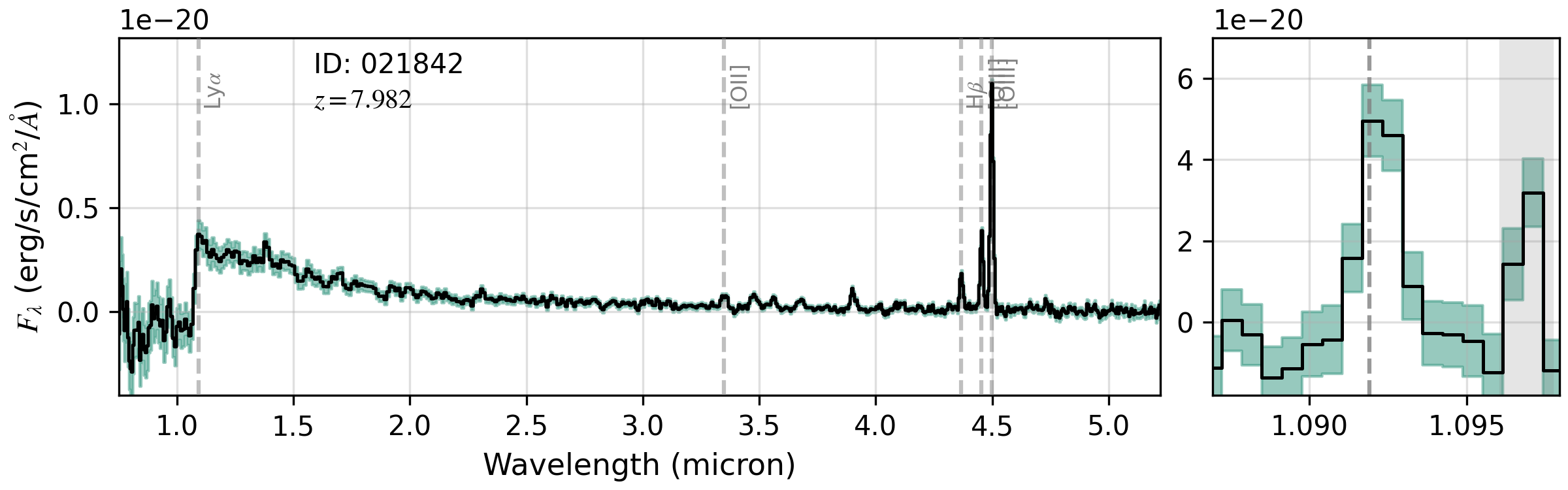
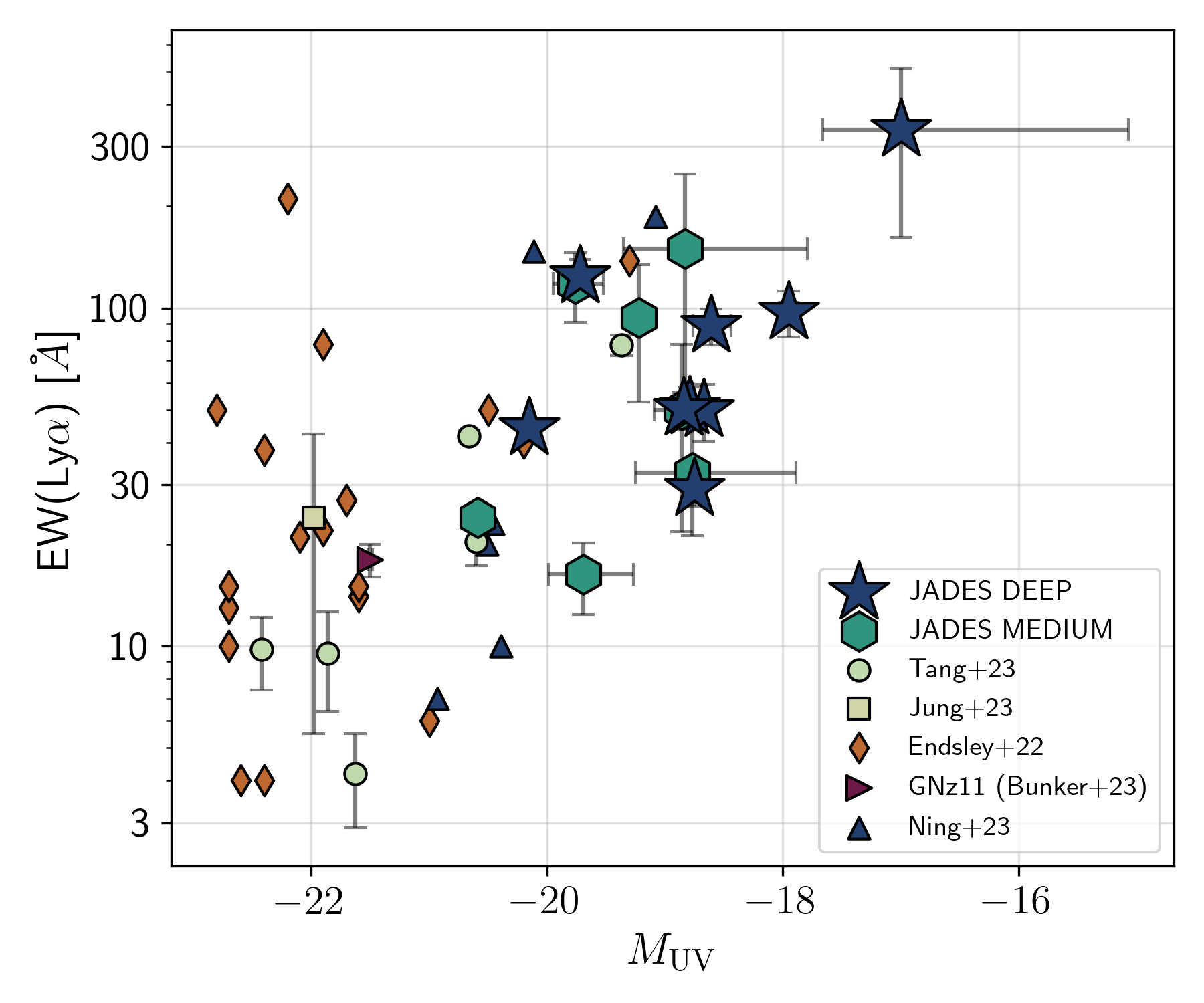
We present the properties of 17 faint Ly$α$ emitting galaxies (LAEs) at $z>5.8$ from the JWST Advanced Deep Extragalactic Survey (JADES) in the Hubble Ultra Deep Field/GOODS-S. These LAEs span a redshift range $z\approx5.8-8.0$ and a UV magnitude range $M_{UV}\approx-17$ to $-20.6$, with the Ly$α$ equivalent width (EW) in the range $\approx 25-350$ Å. The detection of other rest-optical emission lines in the spectra of these LAEs enables the determination of accurate systemic redshifts and Lyα velocity offsets, as well as the physical and chemical composition of their stars and interstellar media. These faint LAEs are consistent with metal-poor systems with high ionization parameters, similar to the general galaxy population at $z>6$. We measured an average ionizing photon production efficiency, log($ξ_ m{ion}$/erg$^{-1}$ Hz) $\approx25.57$ across our LAEs, which does not evolve strongly with redshift. We report an anti-correlation between the Ly$α$ escape fraction (f_ m{esc}) and the velocity offset from systemic redshift, consistent with model expectations. We further find that the strength and velocity offset of Ly$α$ are neither correlated with galaxy spectroscopic properties nor with $ξ_ m{ion}$. We find a decrease in $f_ m{esc}$(Ly$α$) with redshift, indicative of decreasing sizes of ionized bubbles around LAEs at high redshifts. We used a range of galaxy properties to predict Lyman continuum $f_ m{esc}$ for our LAEs, finding that the ionizing photon output into the intergalactic medium remains roughly constant across the observed Ly$α$ EW, showing a mild increase at fainter M$_{UV}$ and at higher redshifts. We derived correlations between the ionizing photon output from LAEs and $M_{UV}$, Ly$α$ EW and redshifts, which can be used to constrain the ionizing photon contribution of LAEs at $z > 6$ towards cosmic reionization.
研究の動機と目的
- 再電離時代 (z ≈ 5.8–8.0) における淡い Lyman-α 発生源 (LAEs) の物理的性質を調査する。
- Rest-frame optical 線から系統赤移動、Lyα の速度オフセット、化学的組成、イオン化パラメータ、塵含有量を決定する。
- Balmer 復元 (dust attenuation) を導くために系統赤の推定、LyC 逃走の影響を再電離予算に結びつける。
- Lyα の性質が銀河特性と/I GM の進化とどう関係するかを探る。
- 観測に基づく相関を提供して再電離モデルの改善を目指す。
提案手法
- JADES Deep および Medium ティアの JWST NIRSpec スペクトルを用いて z>5.8 の 16 の LAEs を同定する。
- R100 及び高解像度の R1000 データから Lyα フLux を測定し、Lyα 特性には G140M の分光を優先する。
- 強い rest-frame optical 線 (Hβ, [O iii], Hα) から G395M/G235M グレーティングで系統赤移動を導出する。
- R100 スペクトルから rest-frame UV 磁気的 Magnitude (MUV) を導出し、1340–2600 Å の連続体をフィットして UV 斜率 β を求める。
- Balmer 復元 (Hα/Hβ、または Hβ/Hγ) を推定して SMC 曲線の下で塵減耗を導く。
- Balmer 線から推定された intrinsic L1500 と N(H0) を用いて ionizing photon production efficiency ξion を推定する(Case-B、Te=10^4 K、ne=100 cm^-3)。
- Case-B 再結合を仮定して dust-corrected Lyα/Hα 比から Lyα 逃走分率を決定する。
実験結果
リサーチクエスチョン
- RQ1z>5.8 で rest-frame optical lines によって追跡される淡い LAEs のイオン化状態、金属量、塵含有量は何か。
- RQ2Lyα の性質(強さ、速度オフセット)は系統的特性や LyC 逃走の潜在性とどう関連するか。
- RQ3これらの淡い LAEs の ionizing photon production efficiency (ξion) はどの程度か、赤方偏移とともに進化するか。
- RQ4Lyα の逃走は赤方偏移とともにどう進化し、IGM の Ionized bubble のサイズに何を意味するか。
- RQ5観測された LAE の性質を用いて現実的で観測に基づく再電離モデルを構築できるか。
主な発見
- LAEs は金属量が少なく、高イオン化パラメータ様の条件を示し、 z>6 の銀河集団全体と一致する。
- 平均的な ionizing photon production efficiency は log(ξion/erg^-1 Hz) ≈ 25.56 で、サンプル全体で赤方偏移の大きな変化を示さない。
- Lyα 逃走分率と系統赤移動の速度オフセットとの間に反相関が見られ、理論的期待と一致する。
- Lyα 強度と速度オフセットは他の分光的性質や ξion との強い相関を示さない。
- Lyα 逃走分率は赤方偏移とともに減少し、初期時代には LAEs の周囲の ionized bubble が小さいことを示唆する。
- 複数の銀河特性を用いて、LAEs からの LyC 逃走予測は、UV Magnitude および Lyα EW との間でほぼ一定で、わずかな赤方偏移の増加を示す。
- LAEs からの ionizing photon output と UV magnitude、Lyα 力、赤方偏移との相関を導出して再電離モデルを情報づける。
より良い研究を、今すぐ始めましょう
論文設計から論文執筆まで、研究時間を劇的に削減しましょう。
クレジットカード登録不要
このレビューはAIが作成し、人間の編集者が確認しました。