
[論文レビュー] Jupiter Mass Binary Objects in the Trapezium Cluster
この研究は JWST NIRCam imagening を用いて Trapezium Cluster における惑星質量候補を 540 件特定し、0.6 Jupiter masses までの範囲、wide binary(JuMBOs)で 9% を占めることを見出し、惑星質量域の IMF の端と形成メカニズムに対する含意を論じる。
A key outstanding question in star and planet formation is how far the initial mass function of stars and sub-stellar objects extends, and whether or not there is a cut-off at the very lowest masses. Isolated objects in the planetary-mass domain below 13 Jupiter masses, where not even deuterium can fuse, are very challenging to observe as these objects are inherently faint. Nearby star-forming regions provide the best opportunity to search for them though: while they are young, they are still relatively warm and luminous at infrared wavelengths. Previous surveys have discovered a handful of such sources down to 3--5 Jupiter masses, around the minimum mass limit established for formation via the fragmentation of molecular clouds, but does the mass function extend further? In a new James Webb Space Telescope near-infrared survey of the inner Orion Nebula and Trapezium Cluster, we have discovered and characterised a sample of 540 planetary-mass candidates with masses down to 0.6 Jupiter masses, demonstrating that there is indeed no sharp cut-off in the mass function. Furthermore, we find that 9\% of the planetary-mass objects are in wide binaries, a result that is highly unexpected and which challenges current theories of both star and planet formation.
研究の動機と目的
- Young cluster における初期質量関数が惑星質量領域へどこまで伸びるかを評価する。
- JWST NIRCam 中・広帯域の光度測定を用い、分子吸収特性(H2O および CH4)を標的とする。
- 惑星質量オブジェクトの多重性を特徴づけ、広い連星の割合を定量化する。
- 観測された PMO の質量分布を形成機構(星のような破砕 vs 惑星のような放出)と比較する。
- 高密度の星形成領域で PMO を背景/前景源と区別するためのカタログと方法論を提供する。
提案手法
- 11' × 7.5' の領域を対象とする JWST NIRCam 画像観測(内部のオリオン大星雲と Trapezium Cluster、34.9 時間、12 フィルター)。
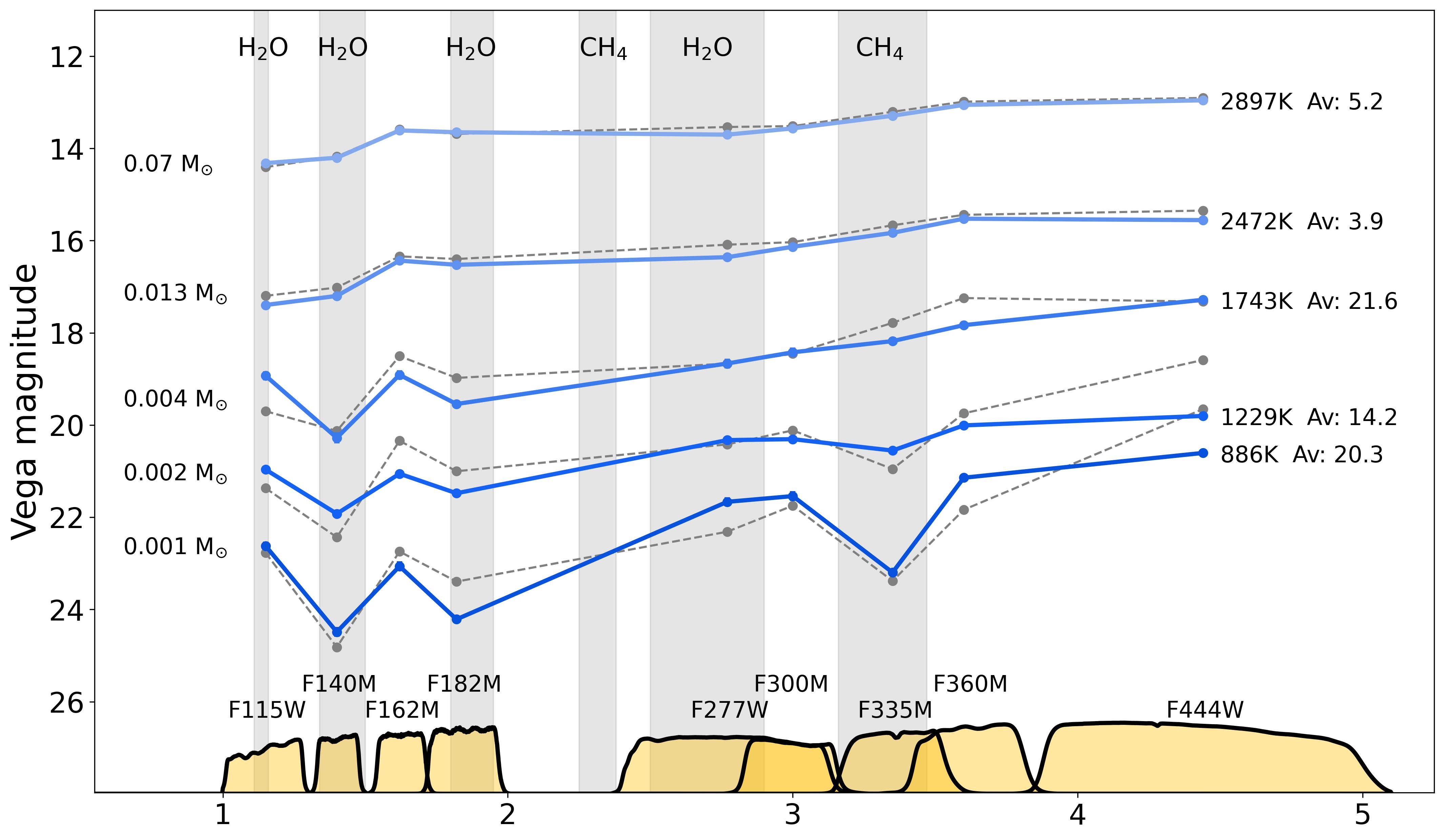
- PMO の光度分類は H2O(1.4 および 1.9 μm)および CH4(3.35 μm)吸収特徴を、特定のフィルター組み合わせと定義された指標(式 1–3)を用いて行う。
- 進化モデルのグリッド(ATMO 2020 の CEQ および NEQ)と BHAC15 を用いた 9 フィルターの SED のモデルフィット(AV 1–100、年齢 1 Myr、距離 390 pc)。
- デレデ redden ードされた光度を 1 Myr の進化モデルグリッドと比較して質量を推定(0.0004–0.015 M⊙)し、≈0.6 Mjup までの PMO を同定する。
- 視覚的検査と絞り込み測光(2.5 ピクセルおよび 4.5 ピクセルのアパーチャ)を用いて、540 個の候補 PMO カタログを作成する。
- 補足資料はデータ処理、天体源検出、混入評価(銀河、背景星)を詳述する。
![Figure 1: The upper panel shows a model spectrum of a young PMO with $T_{\mbox{\footnotesize eff}}$ = 900 K and $\log({\rm g})=5.0$ from the ATMO 2020 chemical equilibrium model set [ 28 ] . The molecular absorption bands with line intensities greater than $5\times 10^{-23}$ cm -1 / molecule cm ${}^](https://ar5iv.labs.arxiv.org/html/2310.01231/assets/Figures/3Pan_Updated_3.png)
実験結果
リサーチクエスチョン
- RQ1JWST の光度計測によって Trapezium Cluster における PMO 集団の下限質量はどこまで拡張されるか。
- RQ2この環境における惑星質量オブジェクトは広い連星(JuMBOs)として存在するのか、その頻度と性質はどうか。
- RQ3PMO の質量関数は 1 Mjup 未満にどこまで拡張され、鋭いカットオフの証拠はあるか。
- RQ4JuMBO 集団とその分離・質量比を説明できる形成機構(星様の破砕 vs 惑星様の放出)は何か。
主な発見
| JuMBO | RA (deg) | DEC (deg) | M_Pri (M⊙) | Av_Pri | M_Sec (M⊙) | Av_Sec | Proj_Sep (au) | M_Ter | Av_Ter |
|---|---|---|---|---|---|---|---|---|---|
| JuMBO 1 | 83.716375 | -5.374688 | 0.001 | 6.3 | 0.001 | 4.3 | 357.7 | - | - |
| JuMBO 2 | 83.718439 | -5.391585 | 0.002 | 16.4 | 0.002 | 13.1 | 114.7 | - | - |
| JuMBO 3 | 83.720854 | -5.379591 | 0.003 | 19.7 | 0.003 | 10.8 | 52.3 | - | - |
| JuMBO 4 | 83.727380 | -5.444921 | 0.002 | 23.7 | 0.001 | 10.6 | 324.4 | - | - |
| JuMBO 5 | 83.727997 | -5.389459 | 0.003 | 10 | 0.002 | 32.8 | 384.3 | - | - |
- 0.6 Mjup までの質量を持つ PMO 候補 540 件を同定し、鋭いカットオフなしで IMF の滑らかな連続を示す。
- PMO の 9% が広い連星系(JuMBOs)に属し、分離は約 25–390 au、惑星質量での発見としては驚くべき結果である。
- JuMBOs は 0.7–7 Mjup にまたがり、分離は均等に分布。平均質量比は q = 0.66、q ≥ 0.8 を持つものは約 40% 程度。
- 主星質量の関数として広い連星割合は PMO 質量で増加する一方、高質量側では減少傾向であり、新たな惑星質量での形成経路を示唆する。
- CEQ 大気/化学モデルは PMO を 2 Mjup まで適合させるのが最適;NEQ は 2 Mjup 未満で弱いモデルが好まれ、垂直混合効果の可能性を示唆。
- 追跡観測の NIRSpec 分光(JWST Cycle 2)により、PMO および JuMBO の温度、スペクトル型、化学組成を洗練させる予定。
より良い研究を、今すぐ始めましょう
論文設計から論文執筆まで、研究時間を劇的に削減しましょう。
クレジットカード登録不要
このレビューはAIが作成し、人間の編集者が確認しました。