
[論文レビュー] JWST, ALMA, and Keck Spectroscopic Constraints on the UV Luminosity Functions at z~7-14: Clumpiness and Compactness of the Brightest Galaxies in the Early Universe
本論文は z~7–14 におけるスペクトロスコピーで確認された 53 個の明るい銀河を収集し、UV 光度関数を制約するとともに形態を研究している。z~7 では塊状・ merger-driven の構造を見出し、z>10 では高いイオン化線が弱い拡張系と強い線を持つ密集系の二つの異なる集団が存在することを示す。
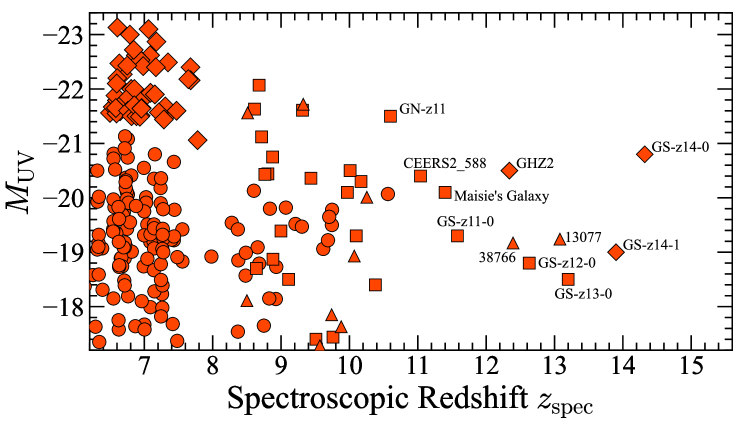
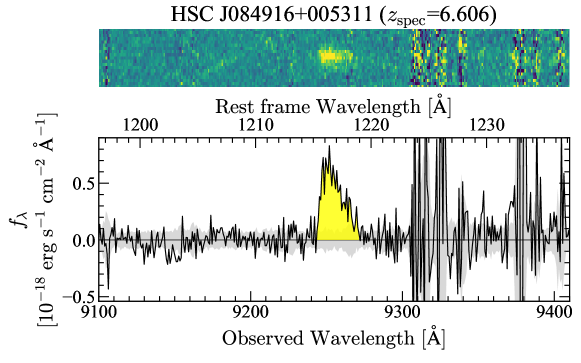
We present the number densities and physical properties of the bright galaxies spectroscopically confirmed at $z\sim7-14$. Our sample is composed of 60 galaxies at $z_\mathrm{spec}\sim7-14$, including recently-confirmed galaxies at $z_\mathrm{spec}=12.34-14.32$ with JWST, as well as new confirmations at $z_\mathrm{spec}=6.583-7.643$ with $-24< M_\mathrm{UV}< -21$ mag using ALMA and Keck. Our JWST/NIRSpec observations have also revealed that very bright galaxy candidates at $z\sim10-13$ identified from ground-based telescope images before JWST are passive galaxies at $z\sim3-4$, emphasizing the necessity of strict screening and spectroscopy in the selection of the brightest galaxies at $z>10$. The UV luminosity functions derived from these spectroscopic results are consistent with a double power-law function, showing tensions with theoretical models at the bright end. To understand the origin of the overabundance of bright galaxies, we investigate their morphologies using JWST/NIRCam high-resolution images obtained in various surveys including PRIMER and COSMOS-Web. We find that $\sim70\%$ of the bright galaxies at $z\sim7$ exhibit clumpy morphologies with multiple sub-components, suggesting merger-induced starburst activity, which is consistent with SED fitting results showing bursty star formation histories. At $z\gtrsim10$, bright galaxies are classified into two types of galaxies; extended ones with weak high-ionization emission lines, and compact ones with strong high-ionization lines including NIV]$λ$1486, indicating that at least two different processes (e.g., merger-induced starburst and compact star formation/AGN) are shaping the physical properties of the brightest galaxies at $z\gtrsim10$ and are responsible for their overabundance.
研究の動機と目的
- スペクトロスコピーで確認された銀河を用いて z~7–14 における明るい端の UV 光度関数 (UVLF) を定量化する。
- 高解像度 JWST 画像を用いて z>7 の最も明るい銀河の形態を評価し、その形成経路を理解する。
- 観測された z>10 における明るい銀河の過剰性が、合併誘発の星burst か密集星形成/AGN か、異なる物理過程によって説明できるかを調査する。
- 高-z 選択における混入・インリポラーの評価と、今後の広域サーベイへの影響を評価する。
提案手法
- JWST、ALMA、Keck から zspec ~ 6.54–14.32 のスペクトロスコピーで確認された 53 銀河のサンプルを組み立てる(新規確認と文献集成を含む)。
- 明るい端を対象とした有効体積を推定して z~6.5–7.5、7.5–8.5、11.0–13.5、13.5–15.0 の4つの赤shiftビンで UV 光度関数を算出する。
- JWST/NIRCam 画像を用いて形態を分析し、 merger-driven 活動を示唆する塊状・複数成分構造を同定する。
- Prospector による SED フィットを行い、z>10 の明るい銀河の星形成履歴と構造型(拡張系 vs. 密集系)を推定する。
- 高-z 候補をスペクトロスコピー確認と照合して、低-z の非活性銀河からのインリポラー混入を評価する。
実験結果
リサーチクエスチョン
- RQ1z ~ 7–14 における明るい端の UV 光度関数の形状はどのようになり、ダブルパワー・ローまたは別の形と整合するか。
- RQ2z ~ 7–14 の明るい銀河の形態と星形成履歴は何か、 merger-driven の爆発的活動を示唆するか、それとも密集形成機構を示すか。
- RQ3z>10 の明るい銀河はどのように二つの物理集団に分かれ、観測される性質と存在量を駆動する過程は何か。
- RQ4低赤方偏移のインリポラーは、明るい端の高-z 銀河サンプルにどの程度影響するか、スペクトロスコピーはこれをどの程度緩和するか。
- RQ5これらの発見が、z>10 の極めて明るい銀河を対象とする今後の広域サーベイにどのような示唆を与えるか。
主な発見
- スペクトログラフィックに確認された明るい銀河(N=53)は z~6.54–14.32 に及び、z~7–14 の UV 光度関数の制約を可能にする。
- 導出された UV 光度関数はダブルパワー・ローの形と一致する傾向があり、明るい端で理論モデルと食い違いが生じている。
- z~7 の銀河の約 70% が複数のサブ成分を持つ塊状形態を示し、 merger-induced starburst 活動を示唆する。
- z>10 では明るい銀河は二タイプに分かれる:弱い高イオン化線を持つ拡張系と、強い高イオン化線を持つ密集系(例:N IV] 1486)で、複数の形成経路( merger-driven bursts vs. compact star formation/AGN)を示唆する。
- JWST/NIRSpec スペクトロスコピーは、地上観測の非常に明るい z~10–13 候補の中には実際には z~3–4 のパッシブ銀河であるものがあることを示しており、厳格なスペクトロスコピー確認と明るい高-z サンプルの慎重なスクリーニングの必要性を強調している。
より良い研究を、今すぐ始めましょう
論文設計から論文執筆まで、研究時間を劇的に削減しましょう。
クレジットカード登録不要
このレビューはAIが作成し、人間の編集者が確認しました。