
[論文レビュー] JWST/MIRI reveals the true number density of massive galaxies in the early Universe
本研究は PRIMER プログラムの JWST/MIRI データを用いて高-z銀河の恒星質量を堅牢に再校正し、z>5 で巨大系の数密度が低下することを示し、LCDM の文脈で赤方偏移と質量に依存したバリオン-to-star 転換効率の上昇を明らかにする。
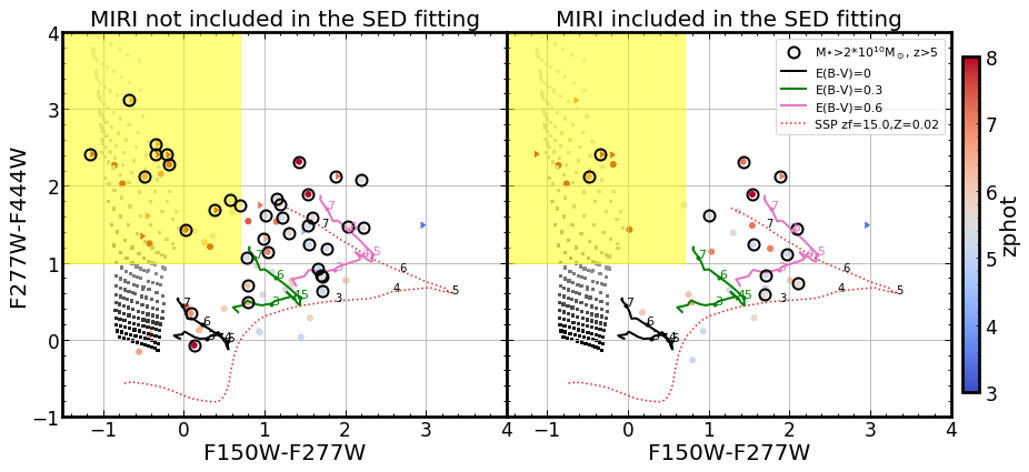
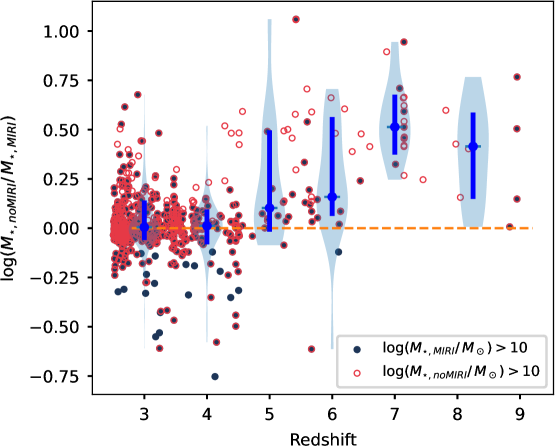
Early JWST studies reporting an unexpected abundance of massive galaxies at $z \sim 5$--$8$ challenge galaxy formation models in the $Λ$CDM framework. Previous stellar mass ($M_\star$) estimates suffered from large uncertainties due to the lack of rest-frame near-infrared data. Using deep JWST/NIRCam and MIRI photometry from PRIMER, we systematically analyze massive galaxies at $z \sim 3$--$8$, leveraging rest-frame $\gtrsim 1\,μ$m constraints. We find MIRI is critical for robust $M_\star$ measurements for massive galaxies at $z > 5$: excluding MIRI overestimates $M_\star$ by $\sim 0.4$ dex on average for $M_\star > 10^{10}\,M_\odot$ galaxies, with no significant effects at lower masses. This reduces number densities of $M_\star > 10^{10}\,M_\odot$ ($10^{10.3}\,M_\odot$) galaxies by $\sim 36\%$ ($55\%$). MIRI inclusion also reduces ``Little Red Dot'' (LRD) contamination in massive galaxy samples, lowering the LRD fraction from $\sim 32\%$ to $\sim 13\%$ at $M_\star > 10^{10.3}\,M_\odot$. Assuming pure stellar origins, LRDs exhibit $M_\star \sim 10^{9 ext{--}10.5}\,M_\odot$ with MIRI constraints, rarely exceeding $10^{10.5}\,M_\odot$. Within standard $Λ$CDM, our results indicate a moderate increase in the baryon-to-star conversion efficiency ($ε$) toward higher redshifts and masses at $z > 3$. For the most massive $z \sim 8$ galaxies, $ε\sim 0.3$, compared to $ε\lesssim 0.2$ for typical galaxies at $z < 3$. This result is consistent with models where high gas densities and short free-fall times suppress stellar feedback in massive high-$z$ halos.
研究の動機と目的
- rest-frame >1 µm フィトメトリを用いて高赤方偏移宇宙の巨大銀河の恒星質量を正確に測定する必要性を動機づける。
- JWST/MIRI データの含有がSEDフィッティング結果をどのように変え、z>4 で M* の過大推定をどのように減らすかを実証する。
- z~3–9 からの質量 M*>10^9 Msun の巨大銀河の累積恒星質量密度を定量化し、LCDM 予測と比較する。
- 赤方偏移と質量に依存するバリオン-to-star 転換効率 ε を推定し、フィードバックなし星爆モデルの文脈で解釈する。
提案手法
- CANDELS-COSMOS/UDS フィールド上の PRIMER 調査の HST、JWST/NIRCam、JWST/MIRI データを用いて大規模な多波長カタログを構築する。
- MIRI光度計を含む/含まないで EAZY を用いた光度赤方偏移推定を実施する。
- 異なるテンプレートセットと赤方偏移入力を用いて、MIRI の有無で BAGPIPES と FAST++ を用いて恒星質量を推定する。
- 質量の完備性を評価し、Schechter 関数をガウスカーネルと畳み込みしてデータにフィットさせることで Eddington バイアスを定量化する。
- 累積恒星質量密度を計算し、ハロー基盤の期待と比較して示唆される ε(M*, z) を導出する。
実験結果
リサーチクエスチョン
- RQ1rest-frame >1 µm フィトメトリを含めたとき、z ~3–9 での巨大銀河 (M* > 10^10 M⊙) の真の数密度はどれくらいか?
- RQ2MIRI photometry の含有は導出された恒星質量および高赤方偏移での恒星質量関数の進化推定にどう影響するか?
- RQ3LCDM の下で、どのように質量と赤方偏移に対して ε が示唆されるのか?
- RQ4観測された高-z の巨大銀河はフィードバックなし星爆モデルのようなモデルと整合するか、極端な効率を必要とするか?
主な発見
- MIRI フィトメトリを含めると、MIRI を含めない適合と比較して z>5 で巨大銀河の数密度と質量密度が大幅に低下する。
- z>5 で M* > 10^10.3 M⊙ の銀河では、MIRI を含めると M* が大幅に低くなり、年齢–減衰の縮退や発光線汚染による過大推定を減らす。
- 観測された累積恒星質量密度は極端なバリオン転換効率なしで LCDM 予測と一致し、一方 ε は M* および z の両方の増加とともに上昇する。
- z~8 で必要な ε は約 0.3、典型的な低-redshift 天体では約 0.14 であり、初期宇宙でより高い効率を示唆する。
- 結果は高いガス密度と短い落下時間が星形成 feedback を抑制する FF B モデルと一致する。
- 本研究は ε(z, M*) が赤方偏移と質量とともに上昇する枠組みを提供し、 ε_max ≈ 0.2 の FFB 予測と一致する。
より良い研究を、今すぐ始めましょう
論文設計から論文執筆まで、研究時間を劇的に削減しましょう。
クレジットカード登録不要
このレビューはAIが作成し、人間の編集者が確認しました。