
[論文レビュー] JWST observations of galaxy damping wings during reionization interpreted with cosmological simulations
この論文は、JWSTで検出された高赤方偏移銀河の減衰翼を、不均一な再電離のシミュレーション(Sherwood-Relics)および Miralda-Escudé モデルと比較し、赤側では良好な一致だが青側では残留中性ガスの影響で不一致が生じることを示し、観測を説明する代替案としてより小さな泡とより強い本来の Lyα 放出を提案する。
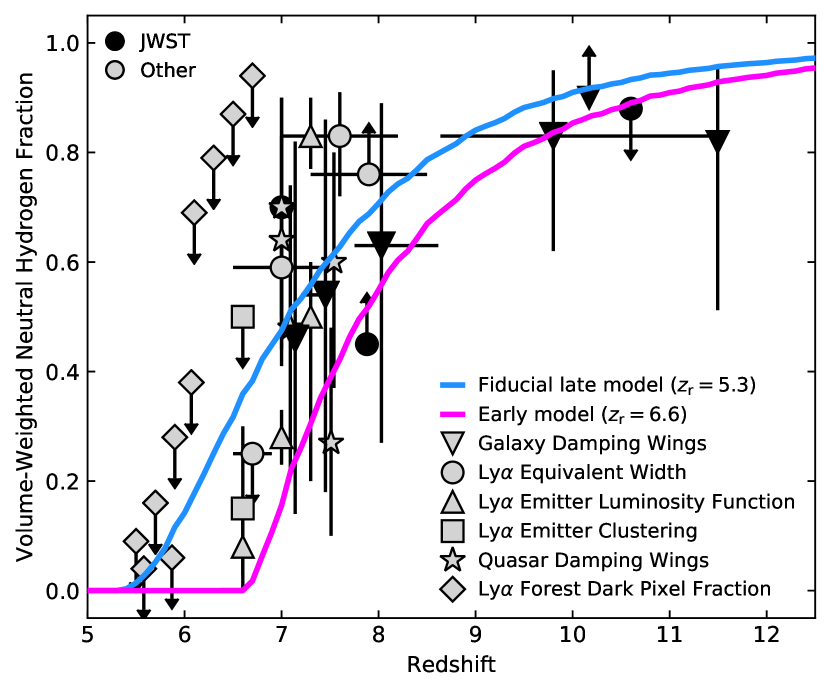
Spectra of the highest redshift galaxies taken with JWST are now allowing us to see into the heart of the reionization epoch. Many of these observed galaxies exhibit strong damping wing absorption redward of their Lyman-$α$ emission. These observations have been used to measure the redshift evolution of the neutral fraction of the intergalactic medium and sizes of ionized bubbles. However, these estimates have been made using a simple analytic model for the intergalactic damping wing. We explore the recent observations with models of inhomogeneous reionization from the Sherwood-Relics simulation suite. We carry out a comparison between the damping wings calculated from the simulations and from the analytic model. We find that although the agreement is good on the red side of the Lyman-$α$ emission, there is a discrepancy on the blue side due to residual neutral hydrogen present in the simulations, which saturates the intergalactic absorption. For this reason, we find that it is difficult to reproduce the claimed observations of large bubble sizes at z ~ 7, which are driven by a detection of transmitted flux blueward of the Lyman-$α$ emission. We suggest instead that the observations can be explained by a model with smaller ionized bubbles and larger intrinsic Lyman-$α$ emission from the host galaxy.
研究の動機と目的
- JWSTの減衰翼を用いて再電離期間の IGM を制約する動機づけ
- Miralda-Escudé (1998) の解析モデルが不均一再電離シミュレーションからの減衰翼を再現できる程度を評価
- シミュレーションベースの減衰翼と JWST 観測および公開された泡サイズ推定を比較
- ionized領域内の残留中性ガスが減衰翼の形状と大泡の解釈への含意を強調
提案手法
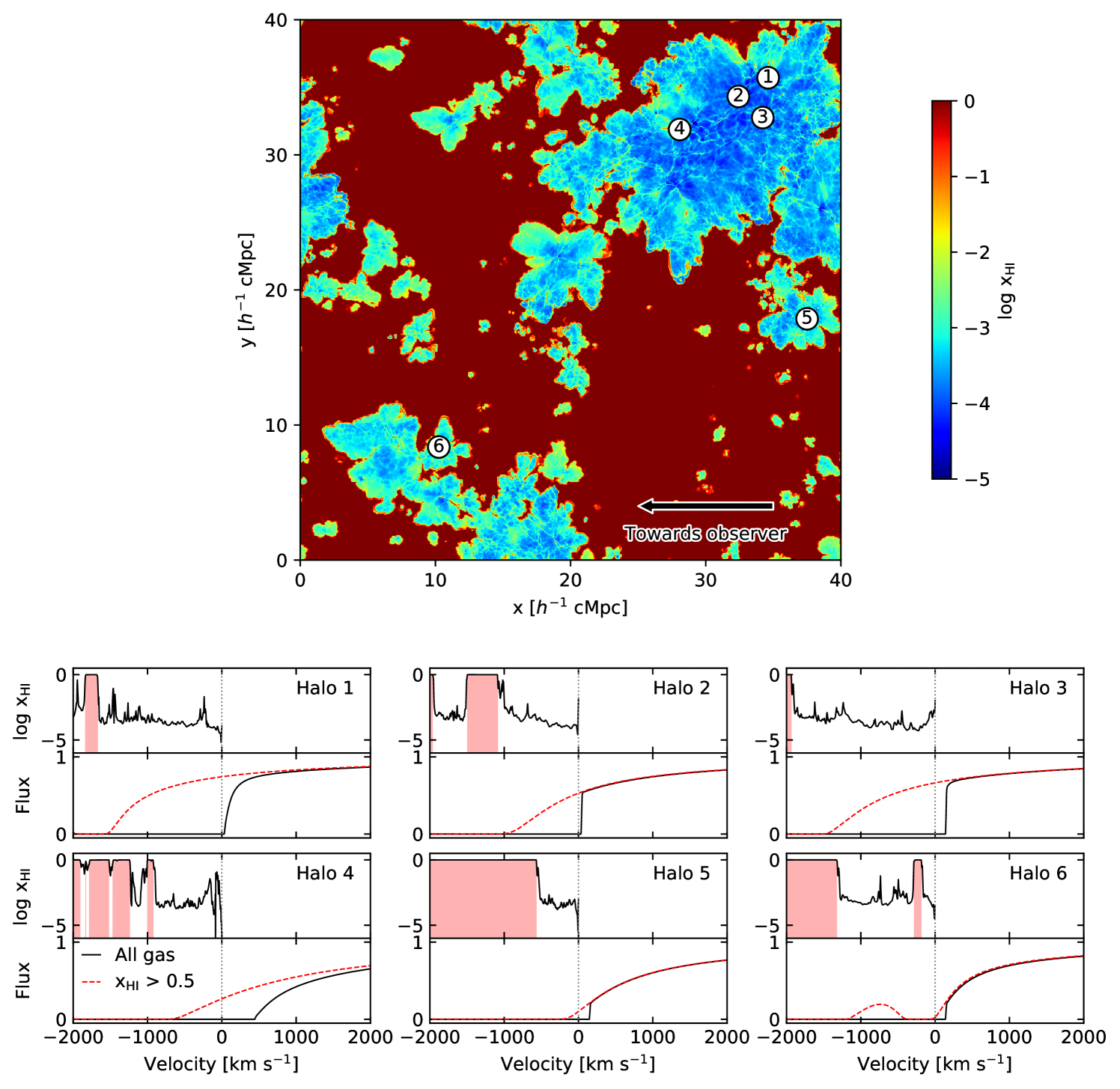
- Sherwood-Relics 宇宙論的流体力学シミュレーションを用い、パッチ状再電離を組み合わせた mock IGM damping wings を z=7,8,9,10 の巨大ハローへ向かう sightlines で作成
- 放射伝達で後処理し、変動する UV 背景を割り当て、 sightlines に沿った Lyα 光学深度を計算
- ハロー内のガスを除外して IGM 減衰翼に焦点を当て、視線に沿った速度偏位を 0 km/s に正規化
- テッパ-García 2006 の解析的 Voigt プロファイル近似を用いて減衰翼を計算し、 simulation-derived neutral fractions と bubble sizes を用いて Miralda-Escudé (1998) モデルと比較
- ガスの peculiar velocities、 ionized bubble 内の残留中性ガス、視線方向の電離 evolution が減衰翼に与える影響を体系的に検証
- 体積効果を調べるため 40h−1 Mpc と 160h−1 Mpc のシミュレーションボックスを比較し、公正な質量分布比較のためハローサンプルを再選定
実験結果
リサーチクエスチョン
- RQ1Miralda-Escudé (1998) の解析減衰翼モデルは、不均一再電離シミュレーションから生成された減衰翼を再現できるか?
- RQ2シミュレーションの減衰翼と解析モデルの間で、特に Lyα 系統点の青側で生じるずれの原因は何か?
- RQ3JWST detected damping wings は z~7 での大規模 ionized bubbles の主張と調和するのか、それとも Smaller bubbles and stronger intrinsic Lyα などの代替説明が優勢なのか?
主な発見
- Miralda-Escudé (1998) は赤側の中央値の減衰翼を再現するが、Lyαの青側では伝送を過大に見積もる。泡が完全にイオン化されていないため。
- ionized bubbles 内の残留中性水素、 xHI ≈ 10−3 でも強い Lyα 吸収を生じ、宇宙間吸収を飽和させ、線中心の青側と解析モデルの不一致を生む。
- ホストバブル内の残留中性ガスを除去し、 peculiar velocities を無視すると、青側で特に青方の整合性が改善。
- 調整をしても、z~7 で大きな泡から推定される伝送量よりも低い予測になるため、それらデータから大泡サイズの解釈は難しい。
- 観測された減衰翼は、より小さな電離泡とホスト銀河のより大きな intrinsic Lyα 放出の組み合わせで説明できる可能性を示唆。
より良い研究を、今すぐ始めましょう
論文設計から論文執筆まで、研究時間を劇的に削減しましょう。
クレジットカード登録不要
このレビューはAIが作成し、人間の編集者が確認しました。