
[論文レビュー] JWST Reveals CH$_4$, CO$_2$, and H$_2$O in a Metal-rich Miscible Atmosphere on a Two-Earth-Radius Exoplanet
TOI-270 d の JWST 透過スペクトルは、高度に金属富みで混和可能な HMWV 主成分のエンベログを CH$_4$, CO$_2$, H$_2$O の署名とともに明らかにし、内部組成と新しいサブネプチュン分類を制約する。
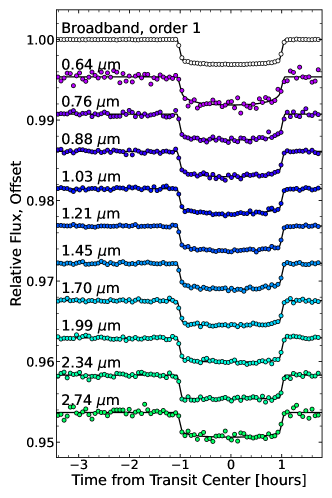
Even though sub-Neptunes likely represent the most common outcome of planet formation, their natures remain poorly understood. In particular, planets near 1.5-2.5$\,R_\oplus$ often have bulk densities that can be explained equally well with widely different compositions and interior structures, resulting in grossly divergent implications for their formation. Here, we present the full 0.6-5.2$\,μ\mathrm{m}$ JWST NIRISS/SOSS+NIRSpec/G395H transmission spectrum of the 2.2$\,R_\oplus$ TOI-270d ($4.78\,M_\oplus$, $T_\mathrm{eq}$=350-380 K), delivering unprecedented sensitivity for atmospheric characterization in the sub-Neptune regime. We detect five vibrational bands of CH$_4$ at 1.15, 1.4, 1.7, 2.3, and 3.3$\,μ$m (9.4$σ$), the signature of CO$_2$ at 4.3$\,μ$m (4.8$σ$), water vapor (2.5$σ$), and potential signatures of SO$_2$ at 4.0$\,μ\mathrm{m}$ and CS$_2$ at 4.6$\,μ\mathrm{m}$. Intriguingly, we find an overall highly metal-rich atmosphere, with a mean molecular weight of $5.47_{-1.14}^{+1.25}$. We infer an atmospheric metal mass fraction of $58_{-12}^{+8}\%$ and a C/O of $0.47_{-0.19}^{+0.16}$, indicating that approximately half the mass of the outer envelope is in high-molecular-weight volatiles (H$_2$O, CH$_4$, CO, CO$_2$) rather than H$_2$/He. We introduce a sub-Neptune classification scheme and identify TOI-270d as a "miscible-envelope sub-Neptune" in which H$_2$/He is well-mixed with the high-molecular-weight volatiles in a miscible supercritical metal-rich envelope. For a fully miscible envelope, we conclude that TOI-270d's interior is $90_{-4}^{+3}\,$wt$\,\%$ rock/iron, indicating that it formed as a rocky planet that accreted a few wt % of H$_2$/He, with the overall envelope metal content explained by magma-ocean/envelope reactions without the need for significant ice accretion. TOI-270d may well be an archetype of the overall population of sub-Neptunes.
研究の動機と目的
- 内部構造が退化した領域で半径谷の近くにあるサブネプチュンの組成理解を促す。
- 約2.2 R⊕ の惑星の上部大気化学を、広範な JWST 波長域を用いて特徴づける。
- 大気組成推定から内部構成とエンベロープの金属含量を制約する。
- 混和可能で金属富むエンベロープを持つサブネプチュンの分類フレームワークを提案する。
- 惑星形成経路と内部-内部-エンベロープ結合への影響を評価する。
提案手法
- NIRISS/SOSS と NIRSpec/G395H を用いて TOI-270 d の 0.6–5.2 μm JWST 透過スペクトルを取得する(0.6–2.8 μm と 2.7–5.2 μm)。
- NAMELESS と supreme-SPOON パイプラインでデータを還元し、1/f ノイズ、背景、宇宙線を補正し、分光光曲線を抽出する。
- ExoTEP と batman 移動モデルを用いて白色光と分光光曲線を MCMC フレームワークで適合させ、系統性とリム暗化を含める。
- 大気をリトリーブでモデル化し、CH$_4$, CO$_2$, H$_2$O の特徴と潜在的な SO$_2$ および CS$_2$ の信号を特定する。平均分子量と金属量を推定する。
- 大気の制約を内部構造モデリングと組み合わせて、岩/鉄の割合とエンベロープの組成を推定する。
- 雲/ヘイズの有無と miscible-envelope 仮説への影響について論じる。

実験結果
リサーチクエスチョン
- RQ1JWST 透過分光観測 によって明らかになった TOI-270 d の上部大気に存在する分子種は何か?
- RQ2惑星のエンベロープの平均分子量と金属含量はどのくらいで、これらの制約は内部構造をどのように示唆するか?
- RQ3もし H/He エンベロープがある場合、それは高分子量の揮発性成分と混ざり合い、混和可能で金属富むエンベロープになっているのか?
- RQ4TOI-270 d の推定内部構造と大気組成を最もよく説明する形成経路は何か?
- RQ5TOI-270 d は半径谷付近のより広いサブネプチュン分類スキームにどのような情報を提供するか?
主な発見
- 1.15, 1.4, 1.7, 2.3, 3.3 μm の 5 個の CH$_4$ 振動帯を検出(9.4σ)。
- CO$_2$ の署名が約 4.3 μm 付近で検出(4.8σ)。
- H$_2$O 吸収が 1.4 および 1.9 μm で検出(2.5σ)。
- 4.0 μm での SO$_2$ および 4.6 μm での CS$_2$ の可能性のある署名; 全体のスペクトルは高度に金属富むエンベロープを示唆。
- 平均分子量は 5.47$_{-1.14}^{+1.25}$ と推定され、エ atmospheric 金属質量分率は 58$_{-12}^{+8}$%、C/O = 0.47$_{-0.19}^{+0.16}$。
- 内部モデリングは、エンベロープが完全に混ざり合っている場合、TOI-270 d が約 90$_{-4}^{+3}$ wt% の岩/鉄であることを示唆し、H$_2$/He の小さな割合と溶岩オーシャン–エンベロープ相互作用がエンベロープ金属を説明する、岩石体としての形成を示唆する。
より良い研究を、今すぐ始めましょう
論文設計から論文執筆まで、研究時間を劇的に削減しましょう。
クレジットカード登録不要
このレビューはAIが作成し、人間の編集者が確認しました。