
[論文レビュー] JWST UNCOVER: Discovery of $z>9$ Galaxy Candidates Behind the Lensing Cluster Abell 2744
本研究では、JWST UNCOVER調査において、深いつながりNIRCamおよびNIRISS画像とドロップアウト選別法および赤方偏移の光度赤方偏移を組み合わせることで、z > 9の高赤方偏移銀河候補19個の発見を報告する。サンプルには9 < z < 12の16候補と12 < z < 13の3候補が含まれ、そのうち8つは非常に信頼性が高いとされる。これらの銀河は、低質量(log(M⋆/M⊙) ≈ 6.8–9.5)、若年(10–100 Myr)、低星形成率(0.2–7 M⊙ yr⁻¹)、青いUV傾き(β ≈ −1.8 から −2.4)を示しており、初期銀河形成モデルと整合的であり、赤方偏移とともに質量-光度関係およびUV傾きが急速に進化していることを示している。
We present the results of a search for high-redshift ($z>9$) galaxy candidates in the JWST UNCOVER survey, using deep NIRCam and NIRISS imaging in 7 bands over $\sim45$ arcmin$^2$ and ancillary HST observations. The NIRCam observations reach a $5-σ$ limiting magnitude of $\sim 29.2$ AB. The identification of high$-z$ candidates relies on a combination of a dropout selection and photometric redshifts. We find 16 candidates at $99$. A few galaxies at $z\sim9-10$ appear to show a clear Balmer break between the F356W and F444W/F410M bands, which helps constrain their stellar mass. We estimate blue UV continuum slopes between $β=-1.8$ and $-2.3$, typical for early galaxies at $z>9$ but not as extreme as the bluest recently discovered sources. We also find evidence for a rapid redshift-evolution of the mass-luminosity relation and a redshift-evolution of the UV continuum slope for a given range of intrinsic magnitude, in line with theoretical predictions. These findings suggest that deeper JWST observations are needed to reach the fainter galaxy population at those early epochs, and follow-up spectroscopy will help better constrain the physical properties and star formation histories of a larger sample of galaxies.
研究の動機と目的
- JWSTのNIRCamおよびNIRISS機器による深いつながり赤外線画像を用いて、z > 9の高赤方偏移銀河候補を特定・特徴付けること。
- ハッブルの赤方偏移-距離限界を超えるために、アベル2744銀河団における強い重力レンズ効果を活用し、微弱で遠方の銀河を増幅すること。
- BEAGLEを用いたスペクトルエネルギー分布(SED)フィッティングと光度赤方偏移を用いて、初期銀河の物理的性質(星形成質量、星形成率、年齢、ダスト減光)を評価すること。
- 理論的モデルと比較するため、初期宇宙におけるUVコンtinuum傾き(β)および質量-光度関係の赤方偏移依存性を調査すること。
- ドロップアウト選別法と独立した光度赤方偏移コード(EazyおよびBEAGLE)を組み合わせることで、高赤方偏移候補の信頼性を評価すること。
提案手法
- JWSTのNIRCamおよびNIRISS機器による深いつながりマルチバンド画像(7バンド)を用い、観測フレームで5σの限界等級が約29.2 ABに達する。
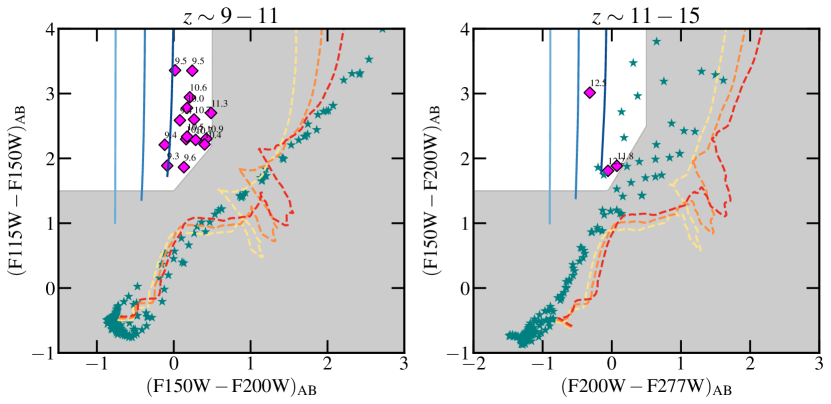
- 短波長バンド(例:F356W)での光度の欠如と長波長バンド(例:F444W)との比較に基づくドロップアウト選別法を適用し、高赤方偏移におけるライマンブレイク銀河の特徴を抽出。
- 独立した2つの光度赤方偏移コード(EazyおよびBEAGLE)を用いて赤方偏移を推定し、候補選別における不確実性を評価し、信頼性を確保。
- BEAGLEを用いたSEDフィッティングを実施し、赤方偏移を固定した上で星形成質量、年齢、星形成率(SFR)、ダスト減光(τV)を変化させ、物理的性質を導出。
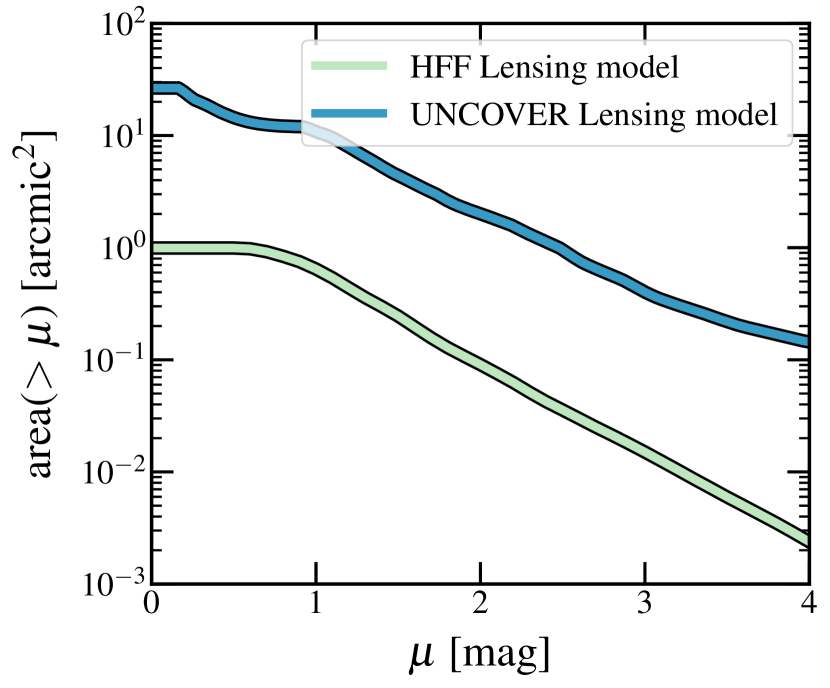
- 重力レンズ増幅(μ = 1.2 から 11.5)を補正して、固有の明るさおよび星形成質量を推定。
- 観測されたUVコンtinuum傾き(β)および質量-光度関係を理論的予測と低赤方偏移の実測関係と比較し、進化の程度を評価。
実験結果
リサーチクエスチョン
- RQ1深いつながりレンズ画像によって、初期宇宙におけるz > 9の銀河の数密度および固有の明るさ分布はどのように特定されるか?
- RQ2z > 9の銀河の物理的性質(星形成質量、星形成率、年齢、ダスト含量)は、理論的期待と比較してどのように異なるか?
- RQ3z > 9において、UVコンtinuum傾き(β)および質量-光度関係は赤方偏移とともにどれほど急速に進化するか?また、現在の理論モデルと一致するか?
- RQ4ドロップアウトおよび光度赤方偏移技術によって同定された高赤方偏移銀河候補の信頼性は、低赤方偏移の混入者(低赤方偏移の誤検出)の可能性を考慮してもどの程度保たれるか?
- RQ5強い重力レンズ効果は、z > 10の微弱で低質量の銀河を検出するために果たす役割は何か?また、銀河集団の性質推定にどのように影響を与えるか?
主な発見
- 9 < z < 12の銀河候補16個と12 < z < 13の3候補が同定され、そのうち8つは光度および形態的基準に基づき非常に信頼性が高いと分類された。
- レンズ補正後のUV等級はM_UV ≈ −22 から −17.6 mag の広い範囲を示しており、明るさの多様な集団であることが示された。
- 星形成質量は低く、log(M⋆/M⊙) は6.8から9.5の範囲にあり、矮星または原始銀河系に一致する。
- 銀河は10から100 Myrの若年で、星形成率は0.2–7 M⊙ yr⁻¹と低く、進行中のがまんあるが控えめな星形成を示している。
- UVコンtinuum傾き(β)は−1.8から−2.4の範囲にあり、初期銀河に特徴的なが、他の初期JWST調査で得られた最も青い源ほど極端ではない。
- 質量-光度関係およびβ–M_UV関係における赤方偏移による急速な進化の証拠が得られ、理論的予測および以前の観測的傾向と整合的である。
この論文を読む
Nubintのビューアで原文を開き、読みながら気になる箇所をすぐに質問できます。
Nubintでこの論文を読むこのレビューはAIが論文の原文をもとに作成しました。引用する前に原文をご確認ください。