
[論文レビュー] Kilonovae of binary neutron star mergers leading to short-lived remnant neutron star formation
本研究は、20 ms以内にブラックホールに崩壮する短寿命の質量の大きな中性子星(MNS)を形成する二重中性子星合体からのカイロノーバ放射を調査する。一貫した数値相対論的および核合成シミュレーションを用いて、これらのカイロノーバは、長寿命MNSからのものと比較して特に光学バンドで著しく弱く、短時間で消えることが判明した。これは、GW170817に伴うAT2017gfoの放射と整合しない。結果として、GW170817の残骸はそれほど速く崩壊していなかった可能性が示唆され、早期の光学・近赤外観測が、ガンマ線バーストの後光に隠れてしまう可能性があるこのようなイベントを検出するために不可欠である。
We study kilonova emission from binary neutron star (BNS) mergers for the case that a remnant massive neutron star (MNS) forms and collapses to a black hole within $20$ ms after the onset of the merger (which we refer to as "a short-lived case") by consistently employing numerical-relativity and nucleosynthesis results. We find that such kilonovae are fainter and last shorter than those for BNSs resulting in the formation of long-lived ($\gg 1\,{ m s}$) MNSs, in particular in the optical band. The resulting light curves are too faint and last for a too short duration to explain the kilonova observation for the BNS associated with GW170817, indicating that the merger remnant formed in GW170817 is unlikely to have collapsed to a black hole within a short period of time ($\sim 20$ ms) after the onset of the merger. Our present result implies that early observation is necessary to detect kilonovae associated with BNSs leading to short-lived MNS formation in particular for the optical blue band as well as that kilonovae could be hidden by the gamma-ray burst afterglow for nearly face-on observation. We provide a possible approximate scaling law for near-infrared light curves with the given reference time and magnitude when the decline power of the ${\it z}$-band magnitude, $d M_{\it z}/d{ m log}_{10}t$, reaches $2.5$. This scaling law suggests that the ${\it HK}$-band follow-up observation should be at least $1$ mag deeper than that for the ${\it z}$-band reference magnitude and earlier than 4 times the reference time.
研究の動機と目的
- 短時間でブラックホールに崩壊する質量の大きな中性子星(MNS)を形成する二重中性子星合体から生じるカイロノーバの電磁的特徴を特定すること。
- 短寿命MNSからのカイロノーバが、GW170817に関連する観測されたカイロノーバAT2017gfoを説明できるかどうかを評価すること。
- ガンマ線バーストの後光によるマスキングなどの観測的課題を特定し、今後のマルチメッセンジャ観測を支援すること。
- 最適なフォローアップ観測戦略を支援するため、近赤外光曲線のスケーリング法を開発すること。
提案手法
- 本研究は、異なる状態方程式を有する二重中性子星系の合体ダイナミクスおよび質量噴出をモデル化するために一貫した数値相対論的シミュレーションを用いる。
- シミュレーションからの核合成産物を用いて、噴出物の組成および放射性崩壊加熱率を決定する。
- 詳細な透過率テーブルとシミュレーションから導出された加熱プロファイルを用いて、放射線輸送シミュレーションを実施し、光学および近赤外バンドにおける光曲線を計算する。
- 光曲線をAT2017gfo(GW170817)およびGRB130603Bの観測と比較し、短寿命MNSシナリオとの整合性を検証する。
- 基準時刻におけるzバンドマグニチュードの減衰指数に基づいて、近赤外光曲線のスケーリング法を導出する。
- 非局所平衡(non-LTE)スペクトル特徴および非球形の噴出物形状の影響を評価するため、モデルにこれらの効果を組み込む。
実験結果
リサーチクエスチョン
- RQ1短時間で崩壊するMNS(約20 ms以内)を形成する二重中性子星合体からのカイロノーバは、観測されたAT2017gfoの特性を再現できるか?
- RQ2なぜ短寿命MNS合体からのカイロノーバは、長寿命MNSからのものと比較して特に光学バンドで弱く、短時間で消えるのか?
- RQ3短寿命MNSからのカイロノーバは、多波長観測において、ガンマ線バーストの後光によってどの程度マスキングされるのか?
- RQ4具体的には近赤外バンドにおいて、短寿命MNSカイロノーバの検出確率を最大化する観測戦略は何か?
- RQ5非球形の噴出物形状およびスペクトル特徴(例:Sr p-Cygniプロファイル)は、カイロノーバ光曲線の解釈にどのように影響するか?
主な発見
- 短寿命MNS形成からのカイロノーバは、質量噴出の減少と放射性加熱 timescale の短縮により、長寿命MNSからのものと比較して特に光学バンドで著しく弱く、短時間で消える。
- 観測されたカイロノーバAT2017gfoは、短寿命MNSシナリオと整合しない。これは、GW170817の残骸が20 ms以上生存していた可能性を示唆する。
- 短寿命MNSカイロノーバの光学および近赤外放射は、特に正面視の幾何配置では、ガンマ線バーストの後光に隠れてしまうことがある。
- 近赤外光曲線のスケーリング法が導出され、HKバンドのフォローアップ観測はzバンド基準マグニチュードよりも少なくとも1等級明るく、基準時刻の4倍以内に実施されるべきであると示された。
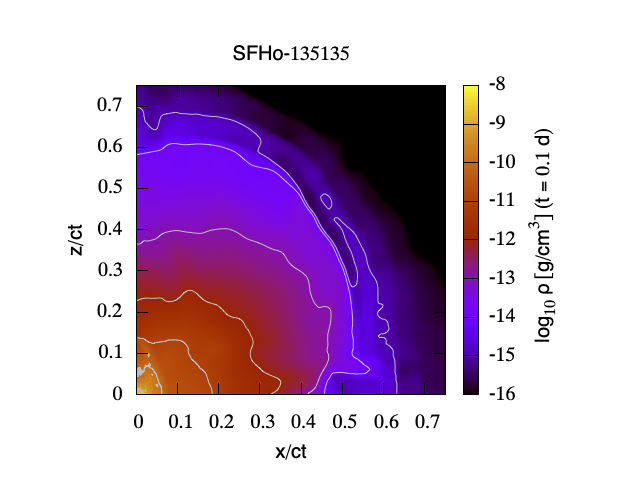
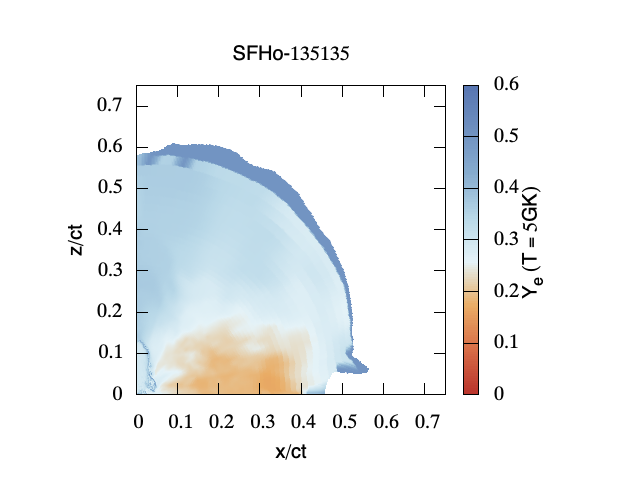
- 短寿命MNSモデルのSr質量密度プロファイルは、合体後1日におけるほぼ球形の形状を示すが、これは最近のAT2017gfoのスペクトル解析が示唆する非球形の噴出物形状と整合しない。
- 本研究は、短寿命MNS合体からのカイロノーバを検出するには、早期で深い光学および近赤外観測が不可欠であることを強調しており、後続段階では観測が困難である可能性がある。
より良い研究を、今すぐ始めましょう
論文の読解から最終レビューまで、研究時間を劇的に削減しましょう。
クレジットカード登録不要
このレビューはAIが作成し、人間の編集者が確認しました。