
[論文レビュー] Krylov complexity and Trotter transitions in unitary circuit dynamics
この論文は、量子カオスおよび演算子複雑度を測る指標であるKrylov複雑度を、静的ハミルトニアンを持たないユニタリ回路ダイナミクスに拡張する。特に、ハミルトニアン系から得られるトロッターズ化回路を対象とする。2つの異なる定常状態が特定される:小さなトロッターステップでは、ダイナミクスはハミルトニアンの挙動を回復し、Krylov複雑度の成長が最大値を示す。大きなステップでは、自己相関関数が消える最大エルゴード的演算子が出現し、記憶のないバスターやる性質を示す。カオス的系では遷移が連続的(クロスオーバー)であり、可積分系では非解析的転移を示す。
We investigate many-body dynamics where the evolution is governed by unitary circuits through the lens of `Krylov complexity', a recently proposed measure of complexity and quantum chaos. We extend the formalism of Krylov complexity to unitary circuit dynamics and focus on Floquet circuits arising as the Trotter decomposition of Hamiltonian dynamics. For short Trotter steps the results from Hamiltonian dynamics are recovered, whereas a large Trotter step results in different universal behavior characterized by the existence of local maximally ergodic operators: operators with vanishing autocorrelation functions, as exemplified in dual-unitary circuits. These operators exhibit maximal complexity growth, act as a memoryless bath for the dynamics, and can be directly probed in current quantum computing setups. These two regimes are separated by a crossover in chaotic systems. Conversely, we find that free integrable systems exhibit a nonanalytic transition between these different regimes, where maximally ergodic operators appear at a critical Trotter step.
研究の動機と目的
- 従来ハミルトニアン系のダイナミクスに適用されてきたKrylov複雑度の枠組みを、静的ハミルトニアンを持たないユニタリ回路ダイナミクスへ一般化すること。
- ハミルトニアン系のトロッターズ化がユニタリ回路における演算子複雑度およびエルゴード性に与える影響を調査すること。
- 異なるトロッターステップサイズにおけるKrylov複雑度成長の普遍的挙動を特定し、カオス的系と可積分系の違いを明らかにすること。
- 自己相関関数が消える(最大エルゴード的)演算子が大規模なトロッターステップで出現するメカニズムを同定し、それらが記憶のないバスターやる性質を示す役割を同定すること。
- カオス的および可積分的系における状態遷移の違いを調査し、カオス的系ではクロスオーバー、可積分系では非解析的転移が観測されることを明らかにすること。
提案手法
- 反復的に進化させた演算子のグラム・シュミット正規直交化を用いて、ユニタリ回路ダイナミクスにおけるKrylov部分空間を定義する。
- ハミルトニアン系のダイナミクスをトロッターズ分解により得たFloquet回路にKrylov複雑度形式を適用する。
- 時間発展演算子を対角化し、自己相関関数を計算するために運動量空間におけるフェルミオン表現を用いる。
- ユニタリ回路下での初期局所的演算子の時間発展演算を解析し、Krylov基底演算子およびその複雑度成長を計算する。
- 行列の時間発展と固有値分解を用いて、運動量空間における初期演算子の自己相関関数の正確な式を導出する。
- 大規模なトロッターステップにおいて自己相関関数が消える演算子の出現を特定し、ランダム行列理論の予測と関連付ける。
実験結果
リサーチクエスチョン
- RQ1ハミルトニアン系のトロッターズ化により得られるユニタリ回路において、Krylov複雑度はどのように振る舞うか?
- RQ2大規模なトロッターステップにおいて、Krylov複雑度にどのような普遍的挙動が現れ、小ステップのハミルトニアン極限とはどのように異なるか?
- RQ3どのような条件下で、自己相関関数が消える(最大エルゴード的)演算子がユニタリ回路に出現するか?
- RQ4異なるトロッターステップにおける状態遷移は、カオス的系と可積分系でどのように異なるか?
- RQ5Krylov複雑度の枠組みは、ハミルトニアン系のダイナミクスを超えて、一般のユニタリ回路モデルへ拡張可能か?
主な発見
- 小さなトロッターステップでは、Krylov複雑度の成長は、ハミルトニアン系のダイナミクスで観測された普遍的挙動(最大成長およびKrylov部分空間内での拡散)を回復する。
- 大規模なトロッターステップでは、自己相関関数が即座に消える最大エルゴード的演算子が出現し、ダイナミクスに対して記憶のないバスターやる性質を示す。
- これらの最大エルゴード的演算子は、Krylov複雑度成長がランダム行列理論の予測と整合する普遍的形に飽和することによって特徴づけられる。
- カオス的系では、小ステップと大ステップの間の遷移はクロスオーバーであり、複雑度成長の挙動に顕著な変化が観測される。
- 可積分系では、遷移は非解析的であり、最大エルゴード的演算子が出現する臨界トロッターステップで発生する。これはダイナミクスの性質が本質的に変化することを示唆する。
- 局所的スピン演算子の自己相関関数の正確な解が、運動量空間におけるフェルミオン化と行列発展演算を用いて導出され、大規模なステップで最大エルゴード性の出現が確認された。
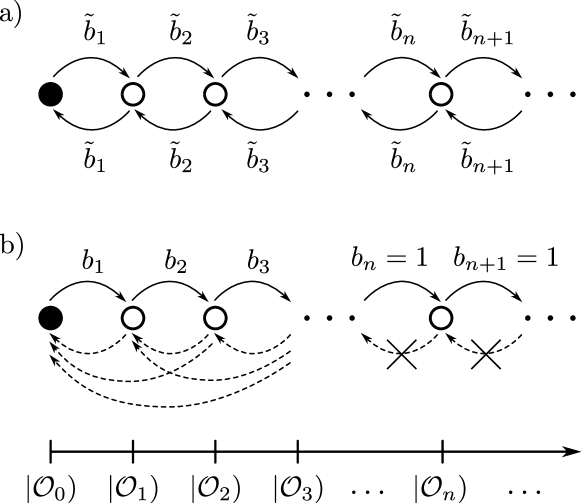
![Figure 2: The unitary superoperator $\mathcal{U}$ [Eq. ( 14 )] describing the evolution of the initial operator $|O_{0})\propto\sum_{j\in\mathbb{Z}}\sigma^{z}_{2j}$ under dual-unitary two-site gates. Here $\mathcal{U}$ is given in the Krylov basis, which is generated by orthonormalisation of $\{\mat](https://ar5iv.labs.arxiv.org/html/2308.03851/assets/x4.png)
より良い研究を、今すぐ始めましょう
論文の読解から最終レビューまで、研究時間を劇的に削減しましょう。
クレジットカード登録不要
このレビューはAIが作成し、人間の編集者が確認しました。