
[論文レビュー] Latency and Privacy-Aware Resource Allocation in Vehicular Edge Computing
この論文は、プライバシーと遅延を考慮したリソース割り当て手法を Vehicular Edge Computing (VEC) に提案し、エッジ処理をユーザー層と RSU/クラウド層に分割し、プライバシー、リアルタイム性、および処理資源に基づいてタスクを割り当てるヒューリスティックを用いる。
The rapid increase in the number of connected vehicles has led to the generation of vast amounts of data. As a significant portion of this data pertains to vehicle-to-vehicle and vehicle-to-infrastructure communications, it is predominantly generated at the edge. Considering the enormous volume of data, real-time applications, and privacy concerns, it is crucial to process the data at the edge. Neglecting the management of processing resources in vehicular edge computing (VEC) could lead to numerous challenges as a substantial number of vehicles with diverse safety, economic, and entertainment applications, along with their data processing, emerge in the near future [1]. Previous research in VEC resource allocation has primarily focused on issues such as response time and privacy preservation techniques. However, an approach that takes into account privacy-aware resource allocation based on vehicular network architecture and application requirements has not yet been proposed. In this paper, we present a privacy and latency-aware approach for allocating processing resources at the edge of the vehicular network, considering the specific requirements of different applications. Our approach involves categorizing vehicular network applications based on their processing accuracy, real-time processing needs, and privacy preservation requirements. We further divide the vehicular network edge into two parts: the user layer (OBUs) is considered for processing applications with privacy requirements, while the allocation of resources in the RSUs and cloud layer is based on the specific needs of different applications. In this study, we evaluate the quality of service based on parameters such as privacy preservation, processing cost, meeting deadlines, and result quality. Comparative analyses demonstrate that our approach enhances service quality by 55% compared to existing state-of-the-art methods.
研究の動機と目的
- V2V/V2I データの増大に伴い、VEC におけるプライバシー対応かつ低遅延のリソース管理の必要性を動機づける。
- 異種混在の VEC アーキテクチャを定義し、アプリケーションをプライバシー、遅延性、精度要件で分類する。
- アプリケーションタイプに基づき、処理タスクを edge、RSU、または cloud に割り当てるリソース割り当てフレームワークを開発する。
- プライバシー保護の分割を組み込み、 private data をユーザーデバイス(OBU)で処理し、非プライベートデータをクラウド/RSU で処理する。
- 提案システムを QoS、QoR、処理コストの観点で最先端手法と比較評価する。
提案手法
- Edge (OBUs)、RSU、クラウド層を用いて VEC アーキテクチャをモデル化する。
- プライバシー、リアルタイム性、および精度要件でアプリケーションを分類して処理場所を決定する。
- Private and Real-Time タスクをユーザーエッジに割り当て、非プライベートタスクを RSU またはクラウドへルーティングし、許容される範囲で近似処理を適用するヒューリスティック PVEC アルゴリズムを提案する。
- QoS を処理コスト、期限の逸失、そしてプライバシーの関数として定義する。
- 処理コストをクラウド処理のみについて PT * SRP として定義する。
- 正確な結果を必要としないアプリケーションには近似処理を用いてエッジ資源を節約する。
![Figure 1 : Vehicular Edge Architecture [ 15 ]](https://ar5iv.labs.arxiv.org/html/2501.02804/assets/x1.jpg)
実験結果
リサーチクエスチョン
- RQ1多様な VEC アプリケーションのプライバシーと遅延要件を満たすよう、edge、RSU、cloud 全体で処理をどのように割り当てるべきか。
- RQ2VEC におけるプライバシーと遅延を意識したリソース割り当てを適用した場合の QoS、QoR、コストへの影響は何か。
- RQ3リソース制約のあるエッジデバイスで近似処理を行い、コストを削減しつつ許容される QoR を維持できるか。
- RQ4private アプリケーションをユーザー層に分離することが、全体のシステム性能とプライバシー保証にどのように影響するか。
主な発見
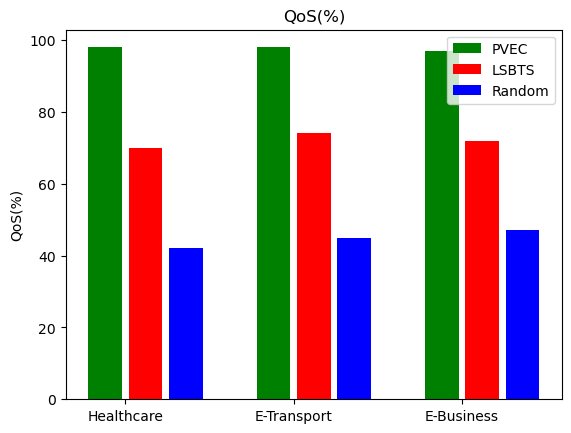
- PVEC アプローチは、Healthcare、E-Transport、E-Business ワークロードにおいて、ベースライン手法(LSBTS および Random)と比較して QoS を 30-55% 向上させる。
- エッジでの近似処理は、5% バンド誤差と95% 信頼区間で QoR の損失がほとんどない。
- 本手法はベースラインと比較してクラウド処理コストを 49-63% 削減する。
- リアルタイム性・近似・プライベートデータタスクにはエッジ処理が望ましく、クラウド処理は正確性が要る、ソフトリアルタイム性、そしてプライベート性の低いデータを扱う。
- 提案されたフレームワークは、評価で最先端手法と比べ約 55% の QoS 改善を達成する。
より良い研究を、今すぐ始めましょう
論文設計から論文執筆まで、研究時間を劇的に削減しましょう。
クレジットカード登録不要
このレビューはAIが作成し、人間の編集者が確認しました。