
[論文レビュー] Latent Style-based Quantum GAN for high-quality Image Generation
tldr: LaSt-QGANは古典的オートエンコーダを用いて画像を潜在空間に写像し、量子ジェネレータが潜在特徴を生成することで、MNIST、FashionMNIST、および SAT4 に対する古典GANと競合する性能を持つ大規模画像生成を実現する。さらにショットノイズとボaran plateau(barren plateau)を分析。
Quantum generative modeling is among the promising candidates for achieving a practical advantage in data analysis. Nevertheless, one key challenge is to generate large-size images comparable to those generated by their classical counterparts. In this work, we take an initial step in this direction and introduce the Latent Style-based Quantum GAN (LaSt-QGAN), which employs a hybrid classical-quantum approach in training Generative Adversarial Networks (GANs) for arbitrary complex data generation. This novel approach relies on powerful classical auto-encoders to map a high-dimensional original image dataset into a latent representation. The hybrid classical-quantum GAN operates in this latent space to generate an arbitrary number of fake features, which are then passed back to the auto-encoder to reconstruct the original data. Our LaSt-QGAN can be successfully trained on realistic computer vision datasets beyond the standard MNIST, namely Fashion MNIST (fashion products) and SAT4 (Earth Observation images) with 10 qubits, resulting in a comparable performance (and even better in some metrics) with the classical GANs. Moreover, we analyze the barren plateau phenomena within this context of the continuous quantum generative model using a polynomial depth circuit and propose a method to mitigate the detrimental effect during the training of deep-depth networks. Through empirical experiments and theoretical analysis, we demonstrate the potential of LaSt-QGAN for the practical usage in the context of image generation and open the possibility of applying it to a larger dataset in the future.
研究の動機と目的
- Motivate and develop a hybrid classical-quantum GAN (LaSt-QGAN) capable of generating large-size images.
- Leverage a pre-trained convolutional autoencoder to map high-dimensional images into a latent space for efficient quantum generation.
- Train a quantum generator with a classical discriminator to reproduce latent features and reconstruct images via the autoencoder.
- Evaluate LaSt-QGAN on MNIST, FashionMNIST, and SAT4 and compare with a matched classical GAN.
- Investigate robustness to shot noise and analyze barren plateau phenomena to inform trainability of continuous quantum generative models.
提案手法
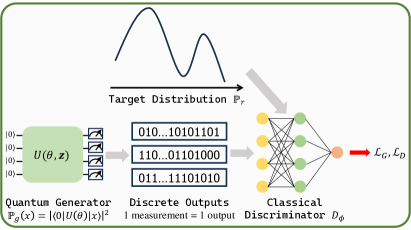
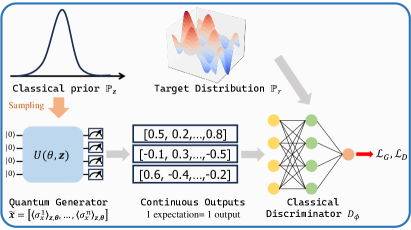
- Use a pre-trained convolutional autoencoder to encode images into a latent space of dimension Dℓ; train a quantum generator Gθ in this latent space and a classical discriminator Dφ with Wasserstein loss and gradient penalty.
- Employ a parameterized quantum circuit (style-based generator) where latent noise z is embedded into rotation angles; use L layers with θℓ = Wℓ z + bℓ (data reuploading concept).
- Measure expectation values ⟨σx⟩ and ⟨σz⟩ on n qubits as latent features and concatenate to form a 2n-dimensional feature vector for the discriminator.
- Reconstruct images by passing generated latent features through the (pre-trained) autoencoder’s decoder; train with a Wasserstein distance objective to match real latent features to fake ones.
- Compare multiple quantum circuit architectures (Circuits 1–3) and quantify performance with FID, IS, and JSD on both features and reconstructed images.
- Assess training dynamics and robustness to shot noise, and analyze barren plateau behavior to propose initialization strategies for polynomial-depth circuits.
実験結果
リサーチクエスチョン
- RQ1Can LaSt-QGAN generate large-size images by operating in a latent space mapped from high-dimensional data?
- RQ2How does LaSt-QGAN performance compare to a classical GAN with a similar parameter count across MNIST, FashionMNIST, and SAT4 datasets?
- RQ3What is the impact of quantum circuit depth and architecture on generation quality and training stability?
- RQ4How robust is LaSt-QGAN to shot-noise (finite sampling) and what training strategies mitigate potential barren plateau effects?
主な発見
| G_theta config | N_Θ | FID ↓ | IS ↑ | JSD (features/ 10^-2) ↓ | JSD (images/ 10^-2) ↓ |
|---|---|---|---|---|---|
| Circ. 1 ( d=2 ) | 1360 | 17.2±0.35 | 8.29±0.02 | 0.79±0.05 | 1.63±0.09 |
| Circ. 1 ( d=4 ) | 2280 | 14.85±0.34 | 8.49±0.04 | 0.75±0.07 | 1.49±0.18 |
| Circ. 1 ( d=6 ) | 3200 | 14.13±0.73 | 8.53±0.05 | 0.71±0.07 | 1.29±0.10 |
| Circ. 2 ( d=2 ) | 1010 | 19.13±0.54 | 8.10±0.06 | 1.22±0.19 | 2.08±0.17 |
| Circ. 2 ( d=4 ) | 1690 | 16.2±0.32 | 8.34±0.03 | 0.94±0.09 | 1.66±0.17 |
| Circ. 2 ( d=6 ) | 2370 | 14.85±0.61 | 8.47±0.06 | 0.85±0.05 | 1.39±0.11 |
| Circ. 3 ( d=2 ) | 3300 | 14.29±0.38 | 8.50±0.04 | 0.76±0.06 | 1.50±0.12 |
| Circ. 3 ( d=4 ) | 6600 | 12.72±0.40 | 8.65±0.05 | 0.71±0.07 | 1.14±0.12 |
| Circ. 3 ( d=6 ) | 9900 | 11.99±0.56 | 8.71±0.04 | 0.72±0.09 | 1.13±0.12 |
| Classical [50,30] | 2960 | 18.24±3.6 | 8.24±0.28 | 3.74±1.64 | 4.51±2.0 |
| Classical [100,50] | 7660 | 12.56±0.91 | 8.80±0.06 | 1.18±0.17 | 1.56±0.13 |
- LaSt-QGAN can generate large-size images and achieves competitive or superior metrics (FID, IS, JSD) compared with a classical GAN of similar size across MNIST, FashionMNIST, and SAT4.
- Faster convergence and higher stability are observed for LaSt-QGAN than the classical GAN on MNIST and FashionMNIST across several circuit depths.
- For MNIST and FashionMNIST, LaSt-QGAN attains lower JSD values and favorable FID/IS trends compared to the classical counterpart, indicating better learning of data distribution and diversity.
- On SAT4, LaSt-QGAN outperforms the classical GAN on all evaluated metrics while using roughly half the number of parameters.
- t-SNE visualization shows generated features form class-separated clusters, suggesting preserved latent structure in generation.
- The study provides a method to mitigate barren plateau effects at initialization with small-angle starts for polynomial-depth circuits, enhancing trainability for continuous quantum generative models.
より良い研究を、今すぐ始めましょう
論文設計から論文執筆まで、研究時間を劇的に削減しましょう。
クレジットカード登録不要
このレビューはAIが作成し、人間の編集者が確認しました。