
[論文レビュー] Learning CO$_2$ plume migration in faulted reservoirs with Graph Neural Networks
本論文は、故障を含む非構造メッシュ上でCO2羽の移動と孔隙圧を予測するグラフニューラルネットワーク近似モデル(MGN-LSTM)を提案し、時間誤差を低減し、見たことのない構成へ一般化する。
Deep-learning-based surrogate models provide an efficient complement to numerical simulations for subsurface flow problems such as CO$_2$ geological storage. Accurately capturing the impact of faults on CO$_2$ plume migration remains a challenge for many existing deep learning surrogate models based on Convolutional Neural Networks (CNNs) or Neural Operators. We address this challenge with a graph-based neural model leveraging recent developments in the field of Graph Neural Networks (GNNs). Our model combines graph-based convolution Long-Short-Term-Memory (GConvLSTM) with a one-step GNN model, MeshGraphNet (MGN), to operate on complex unstructured meshes and limit temporal error accumulation. We demonstrate that our approach can accurately predict the temporal evolution of gas saturation and pore pressure in a synthetic reservoir with impermeable faults. Our results exhibit a better accuracy and a reduced temporal error accumulation compared to the standard MGN model. We also show the excellent generalizability of our algorithm to mesh configurations, boundary conditions, and heterogeneous permeability fields not included in the training set. This work highlights the potential of GNN-based methods to accurately and rapidly model subsurface flow with complex faults and fractures.
研究の動機と目的
- 高忠実度シミュレーションへの依存を減らすため、故障を有する貯留層におけるCO2羽の移動のための効率的で正確な代替モデルの動機づけ。
- 故障や裂け目に適合する非構造メッシュを扱えるグラフベースの代替モデルの開発。
- グラフベースの再帰アーキテクチャを通じて自己回帰代替モデルにおける時間的誤差の蓄積を緩和。
- 未見のメッシュ、境界条件、および不均質透過性場への一般化可能性を示す。
提案手法
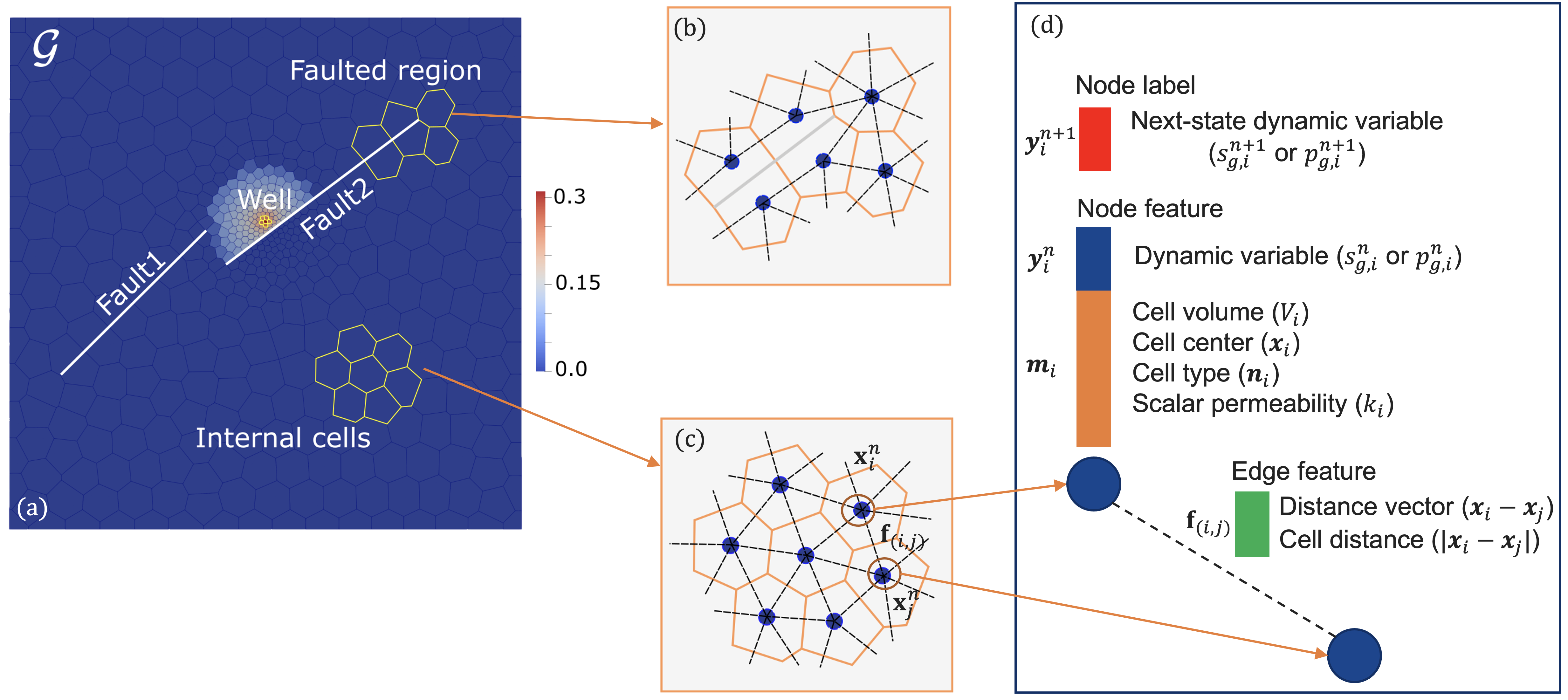
- 未構造メッシュデータをグラフとして、ノード特徴量(動的変数+静的特性)とエッジ特徴量(接続性と距離)を用いて表現する。
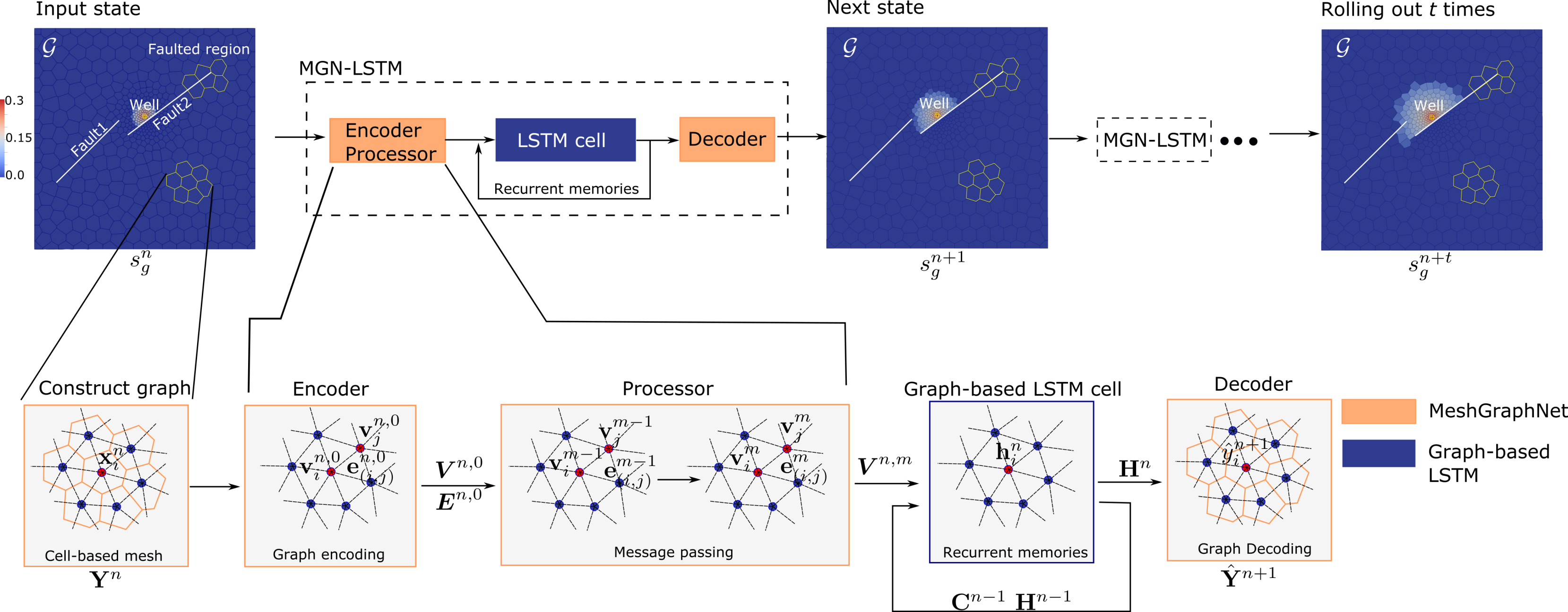
- MeshGraphNet (MGN) をエンコーダ/プロセッサとして活用し、グラフ入力から潜在表現を構築する。
- Graph ConvLSTM (GConvLSTM) を統合して時空間ダイナミクスを捉え、時間を追う誤差蓄積を低減する。
- 自己回帰ローアウトを用いて連続した時間ステップを予測し、安定性のために勾配を系列全体に伝播させる。
- ガス飽和と孔隙圧のそれぞれについてHFシミュレーションデータを真値として用い、個別にMGN-LSTMモデルを訓練する。
実験結果
リサーチクエスチョン
- RQ1不透水性の断層を含む非構造メッシュ上で、グラフベースの代替モデルは二相CO2–塩水流を正確に予測できるか?
- RQ2MGN-LSTMは標準の次状態MGNおよび他のベースラインと比較して時間的誤差蓄積を低減するか?
- RQ3見たことのないメッシュ、境界条件、および不均質透過性場への一般化性能はどの程度か?
- RQ4グラフ入力に追加の物理特徴(相対浸透率など)を含めることが予測精度に与える影響は何か?
主な発見
- MGN-LSTMは故障を含む貯留層におけるCO2飽和プルームと孔隙圧の進展を正確に予測する。
- モデルは標準のMeshGraphNetと比較して時間的誤差蓄積を低減する。
- MGN-LSTMは訓練時に見られなかったメッシュ構成、境界条件、および透過性場に一般化する。
- ノード/エッジ入力により多くの物理特徴を取り入れると飽和予測精度がさらに向上する可能性がある。
より良い研究を、今すぐ始めましょう
論文設計から論文執筆まで、研究時間を劇的に削減しましょう。
クレジットカード登録不要
このレビューはAIが作成し、人間の編集者が確認しました。