
[論文レビュー] Les Houches Lectures on Community Ecology: From Niche Theory to Statistical Mechanics
ニッチ理論と統計物理学をコミュニティ生態学に結びつける調査。Consumer Resource ModelsとGeneralized Lotka-Volterra modelsを詳述し、高次元解析をキャビティ法とランダムマトリクス理論で探る。
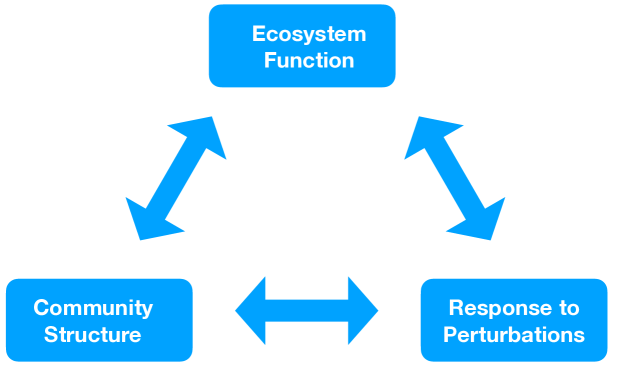
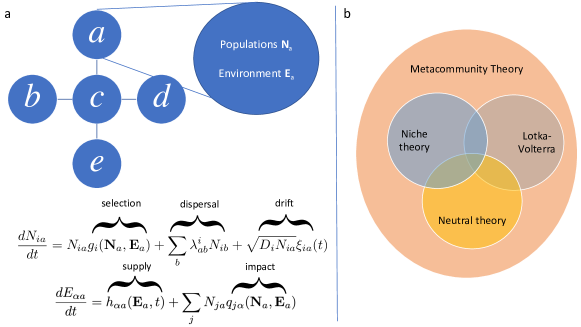
Ecosystems are among the most interesting and well-studied examples of self-organized complex systems. Community ecology, the study of how species interact with each other and the environment, has a rich tradition. Over the last few years, there has been a growing theoretical and experimental interest in these problems from the physics and quantitative biology communities. Here, we give an overview of community ecology, highlighting the deep connections between ecology and statistical physics. We start by introducing the two classes of mathematical models that have served as the workhorses of community ecology: Consumer Resource Models (CRM) and the generalized Lotka-Volterra models (GLV). We place a special emphasis on graphical methods and general principles. We then review recent works showing a deep and surprising connection between ecological dynamics and constrained optimization. We then shift our focus by analyzing these same models in "high-dimensions" (i.e. in the limit where the number of species and resources in the ecosystem becomes large) and discuss how such complex ecosystems can be analyzed using methods from the statistical physics of disordered systems such as the cavity method and Random Matrix Theory.
研究の動機と目的
- コミュニティ生態学の基本原理と、ニッチ理論が群集の形成に果たす役割を紹介する。
- 2つの主要なモデリング枠組みを提示・対比する:Consumer Resource Models (CRMs) および Generalized Lotka-Volterra (GLV) models。
- 生態ダイナミクスが制約付き最適化および高次元統計物理学的手法とどのように結びつくかを説明する。
- 共存・安定性と資源-消費者相互作用の幾何学を扱うグラフィカル手法について議論する。
- 高次元解析と無秩序系手法が生態系の挙動をどのように明らかにするかを強調する。
提案手法
- CRMsとGLVsをコミュニティ生態学の基礎モデルとして記述・分析する。
- ゼロ成長等高線(ZNGIs)や共存コーンなどのグラフィカル表現を用いて共存と安定性の基準を導出する。
- 弾性率の類推を用いた固定点周りの線形応答展開からGLV方程式を導出する。
- 一般化マッカ―アー資源モデルと本質資源/置換可能資源を対応する供給ベクトルと影響ベクトルとともに議論する。
- ランダムマトリクス理論とキャビティ法の概念による高次元解析を導入する。
実験結果
リサーチクエスチョン
- RQ1CRMsとGLVsはコミュニティ組成における生態的相互作用と環境の媒介をどのように符号化するか。
- RQ2CRMsとGLVフレームワークにおいて、複数種が安定に共存するのはどのような幾何学的・ダイナミクス条件下か。
- RQ3高次元の極限(種と資源の数が多い場合)はニッチ理論の下で安定性と多様性をどのように変えるか。
- RQ4生態ダイナミクスにおけるニッチ理論と最適化原理の関係は何か。
- RQ5統計物理学の手法(例:キャビティ法、ランダムマトリクス理論)を大規模な生態ネットワークの解析にどう適用できるか。
主な発見
- CRMsとGLVsは補完的な視点を提供する。CRMsは環境を媒介する相互作用を強調し、GLVsは種間相互作用を捉える。
- CRMsにおける共存は、ZNGIs、供給点、および負の影響ベクトルによって形成されるコーンによって幾何学的に理解でき、競争排除原理は安定な共存を資源の数に限定する。
- 外部供給資源はコーンの幾何を修正し、固定点共存領域を縮小させ、高次元での競争排除境界の飽和に影響を与える。
- 本質的資源(置換不可)は超円形のZNGIsを生じさせ、バイオマスの化学当量に依存して不安定な固定点を生み得る。これにより単純な共存を超える複雑なダイナミクスが生じ得る。
- 生態ダイナミクスからのGLV推定は、実効種間相互作用が環境媒介に依存し、資源を明示的に扱うモデルから導くと高次効果を含み得ることを示す。
- 高次元設定では、ランダムマトリクス理論とキャビティ法の道具が、複雑な生態系の安定性と多様性を分析する枠組みを提供する。
より良い研究を、今すぐ始めましょう
論文設計から論文執筆まで、研究時間を劇的に削減しましょう。
クレジットカード登録不要
このレビューはAIが作成し、人間の編集者が確認しました。