
[論文レビュー] Live Graph Lab: Towards Open, Dynamic and Real Transaction Graphs with NFT
この論文では、イーサリアムブロックチェーン上のNFTを用いて、オープンで動的でリアルタイムの取引グラフを構築するためのフレームワーク、Live Graph Labを紹介する。フルイーサリアムノードを同期させることで、450万以上のノードと1億2400万以上のエッジを持つライブな時系列グラフを構築し、急速に成長する高活動性のダイナミクスを明らかにした。これにより、グラフ機械学習および時系列ネットワーク解析のための新たなベンチマークが提供される。
Numerous studies have been conducted to investigate the properties of large-scale temporal graphs. Despite the ubiquity of these graphs in real-world scenarios, it's usually impractical for us to obtain the whole real-time graphs due to privacy concerns and technical limitations. In this paper, we introduce the concept of {\it Live Graph Lab} for temporal graphs, which enables open, dynamic and real transaction graphs from blockchains. Among them, Non-fungible tokens (NFTs) have become one of the most prominent parts of blockchain over the past several years. With more than \$40 billion market capitalization, this decentralized ecosystem produces massive, anonymous and real transaction activities, which naturally forms a complicated transaction network. However, there is limited understanding about the characteristics of this emerging NFT ecosystem from a temporal graph analysis perspective. To mitigate this gap, we instantiate a live graph with NFT transaction network and investigate its dynamics to provide new observations and insights. Specifically, through downloading and parsing the NFT transaction activities, we obtain a temporal graph with more than 4.5 million nodes and 124 million edges. Then, a series of measurements are presented to understand the properties of the NFT ecosystem. Through comparisons with social, citation, and web networks, our analyses give intriguing findings and point out potential directions for future exploration. Finally, we also study machine learning models in this live graph to enrich the current datasets and provide new opportunities for the graph community. The source codes and dataset are available at https://livegraphlab.github.io.
研究の動機と目的
- グラフ研究分野における、オープンで動的でリアルタイムの時系列グラフデータセットの不足に対処すること。
- 過去のデータや不完全なデータ、あるいはリアルタイムで公開されない既存のデータセットの限界を克服すること。
- ライブで大規模な取引グラフを通じて、出現しつつあるNFTエコシステムの構造的・ダイナミックな特性を調査すること。
- 時系列グラフマイニングおよび機械学習研究のための再利用可能なフレームワークとデータセットを提供すること。
- 継続的に進化する現実世界のグラフ上で、時系列グラフ学習モデルの性能を評価すること。
提案手法
- リアルタイムにすべてのNFT取引データをストリームおよびキャプチャするために、フルイーサリアムノードを同期すること。
- 生のブロックチェーンデータをパース・クリーニング・構造化し、アドレスをノード、NFTの移転をエッジとする時系列グラフに変換すること。
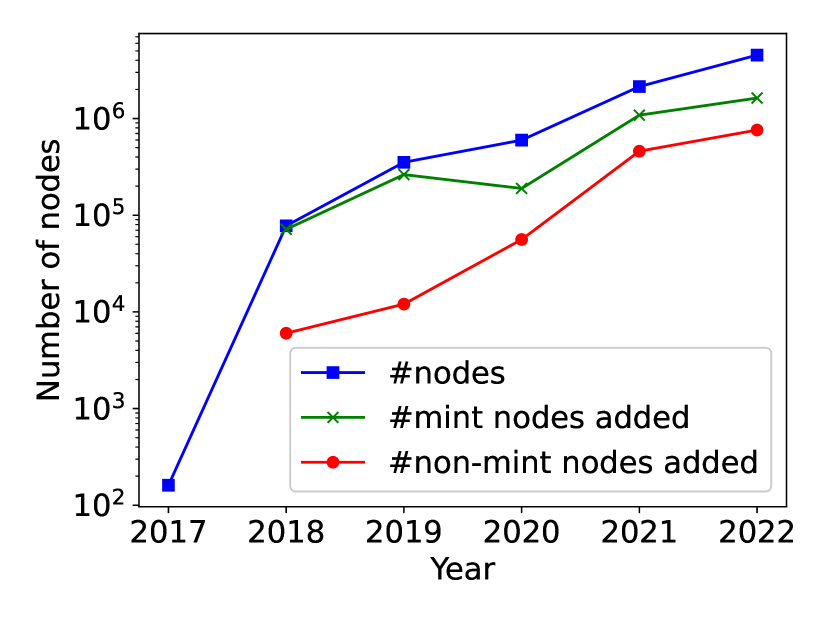
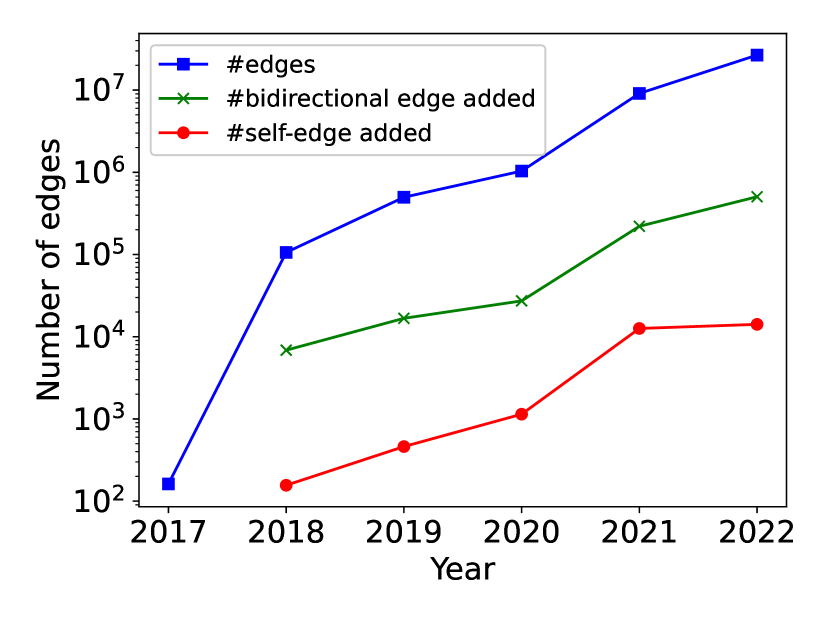
- 2017年から2022年までをカバーするライブグラフを構築し、450万ノードと1億2400万エッジを有すること。
- 次数分布、クラスタリング、時系列ダイナミクスを含む包括的な時系列グラフ分析を実施すること。
- 最先端の時系列グラフ学習モデル(例:TGCN、EvolveGCN、DynGEM)を適用し、ライブデータ上での性能を評価すること。
- エッジの再発生や時系列パターンを分析するため、TEA図およびTET図などの可視化を生成すること。
実験結果
リサーチクエスチョン
- RQ1リアルタイムNFT取引ネットワークの構造的・ダイナミック特性は、従来の時系列グラフとどのように異なるか?
- RQ2NFT取引グラフは、時間の経過とともにどれほど高い活動性と急速な成長を示すか?
- RQ3既存の時系列グラフ学習モデルは、静的または合成データセットと比較して、継続的に進化するライブグラフ上でどれほど性能を発揮するか?
- RQ4現実世界のNFT取引ネットワークにおけるエッジの再発生と時系列パターンにどのような意味があるか?
- RQ5ライブでオープンで動的であるグラフは、将来のグラフアルゴリズムおよびシステム開発のための実用的ベンチマークとして成立するか?
主な発見
- ライブNFT取引グラフには450万以上のノードと1億2400万以上のエッジが含まれており、非常にダイナミックで活発なネットワークを形成している。
- TEA図により示されるように、グラフは急速に成長し、各時刻ステップで新規に形成されたエッジの割合が顕著に高い。
- 時系列エッジトラフィック(TET)分析により、取引に新規性と再発生の両方が見られる、繊細な再発生パターンが明らかになった。
- 時系列リンク予測モデルでは、時間分解能が粗くなるほど性能が低下し、Roland-MAのAUCは1日単位で97.55±0.59から1か月単位で87.69±2.17に低下した。
- DynGEM や Roland-GRU などのモデルがリアルタイムデータ上で示した性能から、グラフ機械学習における新たな課題と機会が明らかになった。
- フレームワークは、上位50のハブノードを削除してもクエリ時間に安定性を保ち、密なグラフ上でも堅牢であることが示された。
より良い研究を、今すぐ始めましょう
論文の読解から最終レビューまで、研究時間を劇的に削減しましょう。
クレジットカード登録不要
このレビューはAIが作成し、人間の編集者が確認しました。