
[論文レビュー] Long-term predictions of turbulence by implicit U-Net enhanced Fourier neural operator
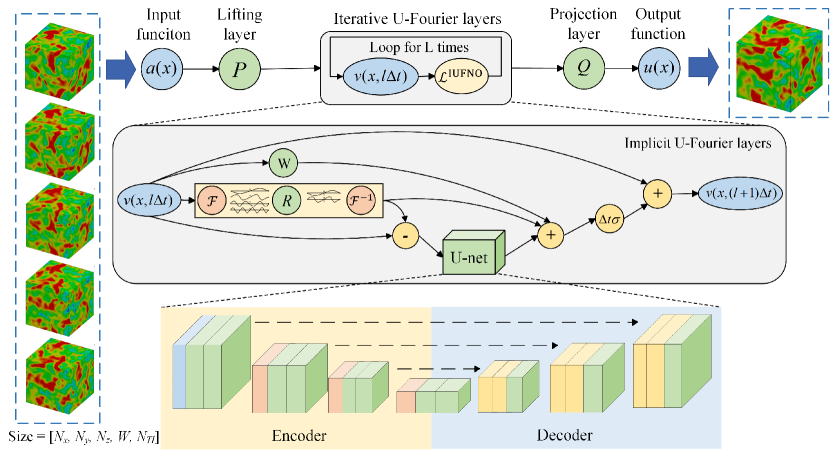
本研究はIU-FNO(Implicit U-Net enhanced Fourier Neural Operator)を提案する。これは陰的U-Netを組み込んだフーリエニューラルオペレーターであり、LESにおける3D乱流の長期予測を安定かつ正確に高速に実現し、素のFNO、IFNO、U-FNOおよびDSMを様々な統計量で上回る。
Long-term predictions of nonlinear dynamics of three-dimensional (3D) turbulence are very challenging for machine learning approaches. In this paper, we propose an implicit U-Net enhanced Fourier neural operator (IU-FNO) for stable and efficient predictions on the long-term large-scale dynamics of turbulence. The IU-FNO model employs implicit recurrent Fourier layers for deeper network extension and incorporates the U-net network for the accurate prediction on small-scale flow structures. The model is systematically tested in large-eddy simulations of three types of 3D turbulence, including forced homogeneous isotropic turbulence (HIT), temporally evolving turbulent mixing layer, and decaying homogeneous isotropic turbulence. The numerical simulations demonstrate that the IU-FNO model is more accurate than other FNO-based models including vanilla FNO, implicit FNO (IFNO) and U-Net enhanced FNO (U-FNO), and dynamic Smagorinsky model (DSM) in predicting a variety of statistics including the velocity spectrum, probability density functions (PDFs) of vorticity and velocity increments, and instantaneous spatial structures of flow field. Moreover, IU-FNO improves long-term stable predictions, which has not been achieved by the previous versions of FNO. Besides, the proposed model is much faster than traditional LES with DSM model, and can be well generalized to the situations of higher Taylor-Reynolds numbers and unseen flow regime of decaying turbulence.
研究の動機と目的
- 3D流れにおける長期非線形乱流予測の課題と既存MLアプローチの限界を動機づける。
- 陰的フーリエ層とU-Netを組み合わせ、大規模・小規模構造を捉える surrogateモデル(IU-FNO)を開発する。
- 長期予測の複数の乱流レジームで、より高い精度と安定性を示す。
- IU-FNOはDSMベースのLESより高速で、再現性のある高Reλ領域や未知の流れ regime へ一般化可能であることを示す。
提案手法
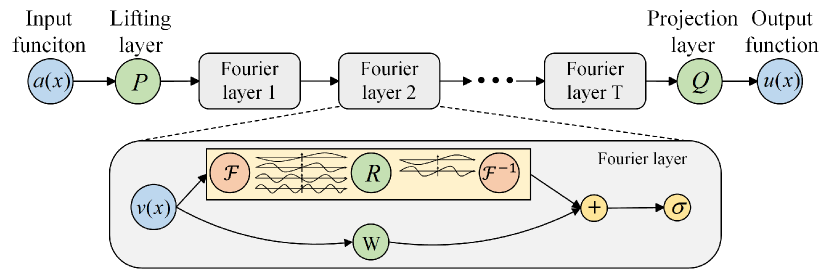
- 陰的フーリエ層をU-Netと統合して、時間ステップ間の速度変動量を予測するIU-FNOを導入する。
- 共有隠れ層を用いて、固定パラメータ数で深層ネットワークを実現し、長時間積分を可能にする。
- 全場と大規模FFT再構成との差分にU-Netを適用して小規模構造の補正を計算する。
- forced HITからのfDNS由来データで訓練し、DSMや他のFNO派生と比較し、複数の乱流流れに対して後解析を評価する。
- 速度スペクトル、渦度と速度変動量のPDF、構造関数、瞬時流れ構造などを用いて性能を比較する。
実験結果
リサーチクエスチョン
- RQ1IU-FNOは vanilla FNO、IFNO、U-FNOを超える安定な長期予測を3D乱流のLESで実現できるか。
- RQ2共有レイヤーを持つ陰的アーキテクチャは、パラメータ数を抑えつつ深いFNOモデルの精度を維持または向上させるか。
- RQ3異なる乱流レジーム(強制HIT、混合層、減衰HIT)に対して、スペクトル・統計・構造指標の観点でIU-FNOはどう性能を示すか。
- RQ4高Reλまたは未知の regime で、従来のDSMベースLESや他のML代替より高速で一般化能力が高いか。
主な発見
- IU-FNOは forced HIT において t/τ ≤ 50 までの短期・長期予測の速度スペクトルを正確に再現し、t/τ ≥ 100 でも安定している。
- U-Netを組み込み、小規模構造を学習させることで、基準のFNOおよびU-FNOより訓練・評価損失が改善され、L=40での評価損失は0.155と最小を記録した。
- 陰的共有層モデル(IFNOおよびIU-FNO)は深さが増してもパラメータ数を抑えつつ性能を維持し、標準のFNO/U-FNOとは異なる。
- IU-FNOは時間を通じて正確な二次・四次構造関数を維持する一方、DSMはいくつかのレジームで発散する。
- IU-FNOの速度変動量のPDFは時間とともにfDNSに近く、後半ではIFNOおよびU-FNOを上回る。
- 総じてIU-FNOは圧力なし乱流統計と瞬時流れ構造においてDSM、DMM、VGM、以前のFNO派生を上回り、従来のLESに比べて計算速度の大幅な向上を提供する。
より良い研究を、今すぐ始めましょう
論文設計から論文執筆まで、研究時間を劇的に削減しましょう。
クレジットカード登録不要
このレビューはAIが作成し、人間の編集者が確認しました。